This is rigging!

Tom Dunlap

Here from the beginning
Administrator
There’s a good reason to have different colored ropes.

Moving loads up, down and laterallydoesnt happen often. Chris Gerard wrote a good article to get you going
 
interesting article. i build an english-reeve for fun and found my sirius rigging rope a little bit dynamic. since then i'm dreaming of something like 400' of dyneema rope. also all the jobs where a reeve would've made sense our usuall 240' ropes were much to short.

good to see that mister gerad is content with his 1/2 arborplex!
 
13mm Sterling htp is crazy static. The least stretch I've ever seen from an all poly rope. I think it would be great for this app but it does get heavy.
I read this article in the magazine and if I remember correctly, he used the arborplex for the highline? Very surprising it worked out well though I've never built any kind of reeve before so I guess I wouldn't know much about what is good to use though I think I remember he would have preferred a more static rope...
I guess it goes to show that a good arb with skills knows how to make the tools he has work, and that you don't have to buy the very best tools to get er done.
Another good article from Chris, thanks bud!
 
Gauging stretch can be a good ‘fuse’ in overloading a rigging system. The boing factor is very real in a intuitive read of forces. Think of negative rigging, and the load locking up, big boing! Same weight and let it run, little to none!

That and angle, say you have a line with 3% per 100’ at 600 lbs your flirting at any deflection greater than 125 degrees with every degree of increase.

Normally I love static ropes! But while it’s not super common I set up high lines to work off of for rappelling and working off bluffs and steep slopes. Having that extra stretch in the line is very comforting but I’m hardly ever actually rope climbing
 
Gauging stretch can be a good ‘fuse’ in overloading a rigging system. The boing factor is very real in a intuitive read of forces. Think of negative rigging, and the load locking up, big boing! Same weight and let it run, little to none!

That and angle, say you have a line with 3% per 100’ at 600 lbs your flirting at any deflection greater than 125 degrees with every degree of increase.

Normally I love static ropes! But while it’s not super common I set up high lines to work off of for rappelling and working off bluffs and steep slopes. Having that extra stretch in the line is very comforting but I’m hardly ever actually rope climbing
When u say over loading the system, do you mean the anchors the ropes attached to?

I understand the negative rigging point but I think of that as more of a shock load and in this application I don't really see the system being shocked. I do see what your mean about the angles as I think Chris touched on too.
 
When u say over loading the system, do you mean the anchors the ropes attached to?

I understand the negative rigging point but I think of that as more of a shock load and in this application I don't really see the system being shocked. I do see what your mean about the angles as I think Chris touched on too.
I'm speaking to both. Angle is a huge multiplier, but even for a static load there can be quite a bit of dynamic loading.. Stretch helps mitigate these peak forces on already high loading situation on the anchors.
 
i think in this situation a very static rope would not be a bad idea. in the end you need a certain amount of clearence in your system. with a dyneema rope it might only take a little bit of tension from your 5:1 to achieve that. with your arborplex you would need to crank with your grcs to archieve the same amount of lift/clearance. and would‘nt that strain your anchorpoints more?
 
Thinking through the physics here (which like my mind is not a fast moving dynamic system) I think we can agree that for a given payload-lift the total forces on the anchor points and lines will be the same regardless of how stretchy the ropes are. The more dynamic lines will just need more pre-tensioning.
 
i dont know for sure. removing the stretch will allready put force on your anchorpoint.
and will this force not add to your anchorpoints (after you have reached your desired lift)? i will set up an experiment with my loadcell. you‘re propably right, though :)
 
First, I just want to thank Tom D. again for posting another one of my articles, I really appreciate it!

In regard to using the ArborPlex, obviously this would not be my first "go to" line when setting up a highline, but it was what we had for the long span required. I would love to have a 300'+ dedicated dyneema line to use for such applications, but you're talking around a $1,000-$1,200 rope that would not be used every day.

Yup, you're right flushcut, that is your HOBBS mod on our well-worn H2 and it still works great. Awesome idea!

Friedrich, I like your idea of putting a load cell and testing. I actually plan on doing the same thing with some Arborplex...when I get a load cell someday!
 
Nice work, we'll check them out. Thanks.

Looks like you're floating wood in the pic with a tip and butt tie. We do this all the time with polyester double-braid lines as well without any issues. Much more favorable rope angles with this technique. As you probably know, floating wood with a highline is a whole different cat. You're talking about rope deflection angles and force multipliers that aren't as easy to control and really need to be thought out to avoid failure in the system.
 
@chris_girard
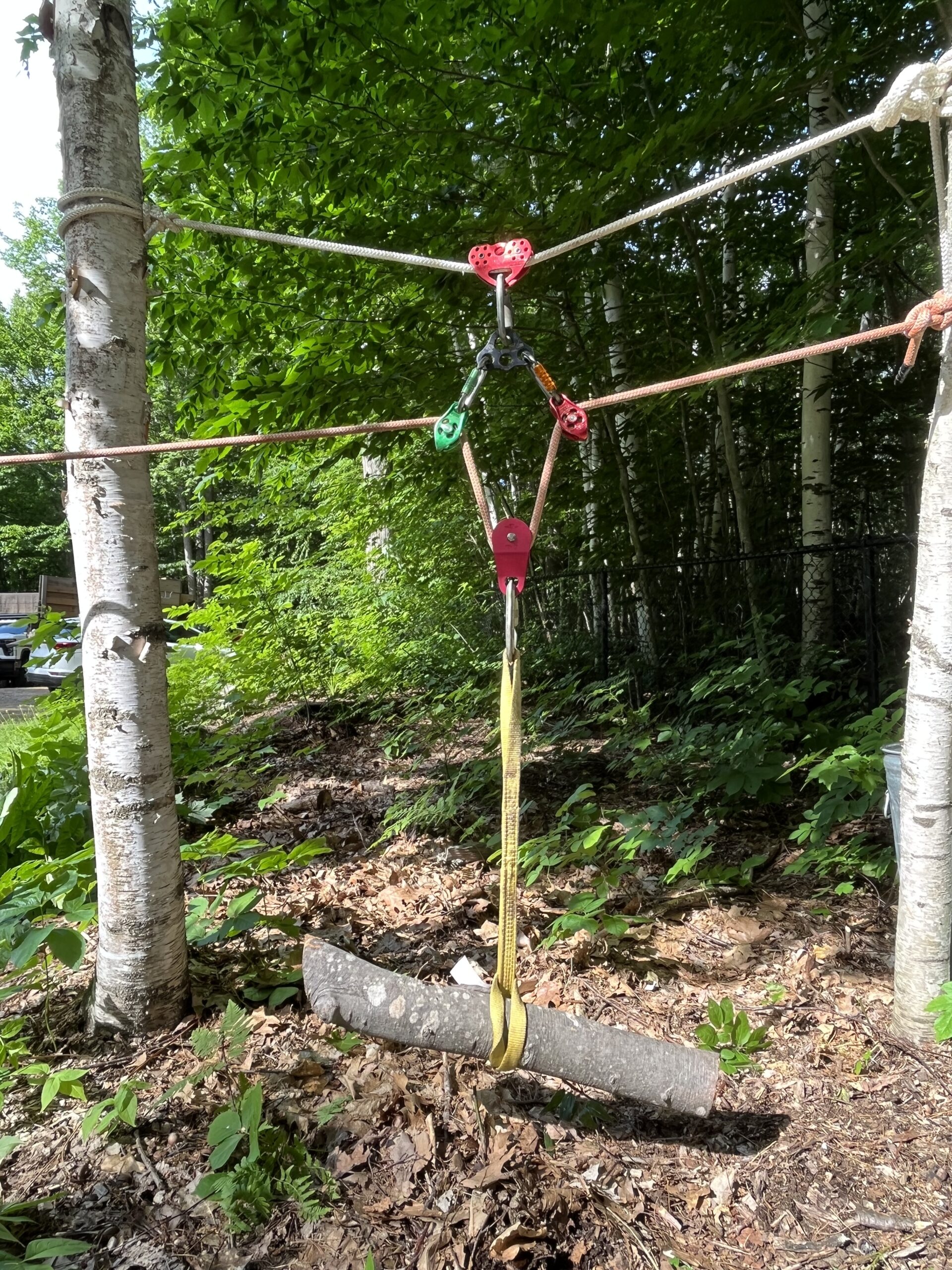
Great article. Definitely learned some new things. Maybe I'm missing it but how do you actually move/haul the load in the English reeve setup you have pictured? I get the highline and the MA of lifting the load, but I don't see how the trolley moves without having another line to pull it. Or haul it back to the cut site for that matter. Looks like at least two more ropes are needed.
english reeve.jpg

Also, would it make it a cleaner setup in the Norwegian reeve to terminate the hoisting control line to the becket on the green Pinto? Not sure if that might mitigate some of the twisting.

norwegian reeve 2.jpg
 
Good eye Phill. Yes, my control line should have been shown in that picture. I was under the gun to get photos in to TCIA and had to do a mock setup of an English Reeve system at my house. You would want to have a control line/s that would allow you move the carriage back and forth.

Will have to try using a termination on the Pinto Becket to see if that would stop some of the twisting. I still think a swivel type lower connection would work best.
 
Excellent article and beautiful plan and execution of the plan. I always enjoy your writing, Chris, and appreciate how you don’t bury the reader in too much technical jargon.


I’m not sure if any of y’all are needing a trolley or any of this stuff here, but there’s some ridiculous low prices on some excellent gear from CMI, if you’re not too opposed to a tiny cosmetic flaw. I picked up 2 of the double micro pulleys to put together a dedicated 5:1 system in a bag with 3/8” Stable Braid. I’m really thinking about that shear reduction device, and the California Swivel they got too.
 
Last edited:
Wow. I’m really glad you asked that question. I felt like such a ninny trying to make sense of that.
every once in a while my brain misfires and something simple slips past me. I almost felt like this was one of those times but I suspected it was a quick mock up since the high line was only like 5-10' long haha. When in doubt, I'll always ask for clarification though.
 

New threads New posts

Kask Stihl NORTHEASTERN Arborists Wesspur TreeStuff.com Teufelberger Westminster X-Rigging Teufelberger
Back
Top Bottom