These mushrooms may be dangerous!

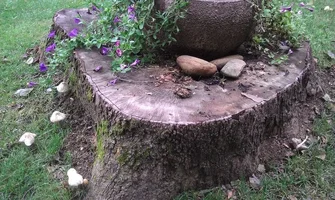
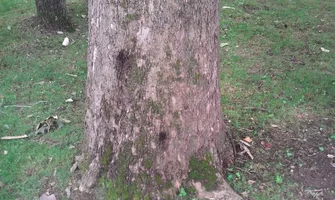
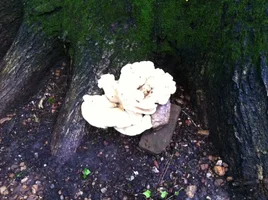
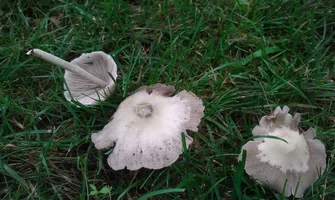
I noticed these fruiting bodies around a sycamore one week before it died. The action was very rapid, and there is a near by sycamore displaying a 'bleeding canker' type symptom. I have not been able to ID this fungus, and I am looking to anyone here for assistance in identification and possible treatment options. I would really like to save the nearby sycamore and not allow it to suffer the same fate as its neighbor.

The sycamore that was removed had a fast progressing white heart rot. The canopy also had black powdery fungal patches (not hypoxylon)

Here are some photos of the mushrooms around the remaining sycamore stump, and the bleeding canker spots on the nearby sycamore.
 

Attachments

  • 286021-IMAG0001.2.webp
    286021-IMAG0001.2.webp
    95.2 KB · Views: 140
i'm with pc; those look saprophytes typically seen in lawns.

white rot hmm how fast? stump pics could have diagnostic value. kevin s is your guy on this one mebbe.

lesions do not look fungal or decay-related, but i would still trace and torch them
icon311.gif
ukliam2.gif
 
Y'all are way ahead of me with the mushroom. Sure, a saprophyte living off of the lawn thatch most likely. May be a species of inky cap (genus Coprinus in a broad sense, including Coprinellus, Coprinopsis, etc. I haven't kept up on the latest with them). Looks a bit more to me like a Paneolus of some flavor. Most inky caps, by the time the cap flattens out with age, are turning to dark mush. This is a large genus of LBMs (otherwise known as little brown mushrooms).
The mushroom is unrelated to the bleeding cankers or the black powdery patches. The photos aren't enough for me to go on!
 
I'm not that up on fungi of any kind, but I am trying to learn more. Seems like whenever a shroom is observed, dire predictions or automatic distrust is the norm.
I am not sure but tend to think that the average shroom not actually attached to a tree trunk or root is likely the manifestation of something normal and healthy, possibly mycorrhizal.
When people ask me about a shroom I am likely to say, oh that's great, lucky you, your soil is probably really healthy. Of course I can't really know that, but just trying to give shrooms some decent PR.

BTW nice tree ring article in June Arborist news Kevin.
 
Thanks Nora and I enjoyed your Detective Dendro and Codit piece. Good way to get information out there!

Are you going the the Prairie Chapter ISA meeting in September? I'm on the program there and will be doing a pre-conference workshop, I believe. Still working on the details!

Indeed, I think you are on the right track with lawn or forest floor mushrooms not usually involved in tree disease. Some are mycorrhizal, others are not. Of course, sometimes decay pathogens fruit some distance from the stem by infecting major woody buttress roots. Armillaria does this pretty often.

Yes there is a lot of demand for mushroom info out there. Earlier this month I did a half-day presentation for the NH State Police forensics lab on mushroom biology. They are needing to distinguish production of legal versus illicit mushrooms. All part of the job!
 
[ QUOTE ]
Thanks Nora and I enjoyed your Detective Dendro and Codit piece. Good way to get information out there!

Are you going the the Prairie Chapter ISA meeting in September? I'm on the program there and will be doing a pre-conference workshop, I believe. Still working on the details!


[/ QUOTE ]

I will certainly be there Kevin. And I will definitely want to attend your workshop.
 
Here's a pic taken today of what i am calling Bondarzewia berkelyii.

Spreading through the butt of a beauteous white oak. Kevin I may have asked about this one already. Infected wood smells really sweet. I have to think there must be a way to categorize or even measure smell in shrooms, like the parfumeries do with attars and nectars.

When it comes to telling the woodrotters vs the good guys, i usually dig out the conk. If it is fastened to a living tree in a rotten spot, that makes it a bad guy.

How reliable is that?
 

Attachments

  • 286473-Bb.webp
    286473-Bb.webp
    255 KB · Views: 66
I'm trying to think of some counter examples, but if a well-developed conk is actually *attached*, it's likely to be part of an active decay column. I hesitate to say that in that I don't want other folks to immediately think that attached lichens, say, are a problem!
Your ID is probably right. A slice into a young, fresh conk will usually exude latex, which is also pretty diagnostic. As for smells being characteristic, you bet! Some keys use aroma as a diagnostic character. A key component of that nice fresh woodsy forest smell is from wood decay fungi and their metabolites.
 
Thanks Kevin,

Indeed, lichens could be on a rotten spot. Can't be too careful issuing general rules like that.

Speaking of careful, I ate a mushroom once in FL that may have made me see things that were not there.
Are cowpies a medium for illicit fungi in NH, too?
Is there a fed list of nonos, or is it state by state?
Any woodrotters in that group?
Just curious...

O and are you familiar with Taylor Lockwood's work? Just saw his dvd--beautiful images, and the diagnostics seem sound to this non-mycologist.
 
Yes, Taylor Lockwood's photos and scholarship are great.

Your question about the list of illicit species is a good one...and that is not how they do it. As I understand it, the legal prohibitions concern the psychoactive compounds irrespective of species. This makes ID tough (that would stand up in court) in that it can be really difficult to tell a psychoactive Psilocybe, say, from one that is not psychoactive. Of course, that is what the authorities would like to have. So the forensics folks run sample extracts through a gas chromatograph or other sensitive analytical device. BTW, the spores are considered not to contain the active principle so are legal for commerce, even those produced by psychoactive caps. So this does provide for enforcement challenges.
Sure, dung is one possible habitat, but so can be thatch. No woodrotters in the group. Most of the enforcement interest is in home cultivation, some of it quite large-scale.
 

New threads New posts

Back
Top Bottom