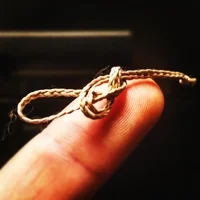
For those of you who don’t own a splicing wand, or do not think the money is worth spending on one (since, as we know, most of us aren’t working at the splicing factory used exclusively by the few main companies that dominate our industry) I would highly recommend getting one.
It makes buries of any sort, even on 5/16” 12-strand and 16 strand so much faster and simpler. Especially when you get the hang of it.
My only complaint is that I’ve snapped my snare within the first 6 months of owning it. I would say I would say I use it once a week for a couple hours at a time, and so it has moderate use to it. you can buy the replacement on tree stuff I believe.
For those of you who do have a splicing wand; if you bothered to read this far you know that I have snapped my poor snare. I just wanna say that it was my first time doing 16-strand and that crossover is a bitch. (I probably wasn’t doing it with the best technique either).
In my need to finish my splice, I attempted to use something that I knew would be a strong string: whipping twine (marlow #6). I made my measurements and back to work. That lasted 35 seconds. The snare snapped immediately. That was the heaviest whipping twine I had at the time so I grabbed my throwline, the smallest “zing-it” one, so fairly small right? Not small enough. Not even close. Next step, just because I saw it as a last resort, was some waxed leather sewing thread. Real heavy duty stuff, but its not whipping twine or spectra. That snapped immediately as well.
To finish my splice I ended up using an old bass guitar string and using that as my fid.
Then I thought to myself, with my quart sized mason jar full of old guitar strings sitting right there, that I could try and use on of those. One thing to keep in mind is the type of metal that the main insert with snare attached to it is made of. It looked to me like either brass or copper, or some mix, but it’s softer metal, that’s for sure.
The main issue is finding the right string, I ended up using a round-wound phosphor bronze from my twelve string, so it’s a pretty small gauge.
Right now I’m using my wand for smaller projects, since I don’t really trust the guitar string snare for making hard crossovers or difficult buries.
I take it other people have had this problem; why else would they sell the replacement? Being that we’re splicers, however, we tend to think outside the box, so should I just buy the damn thing or does anyone have some trick up their sleeve where dental floss does it right every time?? The guitar string is working alright, I just don’t want to end up with a permanent piece of metal floating around in a splice when it comes out on that one bury and you seemed to have lost the snare in the rope. Plus I can tell it’ll break sooner rather than later.
Let’s hear some thoughts on the splicing wand as well; pros, cons, nuisances, getting it the first time and being like why the #$@& is this thing so long?
It makes buries of any sort, even on 5/16” 12-strand and 16 strand so much faster and simpler. Especially when you get the hang of it.
My only complaint is that I’ve snapped my snare within the first 6 months of owning it. I would say I would say I use it once a week for a couple hours at a time, and so it has moderate use to it. you can buy the replacement on tree stuff I believe.
For those of you who do have a splicing wand; if you bothered to read this far you know that I have snapped my poor snare. I just wanna say that it was my first time doing 16-strand and that crossover is a bitch. (I probably wasn’t doing it with the best technique either).
In my need to finish my splice, I attempted to use something that I knew would be a strong string: whipping twine (marlow #6). I made my measurements and back to work. That lasted 35 seconds. The snare snapped immediately. That was the heaviest whipping twine I had at the time so I grabbed my throwline, the smallest “zing-it” one, so fairly small right? Not small enough. Not even close. Next step, just because I saw it as a last resort, was some waxed leather sewing thread. Real heavy duty stuff, but its not whipping twine or spectra. That snapped immediately as well.
To finish my splice I ended up using an old bass guitar string and using that as my fid.
Then I thought to myself, with my quart sized mason jar full of old guitar strings sitting right there, that I could try and use on of those. One thing to keep in mind is the type of metal that the main insert with snare attached to it is made of. It looked to me like either brass or copper, or some mix, but it’s softer metal, that’s for sure.
The main issue is finding the right string, I ended up using a round-wound phosphor bronze from my twelve string, so it’s a pretty small gauge.
Right now I’m using my wand for smaller projects, since I don’t really trust the guitar string snare for making hard crossovers or difficult buries.
I take it other people have had this problem; why else would they sell the replacement? Being that we’re splicers, however, we tend to think outside the box, so should I just buy the damn thing or does anyone have some trick up their sleeve where dental floss does it right every time?? The guitar string is working alright, I just don’t want to end up with a permanent piece of metal floating around in a splice when it comes out on that one bury and you seemed to have lost the snare in the rope. Plus I can tell it’ll break sooner rather than later.
Let’s hear some thoughts on the splicing wand as well; pros, cons, nuisances, getting it the first time and being like why the #$@& is this thing so long?