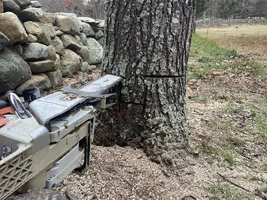
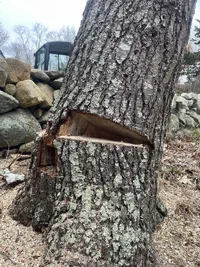
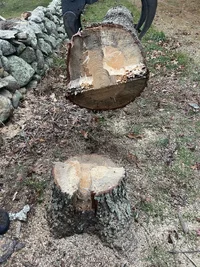
Tall skinny Ash

Bart_

Carpal tunnel level member
Location
GTA
Mid-south Ontario, beside a lake, about 8 trees, 3 open grown others poking out the top of bushy forest growth. They're 60 - 80 ft high, are spindly, almost no lateral branches up the spar, co-doms and branches not far off vertical - all dead eab so no leaf etc id. Crowns 20 to 30 ft dia max. I can't find any structural picture showing ash trees that look like these except possibly by aberration pumpkin and blue ash - definitely not certain. Near vertical suggests green ash but my green ash had 5 to10x the amount of branch/tiwig "fillage" compared to these trees.

Anyone know the likely type of ash?

part 2 - I've had eg 2 yr crispy dead wood snap instead of flex-hinge. Would said 2 year crispy ash hinge snap or flex/bend? My vote is snap but I'm not sure or currently willing to bet on it. Bark sloughing off but not enough to see if drying shrinkage cracks are appearing on the outside of the spar.
 
Mid-south Ontario, beside a lake, about 8 trees, 3 open grown others poking out the top of bushy forest growth. They're 60 - 80 ft high, are spindly, almost no lateral branches up the spar, co-doms and branches not far off vertical - all dead eab so no leaf etc id. Crowns 20 to 30 ft dia max. I can't find any structural picture showing ash trees that look like these except possibly by aberration pumpkin and blue ash - definitely not certain. Near vertical suggests green ash but my green ash had 5 to10x the amount of branch/tiwig "fillage" compared to these trees.

Anyone know the likely type of ash?

part 2 - I've had eg 2 yr crispy dead wood snap instead of flex-hinge. Would said 2 year crispy ash hinge snap or flex/bend? My vote is snap but I'm not sure or currently willing to bet on it. Bark sloughing off but not enough to see if drying shrinkage cracks are appearing on the outside of the spar.
Have you experimented with full gap face and/ or double or triple hinge?
 
These are in position to multi swat houses and trailers, let alone some mid-ish spar break during felling dropping big top chunks. I was considering multi insurance guide ropes plus pull line but that still relies on an intact hinge and doesn't mitigate a mid-snap. no mid-snap vie gentle roping maybe. oh yeah, touch of back/side lean too
 
Local guy pieced them down with a lift. First small pieces tried in wood stove went well. Ash branches stay put as they dry. Houses/yards 40 to 50 yrs old so fighting previously existing brush forest unlikely.

In nearby town I saw a few more examples of these trees.

Going to split 24" dia trunk pieces to check dry/will burn. My bet maybe/not , haven't seen shrinkage cracks and some bark was still attached.

edit - shrinkage cracks in widest trunk, burned great!! perfect timing for winter arrival

edit - out in the countryside, midnight literally a pack of wolves howling nearby, that's different
 
Last edited:
Pics?

Ash also likes to barber-chair. Bore and trigger.
There’s also a way to create what looks like a Coos Bay but also with a hinge.

- Face cut.
- Center plunge from face out the back.
- 2 separate back cuts (one on each side of the plunge) stepped up well higher than the apex of the facet, neither crossing over the plunged area.

I’ve used it to maintain directional control when a hinge can snap too early. Might possibly be a poor choice if using a pull line to overcome a back lean if the tree is brittle up high since the plug can take effort to shear out of the pocket.
 
I need a picture or drawing of that.

Would you please?
I was able to make due with the Pine spar left over from yesterday. Had to form the cut then force it over via machine. Here goes…

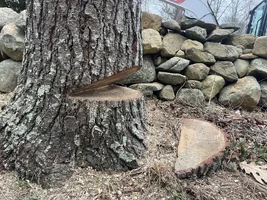
Face cut as normal:
IMG_8424.webp

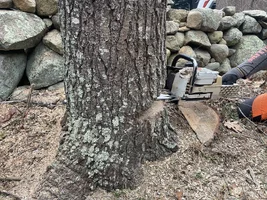
Plunge through the center of the hinge and out the back:
IMG_8428.webp

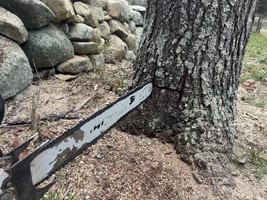
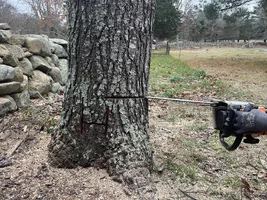
Next, you can adjust the width of the plunge if need be and vertically scribe the sides as a visual aid:
IMG_8435.webp

Begin back cut #1. Compression side first if it’s a consideration. Step well up above the plunge and avoid cutting beyond the scribed lines and desired hinge thickness:
IMG_8436.webp

Back cut #2 avoiding the same overcuts s the first. Here I had to adjust my entry due to the wall:
IMG_8439.webp

When the stem goes over, the keyway will form at the plunge, similar to the Coos Bay:
IMG_8447.webp

When the dust settles, it should look like so:
IMG_8449.webp
 
Last edited:
I was able to make due with the Pine spar left over from yesterday. Had to form the cut then force it over via machine. Here goes…

Face cut as normal:
View attachment 100283

Plunge through the center of the hinge and out the back:
View attachment 100284

Next, you can adjust the width of the plunge if need be and vertically scribe the sides as a visual aid:
View attachment 100285

Begin back cut #1. Compression side first if it’s a consideration. Step well up above the plunge and avoid cutting beyond the scribed lines and desired hinge thickness:
View attachment 100286

Back cut #2 avoiding the same overcuts s the first. Here I had to adjust my entry due to the wall:
View attachment 100287

When the stem goes over, the keyway will form at the plunge, similar to the Coos Bay:
View attachment 100288

When the dust settles, it should look like so:
View attachment 100289
Thanks for that!


What is the purpose?


maybe for other purposes...

I will sometimes cut both sides of the back cut while leaving the center strip of the back cut (strip perpendicular to the hinge, all in the same plane.

This is to release a heavy leaner, particularly if cutting with a less- than- tree-width bar.

That 'Coos Bay-like' strip cuts very quickly after holding strongly.
 
Thanks for that!


What is the purpose?


maybe for other purposes...

I will sometimes cut both sides of the back cut while leaving the center strip of the back cut (strip perpendicular to the hinge, all in the same plane.

This is to release a heavy leaner, particularly if cutting with a less- than- tree-width bar.

That 'Coos Bay-like' strip cuts very quickly after holding strongly.
You’re welcome. I would suggest it will hold direction if there’s concern for a brittle hinge to break early.
 
  • Like
Reactions: evo
I’ll do this when needing to go against a lean and a pull or push isn’t optional. I start with the central plunge and drive a wedge.
Make my face and then do the two part back cut.

Works a treat for those oddball small diameter noodles and allows for wedgin where back cut first technique can be sketch
 

New threads New posts

Back
Top Bottom