Sycamore-leaves blotching???

Tom Dunlap

Here from the beginning
Administrator
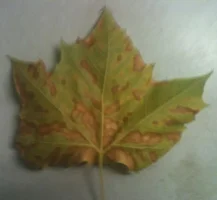
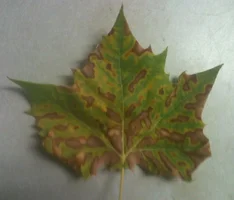
A sycamore has a developed a lot of blotches on the leaves. The leaves are mostly located in the middle third of the canopy.

Even though Austin is in a drought this isn't what I would expect a drought reaction to look like. I'm not too familiar with sycamores :)
 

Attachments

  • 288941-Sycamorebottom.webp
    288941-Sycamorebottom.webp
    20.4 KB · Views: 102
looks a lot like anthracnose. if they yellow and fall off thats the case. I wouldn't worry about it too much, sycamores are pretty tough trees, and should put out another flush of leaves
 
You should have the leaves tested for Bacterial Leaf Scorch (Xylella fastidiosa)
Symptoms are expressed when the tree is under drought stress usually later in the season.
 
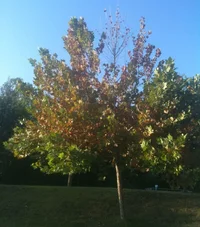
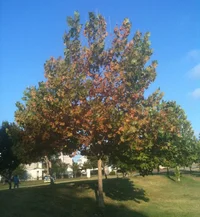
This morning I took whole tree and trunk pics. The top, center has really defoliated a lot just from yesterday.

From what I read about anthracnose it seems like I would see the whole tree affected and the leaf margins too. Since this isn't affecting the whole tree and only intra-veinal I'm still searching
confused.gif


This pic is from the west.
 

Attachments

  • 289103-whole-tree-from-west.webp
    289103-whole-tree-from-west.webp
    127.2 KB · Views: 77
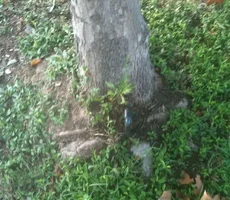
Trunk pic.

The SGR issue can NOT help the tree no matter what might be going on. There is another sycamore about 30' away that looks like I would expect it to in this drought.

I found this in a Journal of Arb. article:

Sycamore. Decline of sycamores caused by
X. fastidiosa and characterized by leaf scorch and
dieback has been reported in Washington, D.C.,
Louisiana, North Carolina, South Carolina, Texas,
and Florida, and is most likely widespread
throughout the mid-Atlantic and southeastern
United States (12,18,38). In mid-summer, leaves
of affected branches develop an interveinal olive
discoloration which later turns tan. Necrotic areas
are preceded by a zone of reddish tissue. Severely
affected leaves curl upwards and generally remain
attached to the tree. Symptoms initially develop in
older leaves and then progress to newer ones,
often leaving tufts of unaffected leaves at the
branch tips. Leaf expansion is delayed, growth is
reduced, and affected trees set less seed.
Symptoms reoccur each year involving progressively
more of the tree canopy. In advanced stages
of the disease, dieback decreases a tree's aesthetic
value necessitating early removal.

 

Attachments

  • 289105-trunk-SGR.webp
    289105-trunk-SGR.webp
    67.3 KB · Views: 59
my first observation is the tree is delining from the inside out which would cause me to look in the direction of a systemic problem.

how about sending a leave sample to the extension service lab for analysis
 

New threads New posts

Back
Top Bottom