Stupid question

Take for example a 2 ton CMI SS block. It is rated for up to 5/8" rope. So if you are supposed to use a bigger connection for your block (loopie, eye sling) what do you do? Does it just mean you shouldn't use a 5/8" rope even though that is what it is rated for? Should you use a 9/16" rope and a 5/8" loopie?

chris
 
That ain't stupid, that's a damn good question.

I use the 1 ton CMI block with 9/16" Stable Braid and 9/16" slings (also Stable Braid), same on the porty although I have some 3/4" slings for it too.
 
It's not so much the size of the line (diameter) that should be bigger, but its overall tensile strength. The knot or sling configuration will play into this as well since that effects breaking strength also.

Tony
 
The block is as strong as it is. Rope diameter is simply the size of rope that will comfortably run across the sheave. This has to do with sheave diameter, bend ratio, etc.

Think of it this way... 1/2" Amsteel is way stronger than 1/2" 12 strand polyester. You could run either through a block with a 1/2" rope capacity... the strength of the rope has nothing to do with it.
 
I'm with you TL.

I took the question based on the theory that the block sling should be stronger than the line reeved in the block. This goes to what SJ said above.

Tony
grin.gif
 
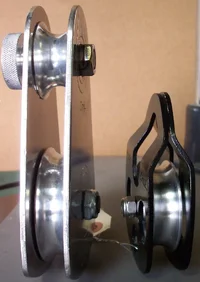
I've used 3/4" spliced eye slings as the anchor on that block for years (CMI RP130). It's OK to use a bigger sling as an anchor, but not as a running rope, 5/8" max.
Check out the sling bushing in the attachment. It is designed to accept a 3/4" rope.
 

Attachments

  • 166894-CMIsideview.webp
    166894-CMIsideview.webp
    133.9 KB · Views: 118
[ QUOTE ]
I've used 3/4" spliced eye slings as the anchor on that block for years (CMI RP130). It's OK to use a bigger sling as an anchor, but not as a running rope, 5/8" max.
Check out the sling bushing in the attachment. It is designed to accept a 3/4" rope.

[/ QUOTE ]

This makes me happy. Thanks Norm and everyone else for your feedback.

Got to love the buzz!

Chris
 
[ QUOTE ]
Always keep in mind that your rope should be the weakest point of your system. As long as your sling SWLL is stronger than your rope... you're good to go!

[/ QUOTE ]

This is very true if you follow the ABC rule of setting up a rigging system (per Don Blair).

Yale Cordage was the first cordage manufacturer to develop a safe knotted working load (SKWL) rating for its deadeye rigging ropes.

In theory, if you follow the industry standard of 5:1 SWLL for slings, and 10:1 SWLL for lowering lines, you can use the same size lines.

No need to go bigger in your slings, if the system is balanced, just like Blinky pointed out above.
 

New threads New posts

Back
Top Bottom