Stress concentration in cuts...

And, this actually leads me to the conclusion that the vertical bore in this case isn't that critical, as that is in a very weak plane anyway - the consequence being that the rear vertical face of the hinge will form as necessary, just as it does on any other back-cut not having a vertical face bored into it. Yeah?
Don't be so sure of that. In this business, you want to through everything to your advantage and that sort (maybe 2") strip of vertical wood that needs to get broken takes a good bit of force. That may depend on species, but either way will add significantly to the force needed to trip a hinge on a big tree. Now does that add to the force or is it a force multiplier?

Then how much does that added force effect a fall? And in exactly what real-world way?
 
And, this actually leads me to the conclusion that the vertical bore in this case isn't that critical, as that is in a very weak plane anyway - the consequence being that the rear vertical face of the hinge will form as necessary, just as it does on any other back-cut not having a vertical face bored into it. Yeah?
This was my exact first reaction to this thread. Vertical bore at the REAR of the hinge is wasting fuel. Put the back cut above the bottom of the under cut, gapped or not, and the fibers separate in the very same vertical plane.
 
Block/box cuts are made to hold on to the stump longer than traditional felling cuts, and are often used specifically on hollow trees, IME.

Jemco
 
Old school Humboldt/ full Gap face with snipe, today.

Spar saved out, landing in a chip bed.
18' stock needed for a project of a friend of the homeowner.
Probably, 2-18'6", and 12'+ log.

The top had blown out, and regrown multiple tops.


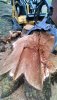
Couldn't break out the face to the hinge, so I ended up boring from both sides, 36" sank from both sides was enough.
 

Attachments

  • IMG_20200423_200028941_HDR.jpg
    IMG_20200423_200028941_HDR.jpg
    393.3 KB · Views: 22
i think center punch allows re-apportioning those fibers to the steering sides for more utility than just hold.
.
i think some of the hinging, depends on species as many other things when talk of wood as a generic substance; especially as breaks and where breaks free some from rear linguin glue side for this model. And wavy grain of Live Oak not following all of straight grain rules. Palm as grass, yet again different.
.
Small trough full across in front of hinge seems to give easier start/less resistance, forced stronger with less front embankment/support(rather than forced stronger with extra load of wedge or rope force to be relieved, here handicap to force stronger in response, then give full strength back), then when embankment braced as gap closes to new fortification. So shifts gears like Dutchman, but across flexible side axis of hinge fibers, not a close down the columnar strength of hinge.
.
Speed variance allowed a trumping factor tho, can be game changer at many levels.
For hinge adjustments are more of a static, non compound when alone factor.
But closes are a different matter, whether down the fiber column or across it, allow speed build up to play in, then, close gives later adjustments, now including speed factor. Specifically the slap and push of a Dutchman, more slap in, more slap out as return adjustment.
Because E=MCsquared; the statics are like the M (mass) single multiplier,
Csquared is for the dynamic, velocity SQUARED,a more of a compounding factor, especially the more it revs up. The free pass/breather room before the closes allow speed up before the close mechanix then take over. Like the pivotal change to new pivot position of any face close, specifically Dutchman here.
.
Even with 1 man, running 1 saw; this is an orchestrated symphony(at least parts that can you give some control to), not a solo, as lil'man taps big elephant in bluff will go where he wants and not get crushed, orchestrating with saw as stick/baton to lead. Isolating parts good to polish moves and views, but especially speed always a potential over riding factor, especially on closes(especially 'early' closes that have less speed going in that late close, but affect more travel after invoked in trade).

 
Last edited:
Wow :oops: - amazing how good photography was back in the 1800s! And look at that ol' logger! Wouldn't wanna muck with the dude.

That's good to know, tho! I've definitely seen the block face, but I thought - at least until Sean's post - that the vertical bore in my initial drawing was doing something helpful. But I guess not, so it's just pretty much a standard block. Neat to see that being used.

What circumstances cause you to employ that style of face, @rico?

Edit: in case it's not clear, I'm kidding, in the first few sentences xD

What you have drawn up is essentially a block cut Mr. Farkwad, and as someone who uses block cuts frequently I can assure you they are a "real cut", they go over like butter with no extra force needed, and offer great control...

View attachment 67055
 
yea sepia setting is kinda cool for making an old timey photo......And you never want to muck around with a fella who weighs 160 lbs, cause when the shit hits the fan he's probably gonna out run ya....

Like old Lazy Lester said... "Im a lover not a fighter, and I'm really built for speed"....


I usually start considering whether on not to use a block cut in 60 inches or bigger...Other factors can also come into play though...
 
Old school Humboldt/ full Gap face with snipe, today.

Spar saved out, landing in a chip bed.
18' stock needed for a project of a friend of the homeowner.
Probably, 2-18'6", and 12'+ log.

The top had blown out, and regrown multiple tops.


Couldn't break out the face to the hinge, so I ended up boring from both sides, 36" sank from both sides was enough.
Great color on that wood. how do the logs look?
 

JB Chopem get 'er done


Left a 60’ in one piece and headed home...late in the evening, yesterday...my GF and I have been getting to the site between 10 and noon, after doing other stuff in the mornings.

Looked like a bit of white rot in the hinge near the center, and the normal brown rot.

I’ll flop a little cedar spar today, maybe buck that log for them, blow and go...last tree out of 10 mature/ mature-ish trees.
 
Nice work Southsound..That came down super soft and it sounded like you didn't break a single board foot of useable wood.......A lot of limbs, but that would mill up into some very nice lumber me thinks....
 

New threads New posts

Kask Stihl NORTHEASTERN Arborists Wesspur TreeStuff.com Teufelberger Westminster X-Rigging Teufelberger
Back
Top Bottom