SRT basil tie off w/RIG rescue, with knot passing.

Fairfield

Participating member
I put this up because I see alot of "how I anchor" but not to many "how I would over come if" vids. The RIG is a popular choice due to its user friendly function. This is how I use it and what I do when you run out of rope during a rescue lower. The video picks up at the point that I have reached the end of the climbers line but the climber still has a bit of distance to still be lowered. This is one of many ways to do it for sure, I tryed to keep with tools that most climbers already have ie: the Bee-line cord for a hitch.
Climb Safe.
http://youtu.be/mNFhTQoGi4I
 
Fairfield
The only thing I saw That I question was when you transfered onto the second line you untied the hitch below the biner and if the rope was incorrectly loaded into the rig there could have been possible trouble. Perhaps pulling down on the prusik to transfer the load back on the extended primary line and proving it, then the prusik could be removed by untying below the biner to easily remove. this could be safer. What do you think?
 
scrat, This is true you can do a prof test by doing a short lower with the RIG first (cant hurt for sure). I do say "make sure the rope is placed in the right way" while I was riging it. Then again I use a RIG every day so I knew it waas rigged the right way. Although if it was to have been rigged wrong n the RIG, I would have known it as I let out on the LRH. At that point I would have been able to stop lock that hitch off and re-rig.... the RIG. You are not wrong at all, that is something that I should have said test the RIG before removing the safety.

Scubadude, I would hope also, but I have done it many times. I thought I was only going for one or two dead limbs straight off the main trunk. The next thing I knew I was going for a few more higher and out toward the tips. At that point a healthy climber just comes back into the trunk to come down, but a hurt climber wont be able to do so. Plus you just have those climbers out there that dont think. So the groundie will have to and on the fly.

One other thing I should have stated was when placing a LRH on the anchor, make sure that the Munter is on the anchor and not the moving rope.
 
Fairfield I have been looking for a way to use the LRH but hadnt found a way yet. That seems to work out quite well. Its deffinately something to have in the back of your mind.
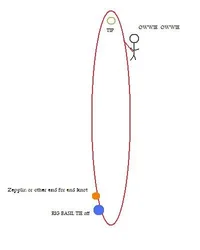
With so many still just on srt acsent only still I drew a picture of how we handle tieing off. Its something I learned from Mark C a few years back at one of his classes. It really only works for acsent though. the climber can be lowered all the way to the ground from anywhere along the acsent line.
The same theory could be used for SRT work possitioning just dont make a loop with one rope, add a second dedicated rescue line with the knot above the RIG. The rope could stay bagged except 10' or so making for a quick clean up when done (if not used).
336159-SRTDrawing.jpg
 

Attachments

  • 336159-SRTDrawing.webp
    336159-SRTDrawing.webp
    7.1 KB · Views: 27
You can just tie your Basal tie with 1/2" rope, clip the rig into a bowline with a long tail. If and when you ever need to pass a knot through your RIG you just use the tail of the bowline to tie a blakes hitch to transfer the load.

For that matter you could just use a dedicated 1/2" eye sling, cow hitch the eye onto the tree, clip the RIG into the eye and use the tail or it all to load transfer with blakes/tautline when needed.

I think all the rigging plates and crazy basal tie systems are unnecessary.
 
[ QUOTE ]
I think all the rigging plates and crazy basal tie systems are unnecessary.

[/ QUOTE ]

So you chocke your line off or use some kind of ring to ring system at the high tie in point with a stopper knot for your SRT climbs? Putting a vid together today of how I like to do a pick off of a climber in ascent mode. See what your thoughts on that are.

Something to keep in mind about rescues of arbs, you may be called one day to help do a rescue of a climber that you dont know and has a different style then you. Thinking on the fly to get that climber down is going to happen. The more skills you pick up outside of your own style will be a huge tool to use.
 
In the limited times I have used a base tie I use an ISC Big Dan Carabiner clipped to the tight eye, wrapped around the trunk and choked to the standing line.

If I need rescue in the tree, chances are it will be in a situation where I am lanyarded in making the basal rescue option not practical.

To me a base tie is a exercise in convenience, not practical rescue. If users want to take the time to set it up and invest in the equipment, why not, I dont see any harm.
 
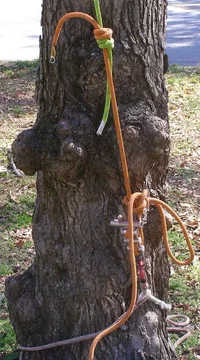
During my preclimb inspection I try to assess how much rope I could ever possibly need. It it seems like my 200' climbing rope might not be enough to do a rescue lower with a trunk wrap or some other sort of basal tie off I add on a second line above the friction/belay setup. This eliminates the need to do a rope extension during a rescue.

This belay system is one that I used years ago. Now I use a trunk wrap exclusively. The TW is much simpler and easier/safer to use.
 

Attachments

  • 336179-CRTworopes1.webp
    336179-CRTworopes1.webp
    145.6 KB · Views: 72
You have a climber suspended with a four wrap prusik attached to an unsecured load releasing hitch. A Dyneema sewn sling at that. The screwgate carabiner could be argued one way or the other. Why have you not backed up that arrangement?

Several meters of tail on one side of the double fisherman's is a sure fire way to get confused and put the tail in the RIG; especially when using similar colored ropes.

You can at least leave the rope secured in the RIG and create enough slack between the RIG and prusik to tie an inline knot. Then do whatever you want with it. If the prusik slips or the load releasing hitch lets go, the rope is still in the RIG.

Six or eight coil prusik, secured connection for the prusik, a figure 8 or some other friction device below the prusik, then secure the whole shebang with an appropriate stopper. Use a much longer prusik and give yourself some room to work.
 
Pseu, All good stuff. The two lines are hard to tell/see on the vid but are diffrent when standing infront of them (color/size & feel). The screw gate ya that can go back and forth in conversation as it has for years now. As for putting an inline knot onto the line between the RIG and hitch (like an inline eight), that would be something I dont mind adopting..... if you have that there, then there is no need for your backup to the hitch as you had stated there needs to be. As for the hitch being backed up, I can see where some may feel that safer or the best way to go. For me I dont feel the need for it as long as the hitch is fully loaded before the RIG comes off. Thats like the arguement that if a three wrap prussic is better then a double, then wouldnt a four or five be even better. Cant arguee that it wouldnt but I find that to be my comfort level and still be safe. Oh, and the LRH was secure I had to un-do it prior to letting slack out. also before letting it out to place the load back onto the RIG the RIG was locked off.
Is there some kind of rule I am not aware of about using the sling as a LRH when needed? Not being a smart arse, just want to know if there is.
Hey about time you started talking!
 
The LRH is basically a slip knot. That's my point about it being unsecured. When working around it, you could snag it and release it. Yeah, lots of wraps there, but you get my drift.

Dyneema would be a choice for a static application, but I wouldn't choose to use it as a LRH. If the LRH came under load quickly and slipped or cinched down on itself, the potential for melting or degrading Dyneema is quite high.

If the four coil holds, it holds. I believe there is a difference between four and six, six and eight. Ten? probably not necessary. However, all things being equal, more surface area = more friction.

Realistically, in the situation described in your video, the climber doesn't weigh much, and friction is present over the natural crotch. Forces will probably not be that great at the basal anchor anyway. But it's all in the details and I believe we should set up our systems to handle potential complications and a spectrum of circumstances. For example: the climber's tie in point turns out to be totally inadequate and has already gone through a primary failure due to the climber falling into it when he or she became injured. During the rescue prep, the tie in point fails completely, dropping one meter to the next crotch down. Quite a shock to the whole system.
 
[ QUOTE ]
The LRH is basically a slip knot. That's my point about it being unsecured. When working around it, you could snag it and release it. Yeah, lots of wraps there, but you get my drift.


[/ QUOTE ]

A proper LRH is much more than just a slip knot. This is a video I did for our rope rescue team so that crews could learn the LRH and practice it.

http://www.youtube.com/watch?v=NnakHHPCK...mp;feature=plcp

There are 2 accepted LRHs (other than the ones you can purchase), the rope version I show and also a webbing version.

Also whenever a LRH is being used (released) it is releasing tention from one braking device (normally a prussik) into another that is already loaded properly, creating a redundency already. Still when releasing the wraps should not be removed, but used as extra friction and when you have released enough you tie it off again so that you can use it again if needed. Our 30 ft LRH gets 3 or 4 uses before it needs to be retied completely.

I agree you could argue the screw gate biners till the cows come home, but in the end, if the fire company comes to the rescue, get used to them cause thats all many of them have.
 
Yup. I forgot to mention that I had kept my hitch distances short for the reason that it would catch as close as poss due to keeping everything compact. If it was to be longer the LRH would not have been as effective. And seeing how this is what I carry while climbing, I am not going to practic with something elese to make it seem a better way. That is something I have aleways hated about some classes. You go into the class use a bunch of gear you dont have. Then go back to your home and have to begg for that gear or think of another way of doing what you had just payed to learn. Hence, I used a Bee-line for a prussic due to most crews having one, and not a normal prussic cord that you will see the rescue companny show up with. I am sure most fire rescue guys will agree. But like I had said, as long as you have trained with it and it is safe and smooth, use your technique. In the end it will be the one that you wont mess up.
 

New threads New posts

Back
Top Bottom