Spiking up a heavy leaner

dmonn

Branched out member
I've got a few box elders that need removal. They have grown into a pretty strong arc to reach more sunlight. The trees are about 8-10" ABH, and are arcing over a fence. The trunks are pretty rotted, and threaten the fence if they fall on their own. I've taken one down already by using climbing lines tied into trees on opposite sides of the leaner to remove the top of the leaner. With a lot of the upper weight removed, I felt confident that the trunk would support my 175 pounds. To take off the part of the trunk that was still leaning beyond the fence I used the same climbing lines but mostly just for work positioning, and spiked up the trunk. While doing that I started thinking about what it would be like if I would slip from the high side of the trunk to the low side if I was only supported by my flipline. I imagined that I could get my legs up enough to wrap them around the trunk, but wasn't sure how I would rotate myself back up to the high side. I figured I'd have to work my way back down the trunk to the ground along the low side of the leaner. Not a fun position to be in, right?

Anybody ever have that happen to them? Slip while spiking up a very strong leaner and rotate around to the low side? How did you deal with it?
 
What the previous guys said, plus, in my experience it is much harder than I thought it would be to get back on top of a trunk or large branch. It also sucks spiking down the bottom side of a hard leaner. Bringing a pre setup climbing line with a split tail can be helpful if you end up on the bottom and can't get back on top. Just throw your line over the lead, go down, and try again.
 
Good suggestions on preventing it from happening. A preset climbing line sounds like the way to go if the prevention doesn't work.

I'm talking HEAVY leaners. They are about 50 degrees from vertical where I need to cut the trunks. I found when spiking up the trunk it got to the point that I could no longer lean back enough to put any pressure on the flipline. At that point I switched to basically a belly crawl on the trunk using the spikes to scoot me along. When I got to where I wanted to cut the trunk, I straddled the trunk with my legs. The positioning ropes made me feel pretty secure that way, and the one tree I cut down came down just like I anticipated.
 
Right, the old side ways tree. Dont strip off all the branches that grow off the top, they are valuable for positioning balance and lanyard placements. You could climb with a couple extras in case you need to aid yourself back on top of the stem. A single loop runner can sometimes make the perfect step out of a painful struggle spot. Your climb line is in another tree, so maybe an ascender could help.
I remember the belly crawl.:endesacuerdo: Almost always there is a more comfortable way to skoot out there, i use my knees and ankles a lot to balance while pushing off the trailing spike. Totally depends on where your rope is tho.
 
@dmonn I ran into this situation before. Like you've implied - There are situations when there is a horizontal or near-horizontal stem and no way of tying above or to the side of it. In your case, it sounds like you were able to tie in to a neighboring tree and use your legs as back-pressure to spike the side of the leaner.
But I've had some situations when there is nothing above or to the side of a horizontal stem. In this case - I AVOID the top of the stem. I don't want to rely on my limited sense of balance (esp. if there's wind involved), and there is no way I want to roll over and slam down on my lanyard. I've done that once and I cat-grabbed that stem so hard I scraped my forearms all to hell.

Instead, I will take my 2-in-1 lanyard or two different lanyards up and just go with gravity. I will climb up under the leaner, advancing one lanyard at a time. You don't need to fight your body weight on the lanyard, just advance the other one, clip into it and tug to adjust it in, and pay out on the other one. Repeat, repeat, repeat, until you're over your fence or other target you're working over.
Then cut the stem. Just... ya know.. don't cut on the wrong side of the lanyard you're dangling on.
 
I've got a few box elders that need removal. They have grown into a pretty strong arc to reach more sunlight. The trees are about 8-10" ABH, and are arcing over a fence. The trunks are pretty rotted, and threaten the fence if they fall on their own. I've taken one down already by using climbing lines tied into trees on opposite sides of the leaner to remove the top of the leaner. With a lot of the upper weight removed, I felt confident that the trunk would support my 175 pounds. To take off the part of the trunk that was still leaning beyond the fence I used the same climbing lines but mostly just for work positioning, and spiked up the trunk. While doing that I started thinking about what it would be like if I would slip from the high side of the trunk to the low side if I was only supported by my flipline. I imagined that I could get my legs up enough to wrap them around the trunk, but wasn't sure how I would rotate myself back up to the high side. I figured I'd have to work my way back down the trunk to the ground along the low side of the leaner. Not a fun position to be in, right?

Anybody ever have that happen to them? Slip while spiking up a very strong leaner and rotate around to the low side? How did you deal with it?

To be clear, I am not addressing the question of spiking leaners. Mainly because there are some leans that cannot be productively spiked, secure from falling yes, able to make a cut worth the effort, no. This sounds like one.

So let me get this straight. Trees are 10" DBH? Even if they are 50 feet tall that conservatively calculates to roughly 2000 lb. You have neighboring trees strong enough to rig from?

You could always move the fence.

Fence alterations possible? Now granted, I am making some assumptions (correct me if I got it wrong). Seems like you are climbing the wrong trees. Tip rig through two vectors (side to side perpendicular to the lean.) Use a but line to keep it from swinging into the fence and serve as a trigger for a remote release snap cut.

Tony

Tony
 
Frequently, I'll use my favorite ground-man to hold the bottom of the tree, and as much weight as possible, while putting as little weight on ropes and rigging. Stronger than an ox.

What I mean, is the ground. Unbelievably bearing capacity, never tired, very predictable.

Currently, the ground is bearing 100% load. Cutting to keep the load on the ground can do wonders.

Double-whip tackling can decease the loads on your ropes, if needed
 
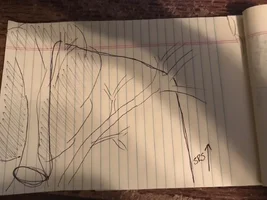
This is a horrible picture but if you have a good solid tree next to the leaner, with a little bit of extra time with your throwball, you could likely set something like this up all from the ground. Single line ascent right to the near top of the leaner. Sometimes it can get a little awkward getting into position at the top but I work with alot of leaners and it works quite well. Really only use it when the lean is significant and extends out away from main anchor tree quite far. This way your also not putting all that weight and leverage on the leaner (cause you said the base was a bit compromised). Just a thought
 

Attachments

  • thumb_IMG_0048_1024.webp
    thumb_IMG_0048_1024.webp
    71.5 KB · Views: 42
Chiselbit, I agree. Not worth getting hurt over, especially since it's my fence. Not easy to take down and put back up, or that would have been first choice. The spruce trees in the direct fall path are a different story. They're big, healthy, and beautiful, and in a location that's surrounded by dead and dying ash trees. I really didn't want to damage them, so I really wanted to take the boxelder down from the top.

I've got a ropewalking setup and used it for working both ropes to get close enough to the top of the leaner to cut off a few hundred pounds of canopy with a pole saw. That was tough, because the closest trees to tie to were a little skinny and not tall enough. I got both ropes (on opposite sides of me) as tight as I could, and could barely get high enough to reach the heavier branches to cut with my pole saw (one-handed!). After removing that much weight I felt the remaining stem would be strong enough to hold me.

No canopy overhead to toss a climbing line over, and no trees close enough or big enough to rig down the pieces. By spiking up the stem while using ropes off to either side for balance and fall protection, I managed to get up high enough to clear the fence with a straight drop of the top of the tree. I pre-tensioned the top to make sure it didn't drop straight down and damage the spruce trees. Everything worked as planned and anticipated, and taking down the remaining stem is today's plan and should be easy to do. My post was about the "what if" I didn't have two ropes to keep my balance during spiking up the trunk and spun around the trunk on my lanyard. What would that be like, and what to do if it did happen. I've got two or three more boxelders in similar settings, so that kind of fun isn't over yet.

Mike Powers, I like the sketch. It's something I probably could have done with that tree, and may need to use for some others. The vector forces on the leaner would be less downward force than the weight of my body. If the tree did come down, I'd be out near the "smaller" and "lighter" end of things, and would probably just go for a wild ride with less risk of bodily injury. Just a busted fence. Rope walking up and trimming off the branches would have been easy.

Thanks for the suggestions.
 
I did the same thing last year. Neighbor wanted a heavily leaning tree removed from over his fence, I am looking at it for a while and finally tell him he should get a "real" arborist to do the job. I was back at my house pricing out work for the next days split rail fence repair ( I do handyman work for a living) when the light bulb in my feeble brain finally illuminated...and I realized that I could just pull a section of stockade fence and fell it.
 

New threads New posts

Back
Top Bottom