Speedline adjustment point in tree-how would you?

southsoundtree

Been here much more than a while
Location
Olympia, WA
I've been trying to improve efficiency, reduce groundie fatigue, and lower ground impact by speedlining lightweight conifer limbs directly onto the low-tension speedline.

I'd like to be able to anchor the bottom of the rope at ground level and adjust the slack from the tree. This will free up one guy who was tensioning/ slacking while the other detached/ moved brush. I'd rather them both be able to do whatever is needed on the ground and I'll just sending limbs down as I'm ready.

How would you choker onto the tree and attach the rope?

I was thinking of something like a timber hitch with a steel 'biner, attaching to the slideline with a munter hitch/ mule knot or a figure-8.

It would not be a great bend radius or super fast to bump up at each whorl. I would probably have to attach above each whole, so that the biner and knot/ figure 8 would be out of the way of the sling and biner.
 
Why don't you incorporate a loopie (or whoopie) sling to a block, with a friction hitch in front. This would allow you to tension the line much like you tension your climbing line.

A sort of split-tail speedline.
 
Chris, that's an awesome idea. No mechanical advantage per se, but you could get your entire body weight on it to tension it, and it's an easy way to deal with the tail/slack. Thanks!

-Tom
 
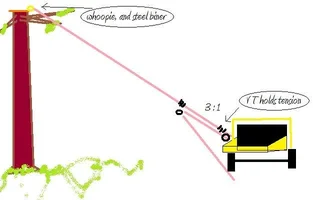
try a whoopie on ur tree, with a steel biner in the eye. terminate to the steel biner with your fav knot. On the other end, put a 3:1 terminated to the chipper, with a vt to hold the tension.

than after you zip a whorl, get your groundsman to run the vt, and release the tension, unclip your steel biner, and move it down to the next whorl. than just tension it back up. rinse and repeat.

try zipping the whole whorl one shot with a rigging paw, or just a steel biner, with a bunch of nylon slings. Its nice because its so easy on the groundsman, limbs face into the chipper.
 

Attachments

  • 193130-speedline.webp
    193130-speedline.webp
    17.7 KB · Views: 129
You could get MA if you redirect it where you cut the piece, but setup a block low on the trunk before you begin. This way you run the line through the area you are cutting, then down the trunk through a block and then through your friction hitch/device. Ste it up one time and then move it down the tree as you work it.
 
[ QUOTE ]
Chris, that's an awesome idea. No mechanical advantage per se, but you could get your entire body weight on it to tension it, and it's an easy way to deal with the tail/slack. Thanks!

-Tom

[/ QUOTE ]

Thanks Tom- If you wanted to get more tension from the climbers position, the tail could run through another block at the base of the tree and back up to the climber. This seems like it would negate the time savings, though, as the system gets more complicated.
 
I use loopies now. They are not as fast as a whoopie would be. With the rough bark of conifer and the loose weave of Tenex (I believe the material of loopies/ whoopies) it is going to be harder than on a smooth barked tree.

The whoopie would be easier/ faster to adjust as the stem tapers.

I was thinking that I could use a large shackle/ clevis with the rope and achieve what I need pretty simply. I don't think that I need the MA too much since the angle will be steeper and the limbs light. I use the MA at the bottom of the tree where the limbs are heavier and the angle is lower.

I think one could terminate the rope at the chipper/ anchor. Then,run the rope up to, and around the trunk. Clove hitch rope to the shackle/ clevis that is around the slideline itself (choking the trunk). The clove hitch would be adjustable, allowing more rope in the active part of the system as I climb higher, and have a decent rope bend radius. This would be a compact enough set-up that setting the choking part above each whorl would be unnecessary, increasing efficiency.
Whadda ya think a that idea?
 
I think the key words are, Lightweight and low tension. When I am in that scenario and I terminate that droop line on the ground or something near the ground. I drag up behind me the rope tail that has enough slack in it to reach the highest furthest slide. Tie off to the tree beside where Im gonna make my cut, Let the slack hang. Cut it off and letter go. No or low tree movement at the size you describe. Worked great when working alone. Great stuff. Great thread.
 
Hammer,

If the biners slide down the rope they would hit the friction hitches and release tension wouldn't they? Maybe that's what you want I don't know.

When I use a speedline I like to have the tension release built in so that the rigger can control the slide.

Using a detachable double whip tackle that can be attached above the munter/F8 works nicely. Since you're not going to need a lot of tension you can go with smaller cord and a Gibbs for the grab.

http://www.smackdock.co.uk/old/tackles.htm

The end in the tree can be choked so that the extra rope is always on the ground at the anchor.
 
[ QUOTE ]


Using a detachable double whip tackle that can be attached above the munter/F8 works nicely. Since you're not going to need a lot of tension you can go with smaller cord and a Gibbs for the grab.

http://www.smackdock.co.uk/old/tackles.htm


The end in the tree can be choked so that the extra rope is always on the ground at the anchor.


[/ QUOTE ]


Tom,

Tom, regarding the MA system,can you clarify, please? Do you mean to have MA in the tree to adjust the tension by the climber?

For this second part, do you mean to leave some of the excess at the lower anchor point, leaving less to deal with in the tree, with an occasional adjustment of the slideline while working in the tree? Perhaps keep an extra 20' in the tree, rather than 50-60 hanging down the trunk?

Normally, I use a running bowline cinching around the bole of the tree, with all the excess on the ground, after the lower anchor point. This means more groundie time making the adjustments, and me sitting idly by waiting. This inefficiency is the part that I am trying to work out.


-------------------------------------

As mentioned, lightweight and low tension, YES! Absolutely.
 
[ QUOTE ]
I think the key words are, Lightweight and low tension. When I am in that scenario and I terminate that droop line on the ground or something near the ground. I drag up behind me the rope tail that has enough slack in it to reach the highest furthest slide. Tie off to the tree beside where Im gonna make my cut, Let the slack hang. Cut it off and letter go. No or low tree movement at the size you describe. Worked great when working alone. Great stuff. Great thread.

[/ QUOTE ]

I think that this is what I'm talking about. How are you attaching the midpoint of the rope to the trunk at your cutting height?
 
I would not use this technique with more tension than i can gain by hand. Greatly reduces the pop. Using any type of tensioning makes it something else. I dont see it being a speedline as much as a only as much tension as i can muster line. Great on "suspect" stuff. Since there is such little movement. All line adjustment is done by climber. One of the things i use. As required. Have great day folks!
 
[ QUOTE ]
Why don't you incorporate a loopie (or whoopie) sling to a block, with a friction hitch in front. This would allow you to tension the line much like you tension your climbing line.

A sort of split-tail speedline.

[/ QUOTE ]

Im so stealing that idea, or borrowing it but Ill give it back
 
[ QUOTE ]
[ QUOTE ]
Why don't you incorporate a loopie (or whoopie) sling to a block, with a friction hitch in front. This would allow you to tension the line much like you tension your climbing line.

A sort of split-tail speedline.

[/ QUOTE ]

Im so stealing that idea, or borrowing it but Ill give it back

[/ QUOTE ]

File this under 'Why didn't I think of that?' LOL!

-Tom
 
There are many arrangements that would work.

Over tensioning speedlines can be very dangerous too even with static loads. Be cautious.

The SL could be choked off in the tree or at the base. Tensioning could be at the top, bottom or both. You could use a F8, munter, lowering device or tree wraps.

No matter how it's rigged, how are you going to control the tension on the line? Can the climber take care of rigging, cutting and lowering? I've done that with certain configurations. This is way too complicated to write out or diagram now though, sorry.

A simple system would anchor the SL at the ground. The climber sets an anchor in the tree with a friction device attached. Then, a tensioning system is used in a piggy back arrangement. The simplest uses a biner/snap attached as close to in-line with the SL. The rope goes through a cammed/shelled ascender like a stainless steel shell Gibbs or Macrocender. A pulley is clipped to the eye. As the climber pulls the 2:1 the slack is taken up at the friction device. When tension is sufficient the friction device is locked off and the tensioner is detached.

When the branches get to the ground the climber starts to clear the rigging and moving up to the next cutting station. When I had this dialed in with the ground crew the climber would be ready to cut at about the same time that the previous debris was cleared.

Sometimes you don't want the branches to slide all of the way to the ground anchor. A stopper can be tied in the SL to catch the biner/pulley that you use to send the branch down. A figure eight on a bight is big enough and pretty easy to untie too. Your choice of knots. If you want to protect the knot you could have a sturdy chunk of wood with a hole in the middle. Thread it onto the SL so that the biner/pulley hits it instead of the stopper. Getting way complicated...add a coil spring as a shock absorber.

Having the branches hanging from the SL makes them easier to handle than laying on the ground. Also, the anchor may be on the wrong side of an obstacle that can't be damaged.
 
[ QUOTE ]
I would not use this technique with more tension than i can gain by hand. Greatly reduces the pop. Using any type of tensioning makes it something else. I dont see it being a speedline as much as a only as much tension as i can muster line. Great on "suspect" stuff. Since there is such little movement. All line adjustment is done by climber. One of the things i use. As required. Have great day folks!

[/ QUOTE ]

Yes, the non-MA tension may be all that should be used if dropping directly onto the speedline/"only-as-much-as-I-can-tension-by-hand-line".

How are you attaching to the tree?

Thanks.
 
This is may not be quite what you are asking but I'll just through it out there. You could set up the zip as if it were a single line. Shoot a through line to a high limb, run a line to the base and tie it off. Then just above your whorl take a strap or sling with a biner with the working end. Have what ever friction, or advantage on the anchor point you want. Adjust the sling/strap as you move up the tree, and have the groundie pull the slack.

The sling would keep the rope close to the trunk, and as it is moved up the tree it would take tension off the zip. If the groundie had a pulley at the anchor, and another attached with a prusik should make all the mechanical advantage you need. Then the groundie would just pull slack out of the system.

Another way to speed things up with lighter limbs is to put multiple straps on the SL and cut the 1st one last so you would be sending down a whorl at a time of light limbs.
 
[ QUOTE ]
Another way to speed things up with lighter limbs is to put multiple straps on the SL and cut the 1st one last so you would be sending down a whorl at a time of light limbs.

[/ QUOTE ]

This works when dismantling horizontal limbs too. By strategically placing the slings and organizing the cuts the whole thing ends up looking like a bouquet of cut flowers...hence...what I call Bouquet Rigging.
 
Thanks for the input all.

What I'm trying to do here is use two ground guys more efficiently. I'd rather them be waiting on me, than me waiting on them.

I'm trying to take one of them out of the tension, slack, tension, slack situation. Just be able to send them down and have them both clearing. When they are ready to unclip and clear the area, I can hold up on sending limbs for a minute so they can come under, during which time I can strap more limbs, or bump up to the next whorl.

They are pretty new at speedlining, and I would rather that they just unclip the limb and clear the area. I could better judge how much tension I need in the line to clear the objects below, and at the same time minimize the lateral force on the spar, etc.
 

New threads New posts

Back
Top Bottom