
Speed lining: Back stays, fixed or floating?

rfwoodvt

New member
Been looking at ways to back tie our speed line spar and am weighing a couple of configurations. One is to fix the slack line and back stays to the main spar and the other is to hang a block, run the slackline through the block and then anchor the end as a back stay.

The former is basic, simple and, aside from a bit more set up time, pretty much bomb proof, until you need to move the system. The latter has ease of re-positioning but am not sure if there is any downside to allowing the spar potential movement.

Below are a couple of sketches showing the gyst of the two systems. I'd welcome all thoughts, ideas and discussion.
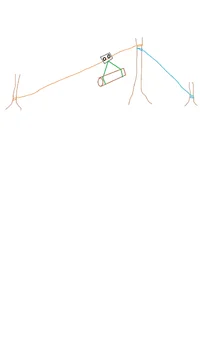
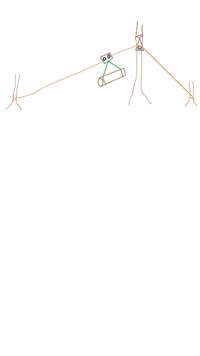
BacktieFixed.webp Backtiefloating.webp
 
Might be simpler to terminate the speed line to the trunk in the middle of the rope, rather than with a block. If you are stripping a single stem tree, a mid-line girth hitched rope, might be easy to choke and release to reposition, leaving you with rope coming to the landing zone, and rope to the guy-anchor.

Alternately, using a tensionless anchor midline could do the same thing. Take a bight, make a few wraps above a stub, and secure then end. The climber can release as soon at the piece is on the ground, and can get ready to move it, while the ground crew gets lines slacked and untied.
 
Alternately, using a tensionless anchor midline could do the same thing. Take a bight, make a few wraps above a stub, and secure then end. The climber can release as soon at the piece is on the ground, and can get ready to move it, while the ground crew gets lines slacked and untied.

How many wraps would work?

how about the bidirectional aspects of the back stay acting on that?
 
I've never used or even considered the need for either of these applications. Though I think I would give the block technique a go if I ever felt the necessity to go that route. Advantages: one attachment to move, and one rope for groundies to pretension.
 
Oh I've thought of more... The pretension could be made by what ever mechanical advantage system you use on the back tie side and then be left with out having to remove in worries of smashing with wood.
 
How many wraps would work?

how about the bidirectional aspects of the back stay acting on that?

tensionless_anchor.jpg

Just experiment. Amount of wraps will be like with a portawrap/ LD, load-dependent. What I'm suggesting would have a bight in the middle, rather than working at the end of the rope.

It just splits one rope into two systems.

What kind of trees are you dealing with?

I would figure it might be anchored above you 10'+, allowing the guy line to be tensioned and left. Less length of rope to work with on both sides, resulting in a guy line that is independent of the speed line.

Its going to be very situationally dependent. Look at the vectors between your trunk and anchors.

As was said, moving a block mean one thing to move, one line to tension. There's value in that, as there is with a 'fixed' guy line.

With a tipped tree, you might need two guy lines leap-frogged up the tree, in order to keep tension on it, while zipping small pieces off. Your guying force will be dependent on speedline force.

Trade-offs.


You can also redirect forces within the tree, to prevent lateral loading on a bad fork, or whatnot. Xman showed a diagram, IIRC.
 
Last edited:
I think the guying rope could be placed a little higher up and tied to the tree, or loped around the trunk with both ends tied off the the base of the anchor tree(double rope so less stretch and maybe tossed and set from the ground). That way the climber only has to move the zip line around and could switch between using that rope for lowering or zipping at will.
 
Just wondering what the job is that you are doing this?

The only time I've had to back tie my zip line tree was during storm damage clean up.

We were cleaning up (removing) a tree that got really busted up so we used a separate tree behind it as our t.i.p. This tree was kind of skinny for the pieces we were pulling out with the zip line and there was going to be lots of pulling, so we back anchored it.
Where the crown broke and hung up sort of depicted what we took.

Normally if I'm zipping I take pieces the t.i.p can hold as you can pic where you cut.

So what are you getting into that the tree can't stand up for itself?
 

New threads New posts

Back
Top Bottom