
I had to remove a 24" 75' Red Oak 2 day. We decided to speed line all most all of it. The only real obsticle was a bunch of thick Buckthorn which would have made removing the debris difficult. It was a lot of fun seeing our plan work out so well seeing how I only speed line a few times a year. We took a few photos but it is very cloady 2 day. I'll try to post them during the week.

Navigation
Install the app
How to install the app on iOS
Follow along with the video below to see how to install our site as a web app on your home screen.
Note: This feature may not be available in some browsers.
More options
You are using an out of date browser. It may not display this or other websites correctly.
You should upgrade or use an alternative browser.
You should upgrade or use an alternative browser.
Speed Line
- Thread starter tod_k
- Start date
Hi, Tod;
What is it about speed lining that you only use it a few times a year? Was there another reason besides easing the difficulty of cleaning up and tearing up the buckthorns that made you decide to use this technique? How did you determine the sizes of pieces to remove when using a speed line? Did you remove the trunk wood using a speed line as well? Where was your rigging point located? Did you need to relocate it? Did you use an anchor point of any sort? If so, what? How was the speed line tensioned? Did you have fun!?
I think 10 questions are enough to ask for now, don't you think so too?
Joe
What is it about speed lining that you only use it a few times a year? Was there another reason besides easing the difficulty of cleaning up and tearing up the buckthorns that made you decide to use this technique? How did you determine the sizes of pieces to remove when using a speed line? Did you remove the trunk wood using a speed line as well? Where was your rigging point located? Did you need to relocate it? Did you use an anchor point of any sort? If so, what? How was the speed line tensioned? Did you have fun!?
I think 10 questions are enough to ask for now, don't you think so too?
Joe
Joe, We do not do too much speed lining because often our trees are not tall enough and have too much spread. I have found in these situations it is difficult to have the control of the loads that I like. We decided to zip this one because of several reasons. One was because of clean up. The tree also had alot of decay at the base and a strong lean because of heaving. The landing zone was opposite of the lean and there was a good anchor tree and a clear path.I was able to tie into a White Oak. The speed line pulled the tree in the opposite direction of the lean acting like a stablizing line. I was worried about this tree failing because of the heaving, so I would rig a piece set up a step cut, then I would get out of the way. Then the ground crew would tighten the line with a GRCS, the load would pop off and a rope man on the haulback line would let it down. On the spar I took a few pieces into the haulback then transfered then into the speed line. The rest was cut and fly. I had a great crew and it was a ton o fun.
You can find a few answers here:
http://www.treevolution.co.uk/documents/speedline.htm
http://www.treevolution.co.uk/documents/speedline.htm
Tod: thanks for the description. Does this mean your rigging point was in yet another tree besides the white oak you used as a tie in point? I get the anchor point for the grcs. Also, I'm having a tough time imagining what the pieces looked like when you used a step cut. I keep seeing horizontal type limbs being removed at this stage. I'm glad you're talking about it and you had fun. It gets me fired up to do some rigging.
Ghivelder: thanks for posting the link. I'm always interested in reading material about rigging, especially, when it's consistent with what I've learned about the subject. The quick history lesson makes me wonder why I didn't learn about speed lining earlier in my career.
Joe
Ghivelder: thanks for posting the link. I'm always interested in reading material about rigging, especially, when it's consistent with what I've learned about the subject. The quick history lesson makes me wonder why I didn't learn about speed lining earlier in my career.
Joe
Joe, the speed line was anchored to the tree being removed, it went through a block and tied off to the ground. ( this reduces the forces on the top). How you invisioned the step cuts of the limbs is just about right. I used two loopies from the rigging plate to balance the limbs. Then Blocked the wood down and transferred it to the speed line.

- Location
- Ontario, Canada
What ropes are being used for speed lining?
I haven't had the need to speed line much but the rope I have for that purpose is static kernmantle.
I haven't had the need to speed line much but the rope I have for that purpose is static kernmantle.
</font><blockquote><font class="small">In reply to:</font><hr />
the speed line was anchored to the tree being removed, it went through a block and tied off to the ground. ( this reduces the forces on the top)
[/ QUOTE ]
ummmm..... correct me if I'm wrong, but I would think this would increase forces on the top of the tree, not reduce them. I'm imagining comparing this setup to SRT where the rope is set through a fork and tied off to the base of the tree. This doubles the force on your fork compared to simply tying directly to the fork with a running bowline.
the speed line was anchored to the tree being removed, it went through a block and tied off to the ground. ( this reduces the forces on the top)
[/ QUOTE ]
ummmm..... correct me if I'm wrong, but I would think this would increase forces on the top of the tree, not reduce them. I'm imagining comparing this setup to SRT where the rope is set through a fork and tied off to the base of the tree. This doubles the force on your fork compared to simply tying directly to the fork with a running bowline.

TheTreeSpyder
Branched out member
- Location
- Florida>>> USA
Brian would be right IMLHO, if that is how the system would be laced. The amount of increased leverage from coming to the ground 2x (once with each end as opposed to ending at top as Brian says), adding another leg of pull to the support. The amount of increased leverage could be determined as the secondary angle(a)/anchor load (L) in Dave's DWT calculator in The DWT Thread . The loading determined by the angle between the 2 legs of line, and the force of the load on one of them.
The primary angle(A) in calculator would be dip in line of speedline. The differance between this speed line lacing and DWT would be the slanted delivery of the line. The load and it's impact would only have so much (finite amount)force, on a speed line some of that is not pressing down perpendicularily onto the line but across it so forces incurred on the line are less. The result is the running down the line; any of that force that is running is subtracted from the possible force pressing down on line; just like running a load to the ground with Porty.
The running the speed line and its' forces against the lean is an excellent strategy; these forces would be lessened by taking heed to the squirrel's parallel comparison. Recognizing these patterns, and breaking the systems down into specific, predictable modules that interact is key i think.
The primary angle(A) in calculator would be dip in line of speedline. The differance between this speed line lacing and DWT would be the slanted delivery of the line. The load and it's impact would only have so much (finite amount)force, on a speed line some of that is not pressing down perpendicularily onto the line but across it so forces incurred on the line are less. The result is the running down the line; any of that force that is running is subtracted from the possible force pressing down on line; just like running a load to the ground with Porty.
The running the speed line and its' forces against the lean is an excellent strategy; these forces would be lessened by taking heed to the squirrel's parallel comparison. Recognizing these patterns, and breaking the systems down into specific, predictable modules that interact is key i think.
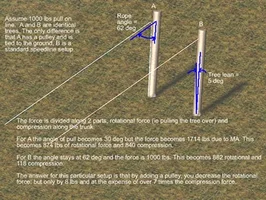
I do believe I reduced the forces on the pull of the speed line and I will try to explain why. The anchor point for the GRCS was quite a distance away from the tree to be removed.I would estimate The angle of deflection on the block was about 75 degrees giving the load factor of 122%. So I increased the load by about 20% but converted much of the wieght into compresion on the tree instead of side pull. We also tentioned the haul back line which also created more compresion intead of side pull. Plus adding a bunch of rope to the system helps reduce forces.

- Location
- georgetown ontario canada

Roger_Barnett
Participating member
- Location
- Seattle, in the PNWet
tod
In my studies of line characteristics, I've found that most static kernmantles have more stretch than any of our arbo lines, be they life or rigging lines.
In my studies of line characteristics, I've found that most static kernmantles have more stretch than any of our arbo lines, be they life or rigging lines.

I just saw a cool little tool that will be coming out in the near future, we used it today as a matter of fact. I will not let the cat out of the bag but I can tell you that a lot of this stuff has been "worked out" and there will be some new "portable stuff" at our disposal in the near future.
New threads New posts
-
test
-

-
-
 Fruit tree holding on by a thread, client wants to get another year out of it. Thoughts?
- Started by climbingmonkey24
- Replies: 1
-
-

-

