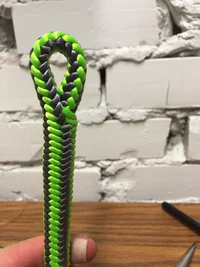
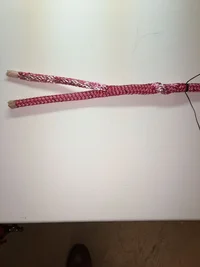
Show off them splices

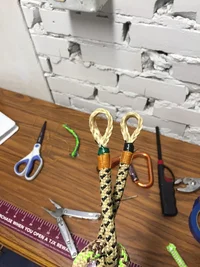
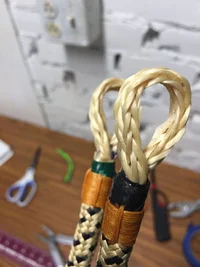
Looks like it broke at the end of one of the cover tail ends.
View attachment 45067
The top eye looks like it came close to pulling out. The bottom eye had the tapering started inside the locked brummel, as I didn't think it would bury back inside, but it easily did. The top one had the taper start after the brummel.
This is the core, the tip and outside are melted, as are the tips of the core strands.
View attachment 45068

Would it be typical for a standard braid splice to "come close" to slipping out during a break test? I've had several double braids of different sizes broken and never seen that before. I know this is a modified double braid splice that you did I'm just curious.
 
Also I got my tachyon splice back today too. I forgot to take a pic but it appeared to break right at the crossover in the throat if the eye. I stitched the crossover on both eyes pretty heavily to ease the burying process so that may be why it broke there. Just speculating
 
After performing an autopsy on the splices, I think what I initially thought of the tail trying to exit the bury, was in fact, recoil from the rope pulling apart. The slack, or bunching was locked in place after the snap by the broken ends semi-fusing together shortly after. Only the one splice, the larger diameter one, seemed to be affected.

Also found that the rope broke 41/2" before the end of the inner cover tail, and 2" after the inner core tail. I think I got sloppy tapering, because the break happened right where the diameter reduced too fast. It needed to be more gradual. I think it still would have broke somewhere in the same location, but might have held on a little longer with a better taper.
 
Brocky, that sounds about right from what I've read. On a good splice, the eye is so overbuilt it should never break. The bulk rope is hopefully just the same as it was before. The taper is the nutty crux of the whole thing, is the stress riser which will determine ultimate strength.

I found a paper the other night experimenting with fid length. They had to go down to something crazy like a <10x fid to get a splice to show slip failure. Splice efficiency was all in the taper, even with crazy stuff like half the normal bury.

Yeah, I'm bored and reading and waiting for my first batch of break results to come back...
 
gonna break.webp

When I contacted my local rope shattering factory, they suggested that I submit samples in triplicate to make it easier to interpret the results.

Two big takeaways:
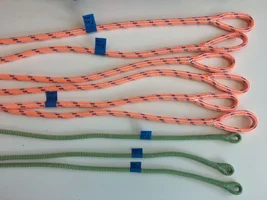
  • Three samples of Velocity = six eye slices, six opportunities to mess up, and all of them tested above the ANSI minimum. (5870, 6360, 6519 lbs) I screwed up and made the eyes too small, so they had to improvise to mount them for testing. None of them were pulled to destruction, I'm guessing because getting them mounted used too much travel. As a rank beginner, I'm happy with the results.

    "While the level of skill demanded of a splicer is not great, a sense of craftsmanship is essential" [1]

  • The Ocean Poly 8mm hitch cords (pulled end to end) tested at 4074, 3804, 4067 lbs. This was with a class 1 splice and Nick's modified sheath taper. Two broke at the throat, one broke at the top of the eye. I suspect this may be due to using a class 1 splice despite OP having an aramid/poly sheath. (See 4.1.4.2 in [1], below. I always thought that class 2 splices were to compensate for less strength in the sheath, but that implies it's more because the materials are just so different that you want to keep load off the sheath entirely?)
I did notice a weird "kink" in every single Velocity eye I made - seemed to be because of sheath deformation? I couldn't figure it out, or what was causing it. (Is this what people are talking about when they point out bag?) Ideas very welcome.

[1] Quote from A Review of Methods for Termination of Synthetic-Fiber Ropes. This 1975 Coast Guard report is an awesome read - I haven't seen anything like it for explaining WHY splices are done the way they are. It lists Kenneth Fogden (of Samson - inventor of double braid rope, and AFAICT the inventor of the double braid splice used to this day) and HA Hood (inventor of parallel yarn kernmantle rope) as technical advisors - about as authoritative as it gets.
 
Thanks for posting the link to the Coast Guard report, interesting reading. I wish the pictures were clearer to see what's going on.

I think you're right about the kinks resulting from distortion of the rope expanding where it enters itself.
 
Classes of rope are defined by the materials in construction.

A class II splice however is a core dependent high modulus braided core construction. OP is a Class II rope but not a core dependent one.


Reed Wortley
CA# SO-6953A
CTSP# 01739
 
View attachment 45199

When I contacted my local rope shattering factory, they suggested that I submit samples in triplicate to make it easier to interpret the results.

Two big takeaways:
  • Three samples of Velocity = six eye slices, six opportunities to mess up, and all of them tested above the ANSI minimum. (5870, 6360, 6519 lbs) I screwed up and made the eyes too small, so they had to improvise to mount them for testing. None of them were pulled to destruction, I'm guessing because getting them mounted used too much travel. As a rank beginner, I'm happy with the results.

    "While the level of skill demanded of a splicer is not great, a sense of craftsmanship is essential" [1]

  • The Ocean Poly 8mm hitch cords (pulled end to end) tested at 4074, 3804, 4067 lbs. This was with a class 1 splice and Nick's modified sheath taper. Two broke at the throat, one broke at the top of the eye. I suspect this may be due to using a class 1 splice despite OP having an aramid/poly sheath. (See 4.1.4.2 in [1], below. I always thought that class 2 splices were to compensate for less strength in the sheath, but that implies it's more because the materials are just so different that you want to keep load off the sheath entirely?)
I did notice a weird "kink" in every single Velocity eye I made - seemed to be because of sheath deformation? I couldn't figure it out, or what was causing it. (Is this what people are talking about when they point out bag?) Ideas very welcome.

[1] Quote from A Review of Methods for Termination of Synthetic-Fiber Ropes. This 1975 Coast Guard report is an awesome read - I haven't seen anything like it for explaining WHY splices are done the way they are. It lists Kenneth Fogden (of Samson - inventor of double braid rope, and AFAICT the inventor of the double braid splice used to this day) and HA Hood (inventor of parallel yarn kernmantle rope) as technical advisors - about as authoritative as it gets.

Did you have the 8mm OP broken in a basket configuration or a straight pull?
 
Did you have the 8mm OP broken in a basket configuration or a straight pull?

Nevermind my reading comprehension is sub par lol . If I'm not mistaken those are pretty good numbers for 8mm ocean polyester. It actually doesn't meet ansi standards of 5400 pounds tensile strength. But when used in a hitch configuration (basket). It far exceeds the ansi requirement.
 
Looks like it broke at the end of one of the cover tail ends.
View attachment 45067
The top eye looks like it came close to pulling out. The bottom eye had the tapering started inside the locked brummel, as I didn't think it would bury back inside, but it easily did. The top one had the taper start after the brummel.
This is the core, the tip and outside are melted, as are the tips of the core strands.
View attachment 45068

Care to share more about how you constructed that splice? It tested well.
I need new projects so that I can procrastinate learning how to splice 16 strand.
 
That splice is now patent pending and the above photos and descriptions will be deleted.

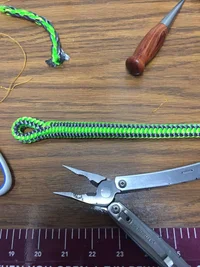
I was splicing 1/2" dbl braid, so used a 11" bury. On the first eye I found that it needed an extra 3/4" of cover with the increase in diameter. I gave the second eye 1" extra because it was going to be slightly bigger.

As usual anchor the rope a few feet down from the splice. Make sure the core and cover are equalized. Expose 3/4" of core from the end and milk the cover past the splice area towards the anchor point. 11" from the end of the cover either mark it, or as I did tie a double constrictor knot there.

Three strands from the constrictor I extracted the core. Two strands further down the core goes through the cover to start the locked brummel. Two more strands and the cover goes through the core, and then the core was buried for 3".
IMG_1136.webp
This is what it looks like at this point. Cut off extra core tail and taper the remaining tail and milk back inside cover. Next taper the cover.

Form the size eye you want and separate the cover strands and mark the core and then extract enough of the core to bury the 11" tail. Open up the core at the mark and bury the cover-core tail up to the constrictor knot.

Smooth it out and bury the core back into the cover.
With only a loss of 870 lbs of strength it seems to be promising.
 
That splice is now patent pending and the above photos and descriptions will be deleted.

I was splicing 1/2" dbl braid, so used a 11" bury. On the first eye I found that it needed an extra 3/4" of cover with the increase in diameter. I gave the second eye 1" extra because it was going to be slightly bigger.

As usual anchor the rope a few feet down from the splice. Make sure the core and cover are equalized. Expose 3/4" of core from the end and milk the cover past the splice area towards the anchor point. 11" from the end of the cover either mark it, or as I did tie a double constrictor knot there.

Three strands from the constrictor I extracted the core. Two strands further down the core goes through the cover to start the locked brummel. Two more strands and the cover goes through the core, and then the core was buried for 3".
View attachment 45657
This is what it looks like at this point. Cut off extra core tail and taper the remaining tail and milk back inside cover. Next taper the cover.

Form the size eye you want and separate the cover strands and mark the core and then extract enough of the core to bury the 11" tail. Open up the core at the mark and bury the cover-core tail up to the constrictor knot.

Smooth it out and bury the core back into the cover.
With only a loss of 870 lbs of strength it seems to be promising.

Oh? Patent pending?
Please pardon the prying and alliterative inclination that is about to be less technical and more personal (I realize that you're one of the bigger string nerds here and also one of the more outside-the-box thinkers, which naturally leads to the creation of unique intellectual property).

Why? Is it substantially quicker or easier than a standard double braid splice? I mean, if there is potential for people to produce substantially more product then I get that there may be a possibility for you to profit, but those pro splicers blast through the standard splice. Just because you can?

I'm going to sit down with some used 3/8 stable braid and see if I can pull one off. Thank you for sharing, and for tolerating my questions.

@96coal449
I feel that you're joking, but I also know that my wife would love it if some of my rope scraps disappeared...
 
Of course I'm joking .... but I am over my head in projects. My wife keeps asking me what am I doing with all the rope I have. I keep telling her each one is for a specific duty. Some are used in sappy trees, and etc. A few of them still are in reserve and brand new. That doesn't include the bags of ropes I bought last year with each order. She says the garage looks like a meat locker with all the hangin' hanks. :D
 
I got the idea for the patent from the Coast Guard report on Splicing that hatchetation posted. Not sure where you could make money by doing that.
This splice seems to be easier than the standard as there is no crossover to get just right, and my favorite part, no snagging of the core trying to bury the core along side itself.
I'm glad you're interested in trying it, that was my goal in posting, to get others to try it and hopefully improve on it, or be inspired to try a different method.
My next attempt at it will be to replace the locked brummel with sitiching, or possibly just do the tapers and just do a straight bury, as I'm not sure if the core and cover need to be locked together.
Good luck with it and stop procrastinating on the 16 strand splice.
 
hatchetation said:
I did notice a weird "kink" in every single Velocity eye I made - seemed to be because of sheath deformation? I couldn't figure it out, or what was causing it. (Is this what people are talking about when they point out bag?) Ideas very welcome.

I observed the same with larger eyes on Vortex. I don't notice the kink on tight eyes. Someone here pointed out the cover strands are pulled tight for the bury and if you follow them around the other side, you can see that is where the kink forms. I don't think that is what people refer to as a baggy eye, my understanding is that is more of excess cover in the eye.

i-7hBrGRG-M.jpg
 
Nice picture Ragnar, it distinctly shows the difference between these two conditions.
On the tight eyes, maybe the cover kinking gets stretched out by the tight bending of the eye.
 

New threads New posts

Kask Stihl NORTHEASTERN Arborists Wesspur TreeStuff.com Teufelberger Westminster X-Rigging Teufelberger
Back
Top Bottom