"Sag but not break" limb cutting

I want to find a reliable way to cut a limb so it sags slowly to a vertical or near vertical position without breaking free. I want to avoid the wild swing that takes place when the typical bottom cut followed by a top cut method is used. Any suggestions?
Why?


Coos Bay cut.
Max depth undercut (kerf) followed by a fast top cut (choose the size the saw as needed, possibly a rear- handle) more toward the butt of the branch than the undercut.
 
Why?


Coos Bay cut.
Max depth undercut (kerf) followed by a fast top cut (choose the size the saw as needed, possibly a rear- handle) more toward the butt of the branch than the undercut.
Guys I learned from call that a flat cut, as it's supposed to drop the limb flat, but I really like the way you think Sean. That is the $64,000 question here innit?
 
That Petzl Mechanical Advantage Rapid System that RNR sells for $1K truly is a thing of beauty.

I'd be hesitant to use any lifting system that's going to put the limb above me while pulling it toward the tree. If the cut end breaks free and falls, the limb will be headed in my direction. Using a MA system anchored above me to ease the limb down as it's being cut has a similar problem if the cut end breaks free before the limb is vertical. A lot of times I'm working with limbs high up, and there's nothing in the canopy above the limb I'd trust to support it.

After considering all the rigging approaches, I still want to find a way to let the limb sag slowly to a vertical position. I've seen so many broken limbs that are hanging from a horribly splintered (but still pretty strong) break as a result of storm action. I want to learn how to make that happen with my saw.

The Bender technique looks like the ticket, and I'm going to try it on my upcoming limb removal project.


The Coos Bay cut is hard to do with my razor saw and 24V 12" Kobalt.

 
For general consideration, thinking on the very valid points you make, if you set the rigging up over lots of branches, like arching over from the opposite side of the tree, all the way over the top, and then down through several smaller banch tips, or more sturdy through the middle of several branches, you might be able to spread the load out enough, AND get the rigging line to come down far enough away from the cut that if the cut fails too soon, it doesn't come at you. I have used this technique a few times, and it works like a treat. It's definitely not a quick setup unless you're a superstar with the throwline, but it hasn't let me down yet.
 
That Petzl Mechanical Advantage Rapid System that RNR sells for $1K truly is a thing of beauty.

I'd be hesitant to use any lifting system that's going to put the limb above me while pulling it toward the tree. If the cut end breaks free and falls, the limb will be headed in my direction. Using a MA system anchored above me to ease the limb down as it's being cut has a similar problem if the cut end breaks free before the limb is vertical. A lot of times I'm working with limbs high up, and there's nothing in the canopy above the limb I'd trust to support it.

After considering all the rigging approaches, I still want to find a way to let the limb sag slowly to a vertical position. I've seen so many broken limbs that are hanging from a horribly splintered (but still pretty strong) break as a result of storm action. I want to learn how to make that happen with my saw.

The Bender technique looks like the ticket, and I'm going to try it on my upcoming limb removal project.


The Coos Bay cut is hard to do with my razor saw and 24V 12" Kobalt.

That Petzl Mechanical Advantage Rapid System that RNR sells for $1K truly is a thing of beauty.

I'd be hesitant to use any lifting system that's going to put the limb above me while pulling it toward the tree. If the cut end breaks free and falls, the limb will be headed in my direction. Using a MA system anchored above me to ease the limb down as it's being cut has a similar problem if the cut end breaks free before the limb is vertical. A lot of times I'm working with limbs high up, and there's nothing in the canopy above the limb I'd trust to support it.

At the risk of sounding like I'm sponsored after my ropejack thread, I'd recommend the ropejack for such a task. Uses the rope you already have and is lightweight.

How long are the limbs you'd be lifting if you went that route? A 10' limb would just need a single pulley 10' above the cut. If you only tied 8' out you could get away with only 8' higher on the trunk. The further out on the limb you tie, the better leverage you'd have.

Most lifts as I described are very static, you can set the lift up several feet below your cut for safety. It's slower that way and requires more climbing up and down, but if your not in a hurry, it keeps you clear of the moving pieces.

Here is a good video by @Muggs that shows how slowly things move in these rigs.

Sent from my SM-S908U1 using Tapatalk
 
Great video, especially with the after-action comments. I was glad to see he got his ropes sorted out and moved away from the limb before it got near vertical.

Most of the limbs I deal with are fifteen to twenty feet long, and they wouldn't require more than a 2:1 MA, if that. I could use my extension pole to get the rigging ropes in place on the limb and above me.

One big advantage of the Bender method is that I won't need to take more stuff up the tree. That's always an issue since I work by myself.

I'll be keeping the other suggestions here in mind in case the need arises. There are so many things I'm already doing that I learned about on TreeBuzz. There are also a few things I don't do any more.
 
Last edited:
I mostly work on the various pines (longleaf and loblolly come to mind) and occasionally various oaks found in southwest Georgia. I'm definitely not a tree identification expert.

I try to avoid working on limbs large enough to cause serious injury or property damage if the cut goes wrong. Having more control over how limbs fall is my goal. A swinging limb could snag my climbing ropes, and that could be very inconvenient.
You could bag your rope. I used to sort of scoff at the idea, but after doing a lot of crane work, I really learned the value. Not all jobs really call for this, but there are plenty in which it’s super helpful for you as a climber and also very much so for the ground worker.
 
Last edited:
The right width and length of rope for the job is helpful. Less weight. Less to manage. Nice having a selection.

If its only a bail out in emergency line/ second life-support system (spike up and down removal) a person can get by with a much smaller rope than they might like for lots of rope pulling.

I climbed a lot on a 120' hank for a while. 55' redirect height/ base-tie would cover most canopy raises. Rarely do I work over 120'. The vast majority of the time, I can top a removal by 120'.
 
I'll reiterate about tree type basically chewy fibres vs crisp snapping wood. I've had hinges/cuts go completely meaningless in crisp brittle wood (yes that's a bad thing) and conversely had ridiculously small shoestrings of fiber suspend surprising amounts of weight, refusing to break when swung and tugged on.
 
I'll reiterate about tree type basically chewy fibres vs crisp snapping wood. I've had hinges/cuts go completely meaningless in crisp brittle wood (yes that's a bad thing) and conversely had ridiculously small shoestrings of fiber suspend surprising amounts of weight, refusing to break when swung and tugged on.
Either extreme is insanely frustrating. Our gray pines are ultra "chewy", and I see a lot of line clearance guys around here really underestimating how much. You can tell by the chewed up looking ends of branches on the ground and the nasty torn out strings going down the trunk.
 
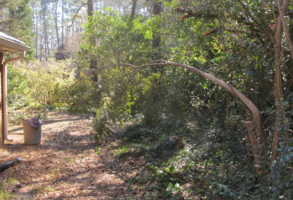
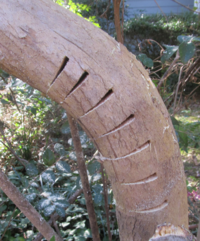
I haven't found a suitable limb yet, but I did use the Bender successfully on six overgrown shrubs alongside this house. I was able to pull them over and away from the gutter and roof edge with my extension pole.
1707025846454.png
1707025938492.png
The technique certainly made the job go smoothly. The multiple cuts also made the bend flexible in rotation, and that was especially important here.
 
Would you trust a mechanic who said "Not sure if that's a Ford or Toyota, but we'll get it fixed well either way"?
Absolutely! And amongst southern pines there’s a huge difference in lifespan and risk potential. Taken me a long while to ID the Shortleaf pine amongst Pitch and Virginia… the latter two are scrubby short lived tipovers, while the Shortleaf is much more stable.
 

New threads New posts

Kask Stihl NORTHEASTERN Arborists Wesspur TreeStuff.com Teufelberger Westminster X-Rigging Teufelberger
Back
Top Bottom