Rope access

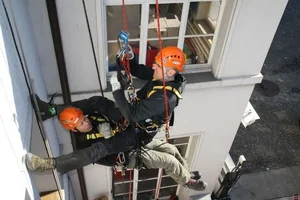
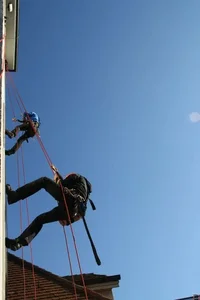
Last week we did an industrial rope access course. The different approach to work at height was really interesting. For one of course as soon as you leave our arb world all other high angle professions use double safety systems.

We were using ID for descending, Pantines, Crolls and Ascenders for ascending and the ASAP as back-up. Up until now I'd only used Rockers for this kind of work. And the ASAP... what can I say? It's a really great piece of kit that just trundles along behind you doing it's job if the need should occur.

Knut Foppe came down from Berlin to run the course which was great. Those of you who have met Knut will be able to confirm how knowledgeable he is about all work on rope related matters... by the end of the course the guys were all fired up.

For me the most important thing about this kind of training is how it stops things from going stale... it forces you to break out of routine and reconsider things you take as a given in your daily routine and re-examine them. And maybe carry on as you did before... or to try to incorporate some little thing into the other areas you work in.

Whatever...

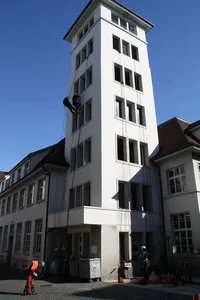
Attached is a pic of the tower we did the training on.

163464-IMG_2730.jpg
 

Attachments

  • 163464-IMG_2730.webp
    163464-IMG_2730.webp
    28.3 KB · Views: 120
I was lucky enough to take a high angle rescue course with some fire fighters. Much different indeed but I really enjoyed it. We could use more of their logic and assesment skills.
 
Back up while using static single line ascents with a seperate back up rope with asap (pull up twin ropes through you throw ball placement). Redundantancy is protocal with high angle rope work and rescue.
 
Yes, thank you Tod. However, perhaps I should rephrase my question... Is the ASAP practically applicable, necessary, and/or desirable for use in arboricultural climbing? Based on your exposure to the device, Mark? Tod? Or anyone else?
 
Norm,

I'll be in Providence. Looking forwards to meeting up.

Taylor,

I don't really see a practicable use of the ASAP in tree care, except maybe in ascent on a back-up line.

One of the reasons for this – and I'm sure you know this already – is the way the device functions: In case of a fall the device will run a distance before the clutch engages, then there's the elongation of the line and then the shock absorber deploys. All of this results in quite long arresting distances. Obviously in a busy structure such as a tree with lots of obstructions in the way of a falling person this is a problem.

Still fun working with gear that does what it's supposed to do in an elegant way.

Countryboypa,

We were tied into anchor point drilled into the concrete structures and/ or slings wrapped around railing. Double anchor points for each climber, with both lines tied into both points, so it's like a double back up on the anchors. Make sense?
 
The ASAP is really good for training as it follows the user both in ascent and descent really well, so you can forget all about it.

In practical work terms it is not my back up device of choice. The design of the cam is far too agressive towards the rope, luckily I have yet to use one in anger - or have one of our students use one! Lots of shredded sheath that can be problematic with rescue.

If you read the small print you should only use the device on a sewn end terminated rope - this is to do with the hight impact forces that can be genereated when those teeth jam in the rope sheath.

As mentioned the actual fall distance is quite high due to the clutch action and breack away webbing - other back up devices offer much smoother and shorter stopping distances.

And the clutch is a little prone to clogging/damage from grit (I imagine sap would kill it very quickly)

One thing to remember - falling that bit further to dissipate energy may result in a branch hit, but a fall that has no energy absorbtion can rupture your aorta or liver (watch out for those ropes with aramid and HMPT (Dyneem/Spectra) in them.)
 
So the obvious remedial action is to prevent the fall, seeing as there is no free space for a shock absorber to deploy into. This has been discussed at length in this forum and at a number of industry events.

Out of interest, what do you base your statements about the back-up devices on? Is this information written up anywhere? Like what back-up devices "offer shorter and smoother stopping distances"? Care to be a bit more specific?

Regards, Mark.
 
Hi Mark,

Definatley! That is the fundementla rule of working at height - don't fall in the first place!! :)

With regards to the choice of back up devices, that is based on personal experience. We have under 'controlled' conditions used both shock absorbing lanyards and EN 353-2 fall arrester devices. It is an imprecise science and I can only say what felt best for me. We usd a dummy for the ASAP drop as in previous tests with breakaway webbing on lanyards - they hurt!

I have not come accross many independent official test results logging the peak impact force and displacement for back up devices - the UK ones are IRTA based and are therefore very Petzl orientated http://www.hse.gov.uk/research/crr_pdf/2001/crr01364.pdf
(you may have to login for this - it's free though) The results are old and these days they do the test with a 5kg weight on the rope to simulate the same tension as a few meters of rope below you - it plays havoc with devices like the Rocker especially with regards to displacement.

As with all gear designed for use on rope, every device works better on one type of rope due to its construction, coating, diameter, etc so the selection to get the 'perfect' combination can be onerous. But lets be realistic though - it's like insurance, you never really want to use it so don't loose too much sleep over it!

My personal choice:
Mittelmann FD/2-12KM shock absorbing lanyard (great for fall factor 2 - though you will never see one in a tree)
Safet Tech STL-RGRC back up rope grab (even though we now manufacture this bit of kit, I've used it since it was the HB design)

Regards, Ben
 
Great pics, looks like you were blessed with the weather.

Took my level 1 IRATA a few years back. Despite much persistance on my part and obtaining my P.T.S., I found it extremely difficult to get any work within the rope access industry in the UK. Just wondering if anyone else has had similar experiences?

Thinking about retaking the level 1, my boss in Germany has recently started a rope access company in Frankfurt.
 

New threads New posts

Back
Top Bottom