Root Crown Burial

opposablethumb

New member
Location
Mid-Atlantic
Why do so many balled&burlapped trees from the nursery have their root crown buried in 2-6" of soil?

I've heard 2 explanations:

1. Moisture conservation, but this seems obviously false
2. It results from soil being mounded up on the trunks by mechanical soil cultivation to control weeds between the rows of trees

PHC wasn't invented yesterday. Why would growers use one cultural practice at the expense of another? It seems like tree growers would be on the same bandwagon as arborists regarding burying the root crown. Where is the disconnect?

Also, on a related note, does it seem that container grown (not containerized) trees seem to suffer less from Root Crown Burial Syndrome?
 
I went to a talk at the ISA SE conference a couple years back and they were saying #2 was the reason why it was mounded. I think a lot of the growers don't know and don't care. Just like the toppers out there. Also, if people keep buying b&b with buried root crowns there is no incentive for nurseries to improve their practices.

I had the opportunity to recently to be a part of a project planting 150 2 inch caliper bare root trees. We'll see about survival rates but they all seemed to have a ton more fine roots than b&b and it was so easy to make sure they were all planted at the proper depth. Light work too. They were all delivered in a pick up truck and handled by hand!

The container grown trees I have experience with have less RCBS but are kept in the pots so long you get all the girdling roots circling around the ball. I guess every method has its pluses and minuses.
 
Around here most commercial nursuries pay minimum wage.

Either buried, like you say, or containered, as we have all seen.

I've asked for 10 or so specific genus/species, and been fobbed off a couple that match and half a dozen close-but-no-cigar pretenders.

Run your nursury on minimum wage, this is what you get.

BUT: If you think you have to run your biz close to the bone, just try running a nursury.

I have a good friend who went and got a job as a nursury forehand, he can't make it work on the budget he's been given.

He knows the problems, can't find money to solve them.

He's in deep, keeps trying.


Northwind
 
Root crown burial and SGRs came to light many years ago from the pioneering work of Dr. Gary Johnson at the U of Minnesota. At the beginning of Gary's work he used a garden hose and a shop vac to do RCX. Some of the first trees that he cleaned up changed from having yellow-green/stunted leaves to full-on green/large, thick leaves in ONE season!

Gary took his research and results to the Minnesota Nursery and Landscape Association. He carried enough credibility into the meetings that they didn't shoot the messenger. Even though they knew what he was saying and acknowledged their complicity to the MNLA credit they took hold of the problem and started to make changes. Educating growers about the value of having good products and then using the quality as a selling point to end users paid off in better sales. What they taught wasn't that it would take more money to grow a good product but more good care.

In computer talk GIGO---garbage in garbage out.

It takes some guts and a stiff spine to inspect and refuse a load of nursery stock. Knowing that if the spring delivery isn't accepted there is a good chance that there won't be more to sell/install until fall. Gulp!
 
Tom, can you expand on your knowledge of that research? I don't see any publications from GJ relevant to plant depth. I have been given anecdotes about health improvements from root crown excavation, but have no evidence.

What are the physiological effects of buried root systems?

My incomplete understanding is this:
Planting too deep leads to primary root death by lack of aeration; adventitious roots develop to support the foliage, but decline is evident.

I think this is incomplete because I have excavated buried trees that have retained their primary root system and have sent new roots vertically towards the surface. Though alive and exploiting the vertical space, the trees are still symptomatic.

Is this just about the roots? Is there some basic physiological issue from having the root crown covered? Unventilated cambium?
 
Also, regarding the cause of burial: burial can be caused by repeated mistakes in sequential repotting during the early life of the tree. This is not an issue in field grown whips, but is obvious in trees that were containerized for 3+ years before being field planted.

Plants that have truly been neglected have obvious layered circling root systems you can see the outline of the pots in the root system: 3", 5", 8" circles of roots. These are often buried each time they are thrown into new pots. Finally, they are buried at planting. Doesn't seem like much depth change at one time, but three 2" repotting buries and a final 6" bury in the ground leads to 12" too deep. And this is BEFORE cultivation.
 
I have been dealing with a lot of trees that are buried too deep in my area. The area is expanding quickly so I joke that there are about 10,000. So far I have helped 7 since January.

I am finding at least 8-12 inches of soil mounding over the root flare not including mulch to be the norm. The secondary canopy decline/insect infestations become evidant at about 6 years. This is also the time for the blow overs to start occuring on smooth wall container trees.

I am finding advantagous roots in the upper 2 inches of mounded soil creating mats. You can roll them back like blankets. The canopy has limited growth, tip dieback, or heavy insect damage. Traditional signs of a root problem. Just looked at one today on a small pear. In the ground 6 years, suckers at the base, dug just a little and found a void in the root zone. The root ball is mobile in the soil and with a push I was able to crack the borders of the original pot it came in. The tree is 5"dbh.

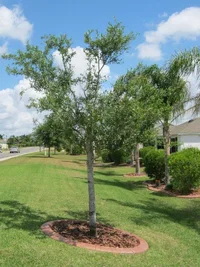
I will post pictures of a live oak that I just attended to today.

Side note: In the November 2010 issue of Arb in Urban Forestry there is a great article by Gillman on the Live oak study concerning root establishment. It covers small pots, large pots, cutting roots, and B&B. A must read.
 
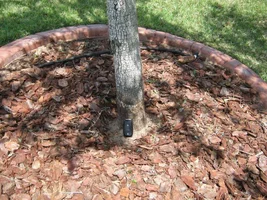
In this you can see the depth of the soil with some Arm. where the mulch base was. The sprinlker will be eliminated by the homeowner. It was orginally buried at the trunk flare and buried by soil.
 

Attachments

  • 278348-Depth.webp
    278348-Depth.webp
    313.9 KB · Views: 52
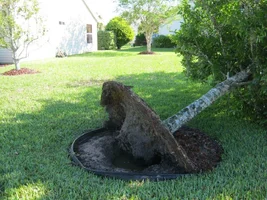
Laurel oak blow over at age 6 in the ground. Homeowner said it was a B&B. Roots say pot. Small planting hole. Fine roots holding the dinner plate together with landscape fabric and rocks over top.
 

Attachments

  • 278349-Blowover.webp
    278349-Blowover.webp
    246.1 KB · Views: 54
[ QUOTE ]
Tom, can you expand on your knowledge of that research? I don't see any publications from GJ relevant to plant depth.

[/ QUOTE ]You may not find any of his work related to managing the problem, either. Typical academic aloofness; describe without getting too involved. Or relevant to practice.
tongue.gif


Yes it is important not to bury stem tissue; most sp. cannot handle it well.

"I have been given anecdotes about health improvements from root crown excavation, but have no evidence."

Search the journal; studies there since the 1970s.
wink.gif


Anecdotal experience can indeed be valid evidence, too. If documented, it can be as useful as more formal research.

ISA contracted for a lit review; apparently still underway.
http://www.isa-arbor.com/education/portalToResearch/litReviewSeries.aspx
 
You can buy that pub if you want to, but caveat emptor--it has next to nothing about treatments, despite its claims:

"The purpose of this publication is to present an objective perspective of SGRs. Most importantly, this publication reviews the symptomology, potential causes, treatments..."

Yeah, right. All it says in one short paragraph is "don't cut them if they are big, because you might ^*%%$^& up."

"Although the extent is relatively uncertain"

Remember this is written in 2000

"...SGRs do cause damage and premature loss of trees or tree health. As with any other natural or unnatural stress, recognizing the problem and preventing future damage to urban trees are the practitioner’s responsibilities and goals."

Recognizing and preventing are all good, but Nothing is said about our PRIMARY goal, improving tree condition--except it's too uncertain to try. Maybe saying that in 2000 showed caution, but to say it in 2008 (as in the harvard paper) or now imo shows a distinct lack of awareness about the industry.

Rant over.
tongue.gif
 
[ QUOTE ]
In this you can see the depth of the soil with some Arm. where the mulch base was.

[/ QUOTE ]

Are you sure of that diagnosis? Mycelia of armillaria grow under, not over, the bark initially. that white stuff of yours looks like eczema tho i am not in your area so who knows? sounding test? fingernail test?

zevr, that "triple corkscrew" phenomenon is ugly i agree.

re research, see the journal stuff by susan day etc. and tate from 1980, which is cited in the attached practitioners' piece. comments/criticism always welcome; it'll get updated someday.
 

Attachments

[ QUOTE ]
[ QUOTE ]
In this you can see the depth of the soil with some Arm. where the mulch base was.

[/ QUOTE ]

Are you sure of that diagnosis? Mycelia of armillaria grow under, not over, the bark initially. that white stuff of yours looks like eczema tho i am not in your area so who knows? sounding test? fingernail test?

[/ QUOTE ]


Never was concerned nor entertained a negitive effect about the "white stuff". It is typical decay fungus found under mulch as it decays. The mulch was piled up to the trunk another 3"s above the soil line that you can see. To my understanding it grows in oxygen depleted environments. I guess my use of Armillaria should have been more generic as I could properly get it identified if I felt it a problem.

Any ideas of the typical decay fungus' that live in mulch beds?

Thanks for the correction.
 
[ QUOTE ]


Never was concerned nor entertained a negitive effect about the "white stuff".
Any ideas of the typical decay fungus' that live in mulch beds?

[/ QUOTE ]

]Looks like a Stereum sp. A bark rotter that can get into wood if tree has no defenses.

fingernail test can tell you a lot more than a book or a lab, to begin with anyway. Armillaria is a whole nother thing.
frown.gif
 

New threads New posts

Back
Top Bottom