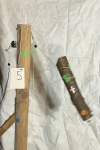
I was mentally sleeping a bit and now see your log accelerometer alone was 5 or 6x log weight so the tip load is mucho big. Pretty hard catch.
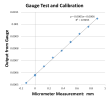
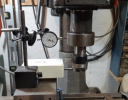
30 years ago I made a few load cells. All that good stuff like surface prep, we used cyanoacrylate with accelerator (surprised me - crazy glue!) matching gauge coefficients to the metal and hitting the target location. And then its "mostly" linear. And for a dose of humour, imagine in a Mr. Rogers voice "Can you say Transverse Sensitivity children?" Coolest integrated strain gauges I ever saw were in the fingers of a dexterous robotic hand, MIT or some such. I knew the poor buggers were struggling with zero drift because amplifiers weren't stable enough yet. Since then amps have self zeroing functions. Magic. We struggled with drifting zeroing. First mini cell I did was as long as the end of your thumb (last joint to nail tip). Wasn't very good. Young and dumb.
If you've got two load cells, anchor a rope on one, route the rope 180 degree U turn through the aerial friction device (i.e. like a rigging tip) and put the second load cell between a "puller" and the rope. That way you get the tension on either side of the device. You could get the tension ratios for the aerial friction devices you used. Would be enlightening. I used an advantage lever to crank up the force for my measurements. An added feature is a linear pot or some such to capture the rope travel as it stretches under load. I think, short of a porty, the highest ratio device on the market is the Morgan block at 5 to 10, or BMS Belay @2 1/2 wraps 18 I think.
Am I a nerd if this sort of thing breaks up the doldrums?
30 years ago I made a few load cells. All that good stuff like surface prep, we used cyanoacrylate with accelerator (surprised me - crazy glue!) matching gauge coefficients to the metal and hitting the target location. And then its "mostly" linear. And for a dose of humour, imagine in a Mr. Rogers voice "Can you say Transverse Sensitivity children?" Coolest integrated strain gauges I ever saw were in the fingers of a dexterous robotic hand, MIT or some such. I knew the poor buggers were struggling with zero drift because amplifiers weren't stable enough yet. Since then amps have self zeroing functions. Magic. We struggled with drifting zeroing. First mini cell I did was as long as the end of your thumb (last joint to nail tip). Wasn't very good. Young and dumb.
If you've got two load cells, anchor a rope on one, route the rope 180 degree U turn through the aerial friction device (i.e. like a rigging tip) and put the second load cell between a "puller" and the rope. That way you get the tension on either side of the device. You could get the tension ratios for the aerial friction devices you used. Would be enlightening. I used an advantage lever to crank up the force for my measurements. An added feature is a linear pot or some such to capture the rope travel as it stretches under load. I think, short of a porty, the highest ratio device on the market is the Morgan block at 5 to 10, or BMS Belay @2 1/2 wraps 18 I think.
Am I a nerd if this sort of thing breaks up the doldrums?
 I'm hoping to replicate it this summer with a bit better measures, and less wires that can be chewed by tree dwelling rodentia...