Matt Follett
New member
Hi Folks,
Long time since I posted here… in fact I was more active on forums many moons ago, not so much anymore.
Anyway, I recently had an article published in Arb News, and Mark suggested I post about it here, and indeed it’s good to get the word out on multiple platforms.
Some background, I’m a climbing arb with a few years under my belt; first working climb was 199something…. I also have a passion for research and am currently back “in school” pursing a PhD in some sort of biomechanics and trees thing . I have a big interest in trees and wind and the practical applications of pruning, and load reduction and general "stuff".
Buuuuutttt, as a climber I also have an interest in climber safety, and have some “side gigs” looking at some rigging dynamics.
Cut to the chase Matt… you’re dragging this out.
So we pulled off a fun project a while back that looked at rigging rings under a running rope scenario, and the while it’s been presented at a few conferences, the first written article is now out (more to come) in the Feb issue of Arborist News
Linky Link https://www.isa-arbor.com/Publications/Arborist-News
But for those that can’t access it (not ISA members), or want a short version, or more of causal discussion, I’ll post here from time to time, and try to keep it light and fun.
Rings and thimbles work… but they don’t solve all the problems of wood falling from the sky.
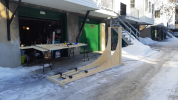
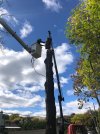
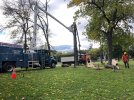
Here’s my experimental design. Basically I wanted it to be a real world as possible, so rather than putting a load cell between the block and the stem; I got some proxies through a bunch of other measures.
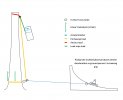
So we measured load at the porta wrap, stem strain (with some super cool homemade high resolution strain gauges (0.001mm resolution) ), and acceleration of the falling block.
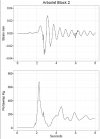
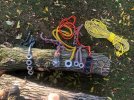
We tested 4 devices, a standard rotating block (DMM impact),a single #3 thimble, a double #2 thimble and a safebloc. Rope was a 9/16 Stable braid, and the piece was 187 kg, the run on the ram was 2.5 m. We got some cool results…
First off we saw a 50% reduction in load at the portawrap with the various ring things… which is as expected; you normally have to take wraps off compared to a block.
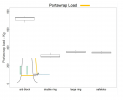
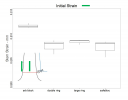
We saw a 1/3 reduction in stem strain with the ring things,
and a 1/3 reduction in our proxy for upper anchor load (take the porta wrap load and add the lead rope load (gained from the accelerometer )
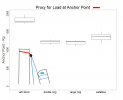
This would suggest we are burning off energy as heat in the rings…
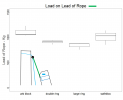
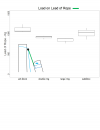
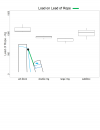
Here’s the kicker though… There was NO SIGNIFICANT difference in the lead rope load for the safebloc, and not much a a difference for the rest. So while we feel a reduction in the energy being put into the stem, and a smoother ride, the rope between the falling piece and the upper anchor is still subjected to the same loads, so it’s still a “fuse” and this is where we are continually tying on, and we still have to think about knots and cycles to failure etc! so yeah.
More to come! I’m putting together more results from a mass damping experiment where I looked at the sequence of branch removal in a negative rig… To be continued!
Long time since I posted here… in fact I was more active on forums many moons ago, not so much anymore.
Anyway, I recently had an article published in Arb News, and Mark suggested I post about it here, and indeed it’s good to get the word out on multiple platforms.
Some background, I’m a climbing arb with a few years under my belt; first working climb was 199something…
. I also have a passion for research and am currently back “in school” pursing a PhD in some sort of biomechanics and trees thing . I have a big interest in trees and wind and the practical applications of pruning, and load reduction and general "stuff".Buuuuutttt, as a climber I also have an interest in climber safety, and have some “side gigs” looking at some rigging dynamics.
Cut to the chase Matt… you’re dragging this out.
So we pulled off a fun project a while back that looked at rigging rings under a running rope scenario, and the while it’s been presented at a few conferences, the first written article is now out (more to come) in the Feb issue of Arborist News
Linky Link
https://www.isa-arbor.com/Publications/Arborist-NewsBut for those that can’t access it (not ISA members), or want a short version, or more of causal discussion, I’ll post here from time to time, and try to keep it light and fun.
Rings and thimbles work… but they don’t solve all the problems of wood falling from the sky.
Here’s my experimental design. Basically I wanted it to be a real world as possible, so rather than putting a load cell between the block and the stem; I got some proxies through a bunch of other measures.
So we measured load at the porta wrap, stem strain (with some super cool homemade high resolution strain gauges (0.001mm resolution) ), and acceleration of the falling block.
We tested 4 devices, a standard rotating block (DMM impact),a single #3 thimble, a double #2 thimble and a safebloc. Rope was a 9/16 Stable braid, and the piece was 187 kg, the run on the ram was 2.5 m. We got some cool results…
First off we saw a 50% reduction in load at the portawrap with the various ring things… which is as expected; you normally have to take wraps off compared to a block.
We saw a 1/3 reduction in stem strain with the ring things,
and a 1/3 reduction in our proxy for upper anchor load (take the porta wrap load and add the lead rope load (gained from the accelerometer )
This would suggest we are burning off energy as heat in the rings…
Here’s the kicker though… There was NO SIGNIFICANT difference in the lead rope load for the safebloc, and not much a a difference for the rest. So while we feel a reduction in the energy being put into the stem, and a smoother ride, the rope between the falling piece and the upper anchor is still subjected to the same loads, so it’s still a “fuse” and this is where we are continually tying on, and we still have to think about knots and cycles to failure etc! so yeah.
More to come! I’m putting together more results from a mass damping experiment where I looked at the sequence of branch removal in a negative rig… To be continued!
Attachments
Last edited:



 i'm all ears. I think we managed that by zeroing the dial each time, but hey.