Matt Follett
New member
Hey Folks,
Another article out this month in Arb News... this time looking at the effects of mass/aerodynamic damping in a rigging situation!
Much of what we know about damping in the crown comes from wind/tree interaction research, and although much of the work has used a mechanical input such as a "pluck test" pull and release, there has not been a lot of work looking at specifically rigging.
So this is just a start!
Here's a link to the other thread here, with some of the data collection methods discussed.
https://www.treebuzz.com/forum/threads/rigging-research-results.46427/
We used the robot groundie again and strain gauges and accelerometers and tension load cells in the rope... and got cool data!
Basically we worked our way up a live ash tree, dropping a pseudo top, recording motion, then removing a limb, and do it again!
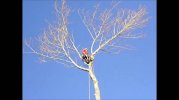
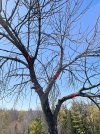
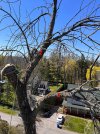
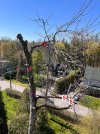
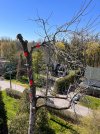
Here's the poor subject tree.
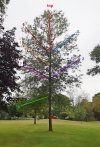
This time due to the long slender nature of the "top" instead of the plywood hinge to line up the piece, I made up this mid-evil "piece chucker" to align the top and control its flight path.
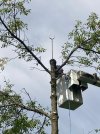
Poor tree... but hey, science right?
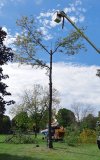
and some raw data...
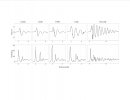
Top graph is the strain in the stem, bottom is the load in the porta wrap.
And of course... the relevant analysis.
Soooo!!!
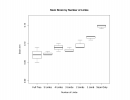
We see a nearly 35% reduction in stem strain through leaving those 2 small upper limbs!!! And 20% leaving one small limb that was less then 1/3rd the diameter of the "top"!!!
Remember that % number is this case specific... but this really points to leaving a few limbs on the stem below you on a negative rig.
Check out the article if you have access. and I'll be happy to chat shop here when I can!
Climb safe!
Matt
Another article out this month in Arb News... this time looking at the effects of mass/aerodynamic damping in a rigging situation!
Much of what we know about damping in the crown comes from wind/tree interaction research, and although much of the work has used a mechanical input such as a "pluck test" pull and release, there has not been a lot of work looking at specifically rigging.
So this is just a start!
Here's a link to the other thread here, with some of the data collection methods discussed.
https://www.treebuzz.com/forum/threads/rigging-research-results.46427/
We used the robot groundie again
and strain gauges and accelerometers and tension load cells in the rope... and got cool data! Basically we worked our way up a live ash tree, dropping a pseudo top, recording motion, then removing a limb, and do it again!
Here's the poor subject tree.
This time due to the long slender nature of the "top" instead of the plywood hinge to line up the piece, I made up this mid-evil "piece chucker" to align the top and control its flight path.
Poor tree... but hey, science right?
and some raw data...
Top graph is the strain in the stem, bottom is the load in the porta wrap.
And of course... the relevant analysis.
Soooo!!!
We see a nearly 35% reduction in stem strain through leaving those 2 small upper limbs!!! And 20% leaving one small limb that was less then 1/3rd the diameter of the "top"!!!
Remember that % number is this case specific... but this really points to leaving a few limbs on the stem below you on a negative rig.
Check out the article if you have access. and I'll be happy to chat shop here when I can!
Climb safe!
Matt
Last edited: