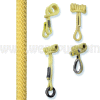
Rigging Prusiks - A General Discussion

27RMT0N

Been here much more than a while
Location
WA
Just now I did a search for 'rigging prusik' and found almost no specific information. I like the idea of making this forum a searchable repository for information on our trade, so I figure this is a good time to start a discussion on the topic. Please contribute any thoughts or experience you have.

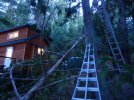
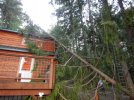
So I looked at a job today that is a partially uprooted doug fir leaning on a house. There is a much larger fir nearby that makes for a great rigging point to lift and swing the leaning fir away, and it would be the perfect scenario for a GRCS or similar device. I might just buy one in the next day or two, but obviously it got me thinking about how to lift a tree without such a tool. Here is the tree in question:
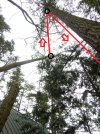
00  rigging plan 02.jpg

I have dealt with similar situations in the past and what I do with the tools I do have, is hang a high block, then put a port-a-wrap on the base of the tree along with a Wyeth Scott - More Power Puller. A 5/8" lowering line is tied to the tree, run through the high block and held by a 1/2" Tenex rigging prusik from Wesspur. With the More Power Puller (great tool by the way) I pull the line down, lifting the tree off the house, and then capturing the progress on the port-a-wrap, as it is a can't-fail back-up system. It is essentially the same method as the winch attachment for the Stein RCW-3001, which is where I got the idea from.
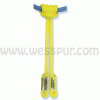
rig402-500.gif

DSCN1505 (Custom).JPG

DSCN1510 (Custom).JPG

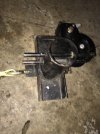
There you can see the setup: port-a-wrap on the left behind the ladder, puller and prusik on the right. Set the prusik as high as possible, lift the piece, capture progress on the port-a-wrap, move the prusik up again and with the second stage of lifting (maybe 6' total of rope pull/stretch in this particular situation) the top did lift up, swung away from the house and could be lowered to the ground on the already rigged port-a-wrap. Obviously there are many links in the system, but to me the biggest wild-card is the rigging prusik and its holding ability. Skinny western red cedar tops like this are pretty light and I'd be surprised if I put more than 300 pounds on the system here, but I don't currently have a way to measure those forces. This obviously brings up the question of what the safe limit is.

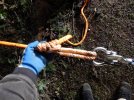
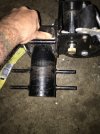
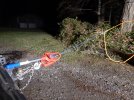
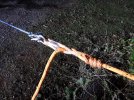
Tonight I decided to play around with it and see what I could learn. To make it as close to what I'd do in the real world, I tied a running bowline on a big fir, attached the rigging prusik to the line, and put a shackle in the eyes of the prusik. That was then attached with the Wyeth Scott - More Power Puller and a grade-70 chain on the hitch to my F350 diesel truck. The truck with its box and tools probably weighs around 7,500 pounds.
DSCN5857 (Custom).JPG

DSCN5842 (Custom).JPG

DSCN5860 (Custom).JPG

With both prusik knots I had identical results. Once the prusiks grabbed the rope (and I tried this on both a well worn 5/8" Samson Stable Braid and a brand new 5/8" Yale Polydyne) it pulled every part of the system tight enough to feel rock-hard, and moved the truck about 2". Both prusik knots held 100%, didn't slip at all nor showed any signs of wear afterwards. Admittedly most of the truck movement was the sit-back in the transmission, but if I had to guess, I probably put 1,000-2,000 pounds of force on the system and the prusiks obviously could have both taken much more if I'd kept going. I didn't want to push it tonight; but maybe when I have a scale to take accurate measurements I'll do more experimentation and make a video or at least a post about it.

It isn't often that I use a rigging prusik, but when I do it is always a critical situation. Clearly something I should have more empirical evidence about. Sometimes it is possible to just use a mid-line knot like a bowline-on-a-bight or alpine butterfly, but in other situations a prusick that you can tie, load, release and advance is the only solution, and is something I am trying to better understand.

If you use rigging prusiks, feel free to share how you utilize them, safe practices, thoughts and other helpful observations.
 
Last edited:
When I'm lifting or pulling its my preference to use a piggy back system.

A bollard is set and the lift rope is rigged to it. Then your MA/winch is put on top with a prusik like you did. THe other end of the puller or MA is anchored to the eye on the top of the bollard. As you take slack it's captured by re-reeving the slack.

This way you can pull in, do the lift. Hold what you've lifted and slack-out the MA or winch. If your prusik slips the slack will have been captured at the bollard.
 
In olde rope speak, you take/hold the rope 'purchase' or pay it out. >>Taking purchase moves load and/or tensions line to.
i think that more 'component' system of separate purchase to 'bank' as Tom says is best vs. the all-in-one (AIO in computer speak) of compression jig and hold utility functions together. This also affords keeping Prusik closer, compressing in segments to end of Prusik run and then re-extend on mainline (garden rake with smooth teeth or wrapped can help extend beyond arm reach).
.
ABoK also lends that at sea, sailor's did NOT talk of 'knots' so much but rather called out the root utility functions reaching for of turn, belay, stopper, purchase, hold/make fast(secure) before 'cast-off' to release. Knot mechanix just afford those raw/base targets. They loaded rope onto a great ship, but called it a line in usage. To me, that means visualized a raw line/linear of force utility, and so my imageries over the years as tried to command.
.
See collective frictions as a friction buffer; leverages against efforts to handicap purchase into bank (BUT no reduction in reciprocal speed differential); but does leverage in our favor to keep or controlled payout purchase from 'bank'/warehouse stock.
.
i would have auto-tending safety Prusik, may have 2 Prusiks at that stage, or any. If single may even have slip knot stopper under Prusik, maintaining to the 2-is-1, 1-is-None safety architecture mantra in that way.
.
i have done a lifts like this powered by 1 ton truck like perhaps one anchored to, into 3/1 against load many times. Redirect pull to low pulley, so rope never lifts up on back of heavily loaded truck that is on good ground for positive grab w/plenty of gas. Prusik auto tend safetys to load side of lower redirect in case of truck fail. Even intermittent truck chock movements as safety limiter, a few times playing around even had truck dragging railroad tie that had kinda wedge side profile behind own truck tires in case there was a problem. Tested with other truck pulling main backwards into RR tie chock and locked well, hitting fairly hard w/impact. Redirect also affords more facing than pulling away from work rather than over shoulder or backing up to watch what doing besides being guided by others, but LONG rope giving plenty of clearance for this game. In 3/1 pulls may need reset anyway, so all safetys and Prusiks hold for that resetting to re-ratchet another pull.
.
Playing with power, just did it gingerly with plenty of overwhelming reserve power band, not fluttering on the edge of power band, but rather gentle giant to the load that we could totally overwhelm as long as load could not invoke speed multiplier. E=MCsquared, it is speed squared as dynamic multiplier of the static Mass, giving impact hammer from lighter weight. Can press hammer head harder onto a bathroom scale hand choked to head, than hammer extended full length, but extended takes the lesser leverage that gives speed reciprocal and capitalizes on that end of the reciprocal yin/yang total force input power combinations possible.
.
Load shown is fairly positive action, but on many other would have extra man working single rope thru frictions that could hold separately if the more dynamic/lift line had any kind of hiccup, even on truck pull. Even if after a friction device have where man could take or relieve other frictions on other trunks as needed on the fly in emergency if can. Might need swigger/sweater at some points right before main frictions in 'taking purchase to hold fast'.
.
In pulls up/off houses etc. i always bind base, as pivot, back towards house(even if rip partial or full connection for no slide or even play) so assure get the pivot /lift rather than slide back by pivot as response, unless that is what am trying to extrude from the system. In which case might be pulling definitively heavier pivot end away from house with truck as lift or in stages back and forth, need smooth uninterrupted ground, as system will seek to hang on any deformity can lock into, including ground ploughed by the drag of this pivot.
.
THEORY: Seeing as the Prusik is a dual legged device/splitting load at legs, and is grabbing a single column of full loaded rope (mainline) as host;
The Prusik should be smaller and or tighter construction
>>to really mechanically impose well/grab and dent the more fully loaded single line with the half loaded duals of Prusik most positively.
.
Single leg pull Tautline , Blake's etc. are more matching, diameter and tensions to matching rigidities to gain control. But lesser rigidity of half loaded Prusik leg grabbing equal diameter fully loaded host of rope column example, Prusik is less rigid tension x diameter x material x construction. Adjust diameter x material x construction to bring half loaded tension to matching or greater rigidity total against host mainline.
Matching-or-denser-force-nipping-other-friction-hitches.png
 
Last edited:
Sewn eye prusiks made of Tenex? Whatever works I guess.

I’ll try to find a pic of my bollard lowering device with winch, or I’ll take a pic tonight when I get home. It’s similar to the Stein RCW 3001, in fact I totally borrowed the idea from it. It’ll lift maybe 600lbs but I use it more for hard pretensioning than lifting.

That More Power Puller gadget looks pretty heavy duty!
 
Found a pic, it’s just a small boat trailer winch bolted to the side of the I beam that’s the base of the device. The winch handle couldn’t rotate without hitting the bollard, so welded the nut in place and use a 15” ratchet and socket as a handle.
6BBEAC23-5C37-452D-AE14-E2737703F17C.jpeg4B0144DC-7689-4207-9C8A-38712B43CDDD.jpeg
 
I’m not sure if it’ll help in your situation, but a favorite rigging prusik setup of mine is using a Blake’s hitch to attach one rigging line to another. When needing two lines to swing material in a controlled fashion so you don’t bust up a tree you’re rigging from, this method is great because you don’t have to untie/retie two lines every time. Slide the Blake’s away to make a longer tail, tie the knot, slide the Blake’s tight against, and let er fly. Slide away to untie. A benefit of the Blake’s hitch is how easy it breaks friction when you need it to, but holds during the rig. Another benefit is not needing a stopper at the block when tying the next piece. When blocking down a spar, I find a standard dead eye sling at the block easiest to use in this system, since pulling the rope from a block would require untying and stowing two ropes each time, nullifying the advantage.

One thing to watch for is rigging through a lot of brush. I’ve had the Blake’s hit a fork and start paying out. It’s not a safety risk, just changes the lowering angle and makes for a frustrating haulback.

Again, I’m not sure if this will help your specific situation, but I thought it would be nice to have the option listed.
 
Not sure what serf life tagged me for, but here's my $.02.

We use a 5:1 pretty frequently for lifting situations like what was posted. two double blocks, with a prussic capturing progress on the haul. Clipped onto the porty top eye. Another prussic to grab the host/ rigging line.

One hauls away while the other tends slack off the porty, works sweet with no slack this way. can be done solo, just slower

For prussics, I prefer ice tail or tenex. They deform to grip host line better than any other I've used, esp. On 1/2" line. The hitch gets pushed up with a pole saw head. I like a VT as it pushes up smoothly. If you need to reset, take up all slack, slack the 5:1 hitch, then ADVANCE the VT. That resets the tension, allowing you to then drag the hitch down with a pole saw head.

GRCS is totally faster, but maybe $2500 more expensive. Solo, maybe worth it. With competent people, not totally necessary.

Bottom line, GRCS is a great tool if you got one. If you're going to use a hitch for lifting I'd recommend a 12 strand hollow braid, and a vt, set and retrieved with a pole saw.
 
Last edited:
I appreciate the thoughts everyone.

The project in my first image is what really got me thinking deeper about how much weight a rigging prusik can hold safely, which is why I did those quick pulling tests at my shop. Obviously what one can safely hold is going to be HIGHLY dependent on the rope, the prusik material, the knot used and a whole host of other variables. I'd love to be able to measure the forces and see if/when different systems slip and have seen some YouTube channels where termination knots, hardware and ropes are break tested, but none on prusik slippage.

A place I've used prusiks much more frequently is to put a pulley on a speedline to give some mechanical advantage when tensioning the line, where I use the 'Sterling's 5/16” RIT' with great results, but of course that isn't holding a lot of weight.

cli359-group-500.gif

And yes @Jonny the More Power Puller is a beast. 6,000 deadlift rating and with the synthetic line you get 35' of travel. A whole different class of tool than those $60 come-alongs with their built-in cables that give you like 12' to work with, but it is priced accordingly. I don't use it often, but it's great in the right situation.
 
i've noted 3/8" Tenex lays flat on arc around 1/2" line; laying flat like webbing on curve is preferable as less dimension to deform on the bent axis/lays flat.
Usually tho flat rope/webbing gets weaker tho in trade when go to make half Hitch etc., scrunches up the wide width to deform hard, reducing efficiency so well preserved in arc to much less than if were round rope. For round rope would not scrunch up to deform so drastically dropping efficiency.
BUT, Tenex after staying favorably flat on host mount's arc, seems to then flip the script and go more towards round than flat/scrunch in other parts of the knot! Does flat around the host line and carabiner; then round when want it too also seems, breaking a normal 'rule'/serving beyond expectation.
.
i do think Friction Hitch is proper, some like to say they are Bends/extensions/couplings. But the host line is just a ridden line, w/o controlling arc, at least not where the Friction Hitch is applied.
.
Usually w/o other influences, the limit on input for 5/1 compression jig is bodyweight.
All applied on dead hang, add more input by arm pull to anchor etc.
i do that part for speed, pretighten.
Finish/tweak by instead of grabbing from outside system to increase pull, grab hand hold inside system after first turn, where adds another 3x to the compression (after redirect).
Inventory now is full not partial bodyweight, plus effort into 5x Input + equal and opposite of effort autonomously inputted into 3x position.
Can go to stand in loop input and grab 3x input and lock down as leg lift into loop . So 5xBoyweight + 8x LEG effort (when needed), then impact.. This principle works in lots of things, and is one of most powerful simple overlooked, over and over have seen!
Another factor is 5/1 compression can also be used for 4/1 lift from input. Effort wise as have shown, makes an 8xEffort compress or lift + bodyweight effects. Puts system on steroids.
 
Last edited:
Hello 27RMTON,
Here are some test results produced by others...
[ ] https://overtheedgerescue.com/rope-rescue/jigger-progress-capture-testing/
[ ] https://sterlingrope.com/logbook/117-friction-hitch-cord-testing-data
[ ] http://itrsonline.org/wordpress/wp-...A-Review-of-Friction-Hitch-Testing-_Evans.pdf
[ ] https://theverticalaxis.com/tests/
[ ] https://caves.org/section/vertical/nh/59/Slow Pull Testing of Progress Capture Devices.pdf
[ ] https://riggingforrescue.com/wp-content/uploads/2019/11/ITRS-2019-Gibbs-Mike-Digital-Paper.pdf
[ ] http://itrsonline.org/wordpress/wp-content/uploads/2015/04/Evans.2014.pdf

Video:
[ ]

A common theme with all of these tests is the mindset of the tester...in that the mind of the tester is typically directed to looking only at MBS yield (pull-it-till-it-breaks).
It is rare for a tester to examine something other than MBS yield.
Interestingly, Evans (2014 ITRS report) did try to think outside the box and determine precisely where failure propagated from.
Note that some testers don't even bother to show the precise geometry of their test specimens - merely 'assuming' that others know precisely how their hitch was tied! Some don't report a lot of detail of the rope materials/brands/specs... or the diameter ratio between host and hitch cord.

It is hoped that one day, a tester might examine other aspects of the effects of load applied to a slide and grip hitch.
Such as:
[ ] jamming threshold (ie at what load does the hitch jam/fuse/weld - to the extent that it cant be loosened by finger strength)
[ ] progressive distortion of the hitch at various load milestones (with detailed photos)
[ ] sewn versus hand tied end terminations (effects)
[ ] slippage - which must be carefully defined and measured...eg marking the rope so a reference point is obtained for measurement...and at various load milestones

Also, and annoyingly, testers appear to work in isolation/ignorance of each other.
There is no effort to try to repeat the test result of others (thats how the scientific community works - others try to repeat the test results from published papers). I would say that the majority of testers are best classified as hobbyist/enthusiast category and don't follow the 'scientific method' (although some have made an effort - paticularly for ITRS papers).
 
Thanks AgentSmith for taking the time to compile this.
In physics a worry is that the observer can possibly modify the results of an expermient just by observing it . . .
In rope testing I have wondered about the effects of the various kinds of pull terminations on the machine side influencing say when/ how a spilce breaks - i.e. if the rope is knotted, sewn as Richard Mumford does, wound around a large post before knotting, if the post can turn freely or not, etc. I find watching these breaks interesting in terms of how much the core slips v.s. the cover and wonder how much this actually mimics, sometimes, an actual straight line pull on a long straight length of rope. Guess once you make it over 5K you're OK, but still my curiousity is piqued if not all the variables are controlled/ documented (or other wise "ignored" as with some kinds of other industry standardized test methods, as long as everyone does things the same way) . . .
I wanted to get this note in here because in a buncha videos, the camera just pans in on the break/ splice and you have no idea whats going on on the other end!
Maybe we need a TreeBuzz official rube goldberg rope/ splice pull testing recording sheet to document all the variables as a start?
 
Another thing to consider is having heavier duty rigging prussics from made for you. I had Wesspur make me some heavy duty rigging prussics a few years ago. They are longer than standard so they can have more wraps and are a larger diameter so they are appropriately sized when using thick ropes and so they have a higher strength. They don't come out of the toolbox often but they certainly inspire confidence when they do.
 
I certainly do find the rigging prusik used here (it's the 36" one) to be a little short, it sort of surprises me that Wesspur only has the one length for sale. Chatting with them about a custom length like you did is a good idea.

(edit: I was wrong, they have two, an 18" and 36")

Having a longer prusik (depending on the knot used) allows the same amount of force to be applied to a larger area of the rope it is attached to, making for a stronger connection that is also less likely to bind I would imagine. I actually saw a photo just yesterday on another forum where someone had a 5:1 or something attached to a rope with a single rope-grab to lift a tree. It obviously worked for him, but to me seemed like a lot of force to be putting on a very small section of of rope and I couldn't help but wonder if a beefy rigging prusik would have been the 'better' option.
 
Last edited:
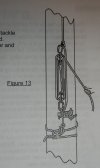
I bought a second port-a-wrap the other day and was looking through the manual which had this diagram:

0 porta lifting.jpg

Obviously this is the 'standard' way to lift with a porty and a few of you mentioned using this system in the tread here. The only reason I didn't do that myself in the original photos I attached is because I don't have an MA pully system like that so I used what I had at the time. And my big-ole Power Puller is too big/heavy/bulky to attach to the porty without it being frustrating. (a pully MA system is on my shopping list, just don't 'need' it often enough to have yet, and I did just buy a GRCS)

Anyways, what I noticed in reference to this thread was the use of a grab instead of a prusik on the line. And right after I came across this video:


~2,500 pounds for the rope grab to strip the rope causing failure, but I'd imagine it may be doing damage to the line before that point, you just can't see it. A prusik on the other hand, with a VT in particular, should slip at peak-load, not damaging the rope. Trade-offs to each I'm sure and to be honest I haven't had time to dig into all the links agent_smith put here, but I've skimmed a few.
 
I agree about he grab, back in the day the fiddle blocks were sold with a petzl microcender. We would do three man pulls and it did leave a noticeable dint in the line but never slipped.

Now I just use a purssic

If you just got a grcs, and work mostly solo from what I gather, I highly recommend getting a m18 super hawg to go with it. In low/low it pulls fast enough that you can have it pull on a 2:1 or very slow on a 3:1...
 
If you just got a grcs, and work mostly solo from what I gather, I highly recommend getting a m18 super hawg to go with it. In low/low it pulls fast enough that you can have it pull on a 2:1 or very slow on a 3:1...

This is deviating from the prusik discussion, but whatever :p Yah I'm certainly interested in that aspect of the GRCS and did order the drill attachment to start down that road, just hadn't gotten into the research about which battery drill to buy yet. Do you have experience with that Super Hawg? For moving material for longer distances and/or for hours at a time, I do have the gas powered Portable Winch, but I'm sure each tool has/will have it's own niche and I can never have too many pulling devices.

 
This is deviating from the prusik discussion, but whatever :p Yah I'm certainly interested in that aspect of the GRCS and did order the drill attachment to start down that road, just hadn't gotten into the research about which battery drill to buy yet. Do you have experience with that Super Hawg? For moving material for longer distances and/or for hours at a time, I do have the gas powered Portable Winch, but I'm sure each tool has/will have it's own niche and I can never have too many pulling devices.

Well you see I added in using a MA with the grcs with implies a prussic
I’ve never used any extra power other than the battery super hawg. Any time the grcs comes out to play I bring it. Obviously it really shines when you need to do a hard pull but then switch to lowering. I’ve done some yarding with it and it does eat batteries, you will want 2-3 and a place to charge then you can go all day with heavy use. I don’t think I’d recommend it for straight up yarding over a gas winch but I’ve never used one, and work with what I have.
 

New threads New posts

Kask Stihl NORTHEASTERN Arborists Wesspur TreeStuff.com Teufelberger Westminster X-Rigging Teufelberger
Back
Top Bottom