Removing a big maple that has been topped

Windwalker

New member
Location
Pine Grove, Pa
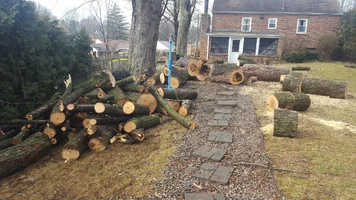
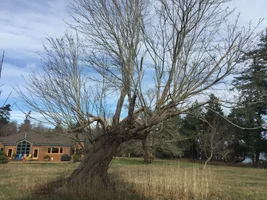
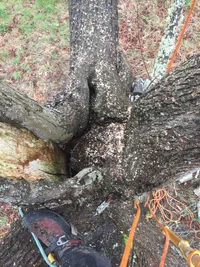
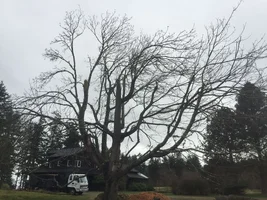
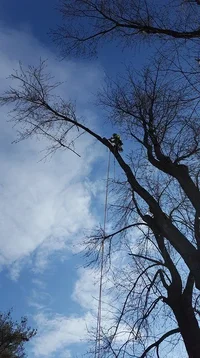
I removed the tree I'm standing at yesterday, these maples were topped many years ago. There is no main lead, rather multiple leads growing out the side of where it was topped. And of course there is a cavity where it was topped. There are a lot of holes and rot from previous limb removals. I'll be the first one to admit when I got up there it was worse that I would have liked and wasn't real comfortable with the situation. Luckily there was very little rigging. We only needed to bring the tips back to the trunk and I used multiple anchors to spread the forces and we could pretty much let it run to the ground. Everything went ok and I can say I was glad when it was on the ground. If you look at the tree behind the center one closest to the house you can get an idea of what the leads look like coming out of where it was topped. This is the next tree he wants removed. This one will require real rigging and I'm sorta nervous about that. Am I being overly cautious about rigging on those leads? I don't see getting started as much of a problem when there are a few to distribute the load, but when down to the last one or two, that seems kinda sketchy.
 

Attachments

  • 28125802_10116218426724724_1502689485_o.webp
    28125802_10116218426724724_1502689485_o.webp
    155.1 KB · Views: 85
  • 28191211_10116218427747674_657164299_n.webp
    28191211_10116218427747674_657164299_n.webp
    99.1 KB · Views: 83
  • 28081958_10116218429020124_214039206_o.webp
    28081958_10116218429020124_214039206_o.webp
    808.1 KB · Views: 90
Any chance of laying her right down in the yard, since that other tree is no longer in the way?

Like you said, use opposing leads to spread the force. Maybe on the last leader, use a truck as an anchor point or some other anchor to tighten up the stem slightly against its lean and even run your porty off it to create a better angle in an attempt to compress the wood.

If you truly don't feel comfy, let someone else with a bucket tear it up. No shame in that at all.
 
Any chance of laying her right down in the yard, since that other tree is no longer in the way?

Like you said, use opposing leads to spread the force. Maybe on the last leader, use a truck as an anchor point or some other anchor to tighten up the stem slightly against its lean and even run your porty off it to create a better angle in an attempt to compress the wood.

If you truly don't feel comfy, let someone else with a bucket tear it up. No shame in that at all.

Too tall to lay down,
Any chance of laying her right down in the yard, since that other tree is no longer in the way?

Like you said, use opposing leads to spread the force. Maybe on the last leader, use a truck as an anchor point or some other anchor to tighten up the stem slightly against its lean and even run your porty off it to create a better angle in an attempt to compress the wood.

If you truly don't feel comfy, let someone else with a bucket tear it up. No shame in that at all.

No chance to be laid down. In the last picture you can see a fence and arbs on the right, and the picture was taken from the door of a three car garage that covers all but 5' of the property width. No bucket truck getting in there, maybe one of those fancy spider lifts or a very large crane. Yeah I'm probably not comfortable with it, just trying to feel if others would be? I know I've looked at jobs that were dead trees that I wouldn't climb, to find out later that they hired another outfit that climbed it. So I know I'm probably overly cautious, but I'm happy and alive and that's where I want to be. I'd consider getting a contract climber in, and I may see if I can find one locally to take a look at it. He doesn't want to do it right away, so I have time.
 
Something to consider is the fact that they take quite a bit of force with leaves and a wind load and have survived so you will probably be safe. That being said this is the most dangerous profession there is. Trust your gut and don't do anything you are not comfortable with.
 
It kinda looks like in the picture there is a fair amount of air space on the left side of that tree. Is there any way to use your idea of spread the load, and like Mike said, find ways to create favorable angles to ground, and do that left side last, then work the left side with less redirects and more room to run?
 
I removed the tree I'm standing at yesterday, these maples were topped many years ago. There is no main lead, rather multiple leads growing out the side of where it was topped. And of course there is a cavity where it was topped. There are a lot of holes and rot from previous limb removals. I'll be the first one to admit when I got up there it was worse that I would have liked and wasn't real comfortable with the situation. Luckily there was very little rigging. We only needed to bring the tips back to the trunk and I used multiple anchors to spread the forces and we could pretty much let it run to the ground. Everything went ok and I can say I was glad when it was on the ground. If you look at the tree behind the center one closest to the house you can get an idea of what the leads look like coming out of where it was topped. This is the next tree he wants removed. This one will require real rigging and I'm sorta nervous about that. Am I being overly cautious about rigging on those leads? I don't see getting started as much of a problem when there are a few to distribute the load, but when down to the last one or two, that seems kinda sketchy.
Can you get a crane to it? Or is it too far ?
 
Something to consider is the fact that they take quite a bit of force with leaves and a wind load and have survived so you will probably be safe. That being said this is the most dangerous profession there is. Trust your gut and don't do anything you are not comfortable with.

True, but the reason we took the middle one out was because two limbs came down in the last 6 months. Seems like a ticking time bomb.
 
It kinda looks like in the picture there is a fair amount of air space on the left side of that tree. Is there any way to use your idea of spread the load, and like Mike said, find ways to create favorable angles to ground, and do that left side last, then work the left side with less redirects and more room to run?


The left side of the tree has the electric service, phone and cable going from the pole to the peak of the house. Having them removed would definitely help with more room. And agreed the limbs on the left have a more vertical stance to improve compression angles. I was thinking a speedline rigged through the garage (where the last picture is taken) but not having a central main stem makes me think side loading whats there would be more likely to cause failure.
 
It's hard to tell from the pics, can you set up your rigging in the remaining tree? Even with a long stretch between them, all you need is to swing the wood to the open area in between, that you just created with this removal
 
The left side of the tree has the electric service, phone and cable going from the pole to the peak of the house. Having them removed would definitely help with more room. And agreed the limbs on the left have a more vertical stance to improve compression angles. I was thinking a speedline rigged through the garage (where the last picture is taken) but not having a central main stem makes me think side loading whats there would be more likely to cause failure.

No harm in walking. However what I can see is that there is a lot of callus wood, which is freaky strong. I read where you cannot fell the tree out right. Perhaps redirect lowering line set up to pull the stems together, and just take small pieces. Don’t add any more friction than you have to, let them burn to the ground if you can. Or you could do what I’d do, and just walk.

I just walked on a bid. HO had a actively failing alder, open crack (actually looked like it was open for half the winter). Stems were flopped over. The only tie in was to the third stem which was simi vertical, but still part of the whole unit. I recommend a bucket, or spider lift. Then told them to block off the area and don’t walk to their house. Felt really bad as they are younger, have a 7 month old baby, and honestly it looks like it’s a actively creeping landslide (which is very realistic, also warned them to get a geologist on-site ASAP)
 
If you want good input, you could post a google maps link, if the pictures are good.


Inclusions?

Seems like they were possibly topped once, way back, and have survived for a long time.


Cranes are great and get a ton of work done quickly.
 
Here is a picture of the tree we removed. You can see the top of the tree behind it, which is the next tree set for removal. Gives an idea of what we're dealing with.

if you follow the left lead of the tree we removed at the top where the other leads come out, you can see on the left a lead is missing. There was a big cavity there, that unsoundness is what has me concerned. The right lead wasn't as bad and I climbed higher and dropped smaller pieces. The left required some rigging as stated in the OP.
 

Attachments

  • 27144656_10116026946792044_934263474_o.webp
    27144656_10116026946792044_934263474_o.webp
    126.2 KB · Views: 26
Rig small, compress wood in your rigging system.

A near vertical speedline, with a easy-to-slip anchor point (munter hitch slides at a low-load, 3 wraps on a POW is absolutely going to lock it off.), creating a big crash pad of brush to dump wood onto, MIGHT be in order. Pulling stuff out of the tangled pile with a winch or other powered-pulling method might be in order. If you can crash land stuff, not worrying about burning a natural-crotch rope on the job, you can keep you loads low and under enough control, often times. A lot of time, crashing on the tips absorbs the energy quite a bit, and you have control of the butt, kept up off the ground as needed. Personally, I self-lower a lot, over expecting a groundie to get it right. In a split-second, I"ll choose smash the fence over hurt the climber. Haven't had to, though.


How big of tops are you rigging out? What dimensions are the trees?


I've done some bad maples lately. I have life-support on one lead, rig onto another. When down to the the last spar, chunk it down as small/big as appropriate. Or work back and forth from two spars, alternating (time consuming). As you get a top and branches off, the load on the spar is greatly reduced, from reduced gravity. Some reasonable negative-rigging might be all it takes.
Rigging small, might mean less stress, and smaller gear, faster to install/ uninstall.

If you can get a tall tow-behind lift in there (5'???), would that help?
 

New threads New posts

Back
Top Bottom