Releasable Throw Weight

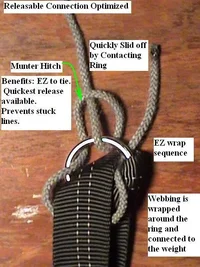
This describes how to construct a releasable-throw-weight. The webbing is tied to the metal ring as a simple wrap and connected to the weight by sewing, pop-rivet or lashing. The throw line is attached to the metal ring via a Munter Hitch followed by a wrap. When the weight is hanging or thrown, this configuration locks the line. This locking mechanism is the fireman belay, where a Munter Hitch descent is halted by tension applied below the knot. When the line is bounced or the ring is contacted with a downward force, the line feeds through the ring and releases the weight. There are two events that apply a downward pressure to the ring and release it. The ring is either stuck in a fork or the climber presses the ring to trigger a release. For example, it's a good idea to remove the weight before a pullback. When the climber executes this release, the weight slides off the line swiftly. This is a quick technique for removing a weight from a throwline and leaving a smooth line for pull back. It's a simple method once the knotting sequence becomes part of muscle memory - as is typical in climbing skills.

 

Attachments

  • 69452-2007ReleasableThrowWeightOptimized.webp
    69452-2007ReleasableThrowWeightOptimized.webp
    63.4 KB · Views: 239
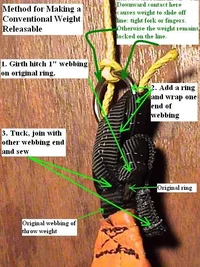
This configuration shows how to attach 1 inch nylon webbing to a conventional throw weight, forming a releasable connection with the throwline. The tying sequence begins with a girth hitch to the original ring. One end wraps a new ring. That's tucked through the original ring. Finally it's sewn to the other webbing end.

If these posting sound familiar to someone, I had posted the concept several months ago, using other materials than webbing. Webbing appears to be the best material. A simple wrap on the ring provides the mechanical device that cinches the weight on the throwline.

Here's a link where the pics may show-up with more resolution.

http://www.treeclimbercoalition.org/foru...;t_status=sNYfR
 

Attachments

  • 69453-2007MethodforMakingaConventionalThrowWeightReleasable.webp
    69453-2007MethodforMakingaConventionalThrowWeightReleasable.webp
    87.3 KB · Views: 162
Why not just tie or splice a loop in the end of your line and then go through the ring and over the bag? You're idea seems way to complicated and time consuming. No offense but I bet I can get my bag on and off with a loop on the end of the line a lot easier and with it I don't have the bulk of the nylon webbing that could potentially get stuck in the tree while working to isolate a crotch.
 
I tried JimK's idea a year or so ago when I first saw it. It worked well but took a bit more time and doings than I liked.

I fussed around and modified his idea a bit (with a helpful suggestion from Dan Kraus) and came up with this method.

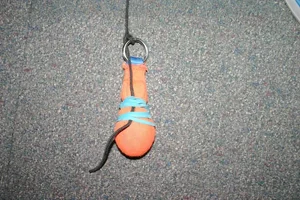
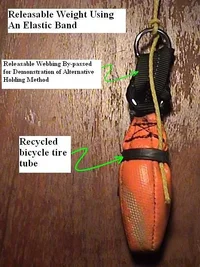
All you need is a good rubberband. Tie a munter hitch around the tbag ring. These days I am using a wide rubber band or sometimes a 1/2" to 3/4" wide piece of a bike inner tube for the friction around the bag.

I leave about a 6 inch tail so that when I am "dancing" the bag from limb to limb I can tell if the throwline is slowly easing through the rubber band.

Just a munter hitch won't hold...it slides. With the band on the tail you can shoot it, retrieve it thru the tree (if the crotches are wide), dance the bag, etc.

This system has worked very well for over a year now.
 

Attachments

  • 69473-t-bagreleasable(2).webp
    69473-t-bagreleasable(2).webp
    110.9 KB · Views: 164
[ QUOTE ]
Why not just tie or splice a loop in the end of your line...

[/ QUOTE ]

PUClimber,

This configuration allows you to release the weight mid-air. If hanging, it can be bounced off the line; it works like a ratchet. If stuck in a tight fork where the ring is contacted, then it slides off.

This system isn't a perfect solution. It reduces the incidents of stuck weights. Could this added bulk create an occasional problem? As we all now, the throwline goes through amazing gymnastics that leave some incredible knots. This configuration isn't immune to those amazing holds that nature does on a throwline.

It's a different approach. The frank feedback is welcome.
 
Ok Jim
I didn't realize that you could use it to unhook while still in the tree. So if you get it stuck in a crotch there is a way to unhook the bag? The only downfall is if you have it stuck and you try to pull hard to get it through the crotch and it comes off then you'd have to rethrow. It's like anything else though you have to weigh the pros and cons of it.
 
PUClimber,

I used a loop in the end of a throwline once. It caught on every little stub, branch, and piece of bark. I took the loop out when I managed to get my line back on the ground.
 
Gary,

I tried your version with a recycled bike tire tube. The simple solutions are the best solutions.

JimK
 
I missed my attached with Gary's version.
 

Attachments

  • 69603-2007ReleasableWeightUsingElasticBand.webp
    69603-2007ReleasableWeightUsingElasticBand.webp
    67.6 KB · Views: 132
I use a spliced loop on the end and it's snagged maybe 3 times in the last 4 years. I'll count that as "good enough to not change."

I like this muntered method. Definately has it's merit and a good thing to remember.

love
nick
 
[ QUOTE ]
Gary,

I tried your version with a recycled bike tire tube. The simple solutions are the best solutions.

JimK

[/ QUOTE ]

Glad it worked for you...your picture looks good. The only thing I have learned to do differently is leave about a 6 inch tail sticking out past the throwbag. Then when you are manipulating the bag way up high you can tell if the tail is starting to slip through the rubber band. After several hard tugs it might be slipping some (which it is supposed to do , of course)...it's nice to be able to tell from the ground.
 

New threads New posts

Back
Top Bottom