













This was my reason for the rabbit hole comment.I was going to say what is with your obsession with flattening, it's ridiculous we're climbing ropes that we want to be flexible not steel.
Navigation
Install the app
How to install the app on iOS
Follow along with the video below to see how to install our site as a web app on your home screen.
Note: This feature may not be available in some browsers.
More options
You are using an out of date browser. It may not display this or other websites correctly.
You should upgrade or use an alternative browser.
You should upgrade or use an alternative browser.
Redundant Bridge vs. Second Bridge
- Thread starter Njdelaney
- Start date

Willber
New member
- Location
- Milford, NH
@moss
If Dyneema could safely function well as a compressed core, having nylon or possibly poly as the cover, is interesting.
Yes, the goals differ in that, flattening of a bridge is ideal to reduce over stretching of the outer strands, of the core. And, flattening provides more surface for less wear, and surface resistance for more controlled movement from one side of the bridge to the other.
Though what if there was a rope climbing device that was designed for a stiff round rope, in that the rope catching surfaces were half piped, then it would be more completely capturing the rope, than opposed to the devices now that flatten the rope, where much of the outer ends of the “oval” are not being contacted by the device.
Yes, the possibility of a Dyneema core overheating, if in a climbing line, when it’s used in ring to ring, or less likely a pulley.
Though I never used the Beal rope in a MRS pulley system, only simply running rope over branches, so the core may heat up a bit using an MRS pulley system.
Maybe elastic property of nylon would be better as a cover if the core is going to be highly compressed, as was the Beal rope.
That sounds encouraging to only see about 5% of the Dyneema core abraded, after 2yrs.
The sand particles getting in the rope mention, was just trying to account for the expansion of the core of nylon/poly ropes.
If Dyneema could safely function well as a compressed core, having nylon or possibly poly as the cover, is interesting.
Yes, the goals differ in that, flattening of a bridge is ideal to reduce over stretching of the outer strands, of the core. And, flattening provides more surface for less wear, and surface resistance for more controlled movement from one side of the bridge to the other.
Though what if there was a rope climbing device that was designed for a stiff round rope, in that the rope catching surfaces were half piped, then it would be more completely capturing the rope, than opposed to the devices now that flatten the rope, where much of the outer ends of the “oval” are not being contacted by the device.
Yes, the possibility of a Dyneema core overheating, if in a climbing line, when it’s used in ring to ring, or less likely a pulley.
Though I never used the Beal rope in a MRS pulley system, only simply running rope over branches, so the core may heat up a bit using an MRS pulley system.
Maybe elastic property of nylon would be better as a cover if the core is going to be highly compressed, as was the Beal rope.
That sounds encouraging to only see about 5% of the Dyneema core abraded, after 2yrs.
The sand particles getting in the rope mention, was just trying to account for the expansion of the core of nylon/poly ropes.
Willber
New member
- Location
- Milford, NH
A maintenance of roundness is necessary for optimum tending through a device. A stiff round rope like the 11mm Beal Access rope, was surprisingly flexible, and held almost every knot. Best of both, a cable and rope.I was going to say what is with your obsession with flattening, it's ridiculous we're climbing ropes that we want to be flexible not steel.
Edit: another advantage of a very round rope is that it datches better than a typical rope like BlueMoon. So you can get it unstuck more effectively and the rope will transfer rotation more of a distance than a typical rope.
Last edited:
Willber
New member
- Location
- Milford, NH
Well, there must be some microscopic particles of sand that get beneath the cover. How is it not possible, fine "dust" gets everywhere, hence the need for clean rooms in electronic manufacturing. And, it's just that Dyneema being very susceptible to abrasion, is the reason for the mention.Will you be using your bridge for 12 years? I hope not. Do you drop your saddle in the sand when you take it off? I hope not. Are you climbing trees in the desert? Probably not. Replace that bridge every six months and no worries about sand inside.
BTW, you have a flattening fetish like no one I've ever known.

moss
Been here much more than a while
- Location
- Carlisle, Massachusetts, U.S.
Well, there must be some microscopic particles of sand that get beneath the cover. How is it not possible, fine "dust" gets everywhere, hence the need for clean rooms in electronic manufacturing. And, it's just that Dyneema being very susceptible to abrasion, is the reason for the mention.
No sand or fine dust is getting through the cover, then the intermediate "PEZ" sleeve that is over the Dyneema core TM 10mm bridge. I've dissected at least 4 of them after I retired them, clean as a whistle, Dyneema braid and fibers looked perfect. You may be looking for a problem that doesn't exist in tree climbing.
-AJ
Willber
New member
- Location
- Milford, NH
Yes, if the cordage is only used as a bridge, it won't get exposed to silica, as a rope would, and especially if the rope is used only as an MRS rope, for tree ascent.
I brought up about the fine sand getting in this possible "new cordage" you guys were starting to talk about, as a possible caveat, given the Dyneema core is abrasion sensitive.
And, that if I were to use this new cordage (only if it were non-flattening {high pressure cover, like the Beal}), because in MRS rope ascent of a tree, one gets their rope cover exposed to more soil/sand (excess rope is needed to than in SRT, set with a throw bag. And, a possible explanation for the core expansion of my friends Velocity that is 5yrs old, (he also only climb MRS).
Maybe the cover to core surfaces are is getting fuzzy, in this Velocity, causing the core expansion, similarly to what you discovered on the Dyneema core surface, without the PEZ sleeve. And, also the core expansion might be from the plastic strands getting "white interior stress bubbles", similar to large pieces of plastic that get white from being bent multiple times, which does expand a bit from this stress. Especially when a rope is used solely and frequently in MRS, could also create a fuzzy surface, given MRS is similar to bridge use.
I never intended to discredit your knowledge, sorry if it came across that way.
I do appreciate your investigative interest in the "PEZ" sleeve effectiveness and possible fine sand particle infiltration of the cover, with the TM 10mm bridge. It's great to know this.
I brought up about the fine sand getting in this possible "new cordage" you guys were starting to talk about, as a possible caveat, given the Dyneema core is abrasion sensitive.
And, that if I were to use this new cordage (only if it were non-flattening {high pressure cover, like the Beal}), because in MRS rope ascent of a tree, one gets their rope cover exposed to more soil/sand (excess rope is needed to than in SRT, set with a throw bag. And, a possible explanation for the core expansion of my friends Velocity that is 5yrs old, (he also only climb MRS).
Maybe the cover to core surfaces are is getting fuzzy, in this Velocity, causing the core expansion, similarly to what you discovered on the Dyneema core surface, without the PEZ sleeve. And, also the core expansion might be from the plastic strands getting "white interior stress bubbles", similar to large pieces of plastic that get white from being bent multiple times, which does expand a bit from this stress. Especially when a rope is used solely and frequently in MRS, could also create a fuzzy surface, given MRS is similar to bridge use.
I never intended to discredit your knowledge, sorry if it came across that way.
I do appreciate your investigative interest in the "PEZ" sleeve effectiveness and possible fine sand particle infiltration of the cover, with the TM 10mm bridge. It's great to know this.
Last edited:

Reach
Been here much more than a while
- Location
- Atglen, PA
Did you ever consider that the core is not expanding, but the cover is tightening as it expands, both outward and inward? That sure seems to be what happens with rock climbing lines, even those used in a gym, fixed in place, where they’ve never touched the floor (made of clean rubber pads anyway)Yes, if the cordage is only used as a bridge, it won't get exposed to silica, as a rope would, and especially if the rope is used only as an MRS rope, for tree ascent.
I brought up about the fine sand getting in this possible "new cordage" you guys were starting to talk about, as a possible caveat, given the Dyneema core is abrasion sensitive.
And, that if I were to use this new cordage (only if it were non-flattening {high pressure cover, like the Beal}), because in MRS rope ascent of a tree, one gets their rope cover exposed to more soil/sand (excess rope is needed to than in SRT, set with a throw bag. And, a possible explanation for the core expansion of my friends Velocity that is 5yrs old, (he also only climb MRS).
Maybe the cover to core surfaces are is getting fuzzy, in this Velocity, causing the core expansion, similarly to what you discovered on the Dyneema core surface, without the PEZ sleeve. And, also the core expansion might be from the plastic strands getting "white interior stress bubbles", similar to large pieces of plastic that get white from being bent multiple times, which does expand a bit from this stress. Especially when a rope is used solely and frequently in MRS, could also create a fuzzy surface, given MRS is similar to bridge use.
I never intended to discredit your knowledge, sorry if it came across that way.
I do appreciate your investigative interest in the "PEZ" sleeve effectiveness and possible fine sand particle infiltration of the cover, with the TM 10mm bridge. It's great to know this.
moss
Been here much more than a while
- Location
- Carlisle, Massachusetts, U.S.
No offense taken.Yes, if the cordage is only used as a bridge, it won't get exposed to silica, as a rope would, and especially if the rope is used only as an MRS rope, for tree ascent.
I brought up about the fine sand getting in this possible "new cordage" you guys were starting to talk about, as a possible caveat, given the Dyneema core is abrasion sensitive.
And, that if I were to use this new cordage (only if it were non-flattening {high pressure cover, like the Beal}), because in MRS rope ascent of a tree, one gets their rope cover exposed to more soil/sand (excess rope is needed to than in SRT, set with a throw bag. And, a possible explanation for the core expansion of my friends Velocity that is 5yrs old, (he also only climb MRS).
Maybe the cover to core surfaces are is getting fuzzy, in this Velocity, causing the core expansion, similarly to what you discovered on the Dyneema core surface, without the PEZ sleeve. And, also the core expansion might be from the plastic strands getting "white interior stress bubbles", similar to large pieces of plastic that get white from being bent multiple times, which does expand a bit from this stress. Especially when a rope is used solely and frequently in MRS, could also create a fuzzy surface, given MRS is similar to bridge use.
I never intended to discredit your knowledge, sorry if it came across that way.
I do appreciate your investigative interest in the "PEZ" sleeve effectiveness and possible fine sand particle infiltration of the cover, with the TM 10mm bridge. It's great to know this.
My double braids are retired when they become “work hardened”. I don’t know if work hardening for arb ropes has been quantified but for my lines I know one factor is the cover braid being damaged by UV. In general lines get “thicker” because the cover fibers are broken and “fuzz up”. The cores look normal on my retired climbing lines.
-AJ

Muggs
Been here much more than a while
- Location
- Canuckistan
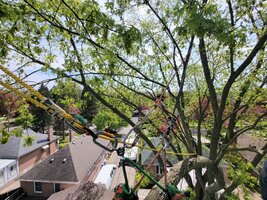
Triple Threat today in a very spready silver maple
Willber
New member
- Location
- Milford, NH
@Reach Yes, interesting, that the cover is expanding forcing the rope to increase it's size, giving the feel that the core has expanded. I didn't actually think of that, nor have I dissected an old rope that became less flattening as it was used more. I should do that. The only rope I had used long enough was the Beal, and I actually accidentally cut a it near the end, so I was able to dissect that, though it was a highly compressed core from when it was new.
And, therefore it didn't shed light on what caused other supple ropes to stayed more round under pressure, after they were used for a year or more. Thanks.
@moss Yes, that is interesting, the cover strands fuzz up and break, actually overall expanding the covers total size, forcing the whole rope to stay more round.
That's good to know the cores looked normal on the old retired clim lines.
I definitely prefer the well used Velocity, to a new one, and given you've inspected cores of ropes that have become work hardened, hopefully when the ropes I have are work hardened they will be still safe to use, like the old Velocity. Thanks.
Well, I'm looking forward to my Drenaline expanding its cover so it'll stay more round and have better grip.
And, therefore it didn't shed light on what caused other supple ropes to stayed more round under pressure, after they were used for a year or more. Thanks.
@moss Yes, that is interesting, the cover strands fuzz up and break, actually overall expanding the covers total size, forcing the whole rope to stay more round.
That's good to know the cores looked normal on the old retired clim lines.
I definitely prefer the well used Velocity, to a new one, and given you've inspected cores of ropes that have become work hardened, hopefully when the ropes I have are work hardened they will be still safe to use, like the old Velocity. Thanks.
Well, I'm looking forward to my Drenaline expanding its cover so it'll stay more round and have better grip.

southsoundtree
Been here much more than a while
- Location
- Olympia, WA
Are you washing off the manufacturer's braiding wax to get a better grip?
Willber
New member
- Location
- Milford, NH
@southsoundtree
I have not on this Drenaline, but maybe I will. I just want to milk it one more time before washing.
I have not on this Drenaline, but maybe I will. I just want to milk it one more time before washing.
moss
Been here much more than a while
- Location
- Carlisle, Massachusetts, U.S.
I’ve probably already mentioned but simply climbing on the line will balance the core and cover nicely. I find that after roughly six climbs the process is done.@southsoundtree
I have not on this Drenaline, but maybe I will. I just want to milk it one more time before washing.
-AJ
moss
Been here much more than a while
- Location
- Carlisle, Massachusetts, U.S.
The exception being some newly released lines that are waaay out of core/cover balance. It seems to take a few initial runs before the manufacturers get the balance right.
-AJ
-AJ












New threads New posts
-
test
-
-

-
-
 Free CEUs: February 05 & March 05 - 'Urban Forestry Today' Webcasts @ Noon (Eastern)
- Started by UFT
- Replies: 0
-

-








