Reduction pruned red oak

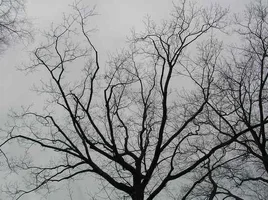
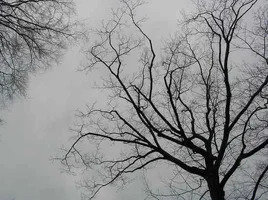
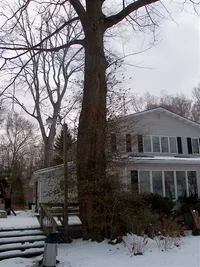
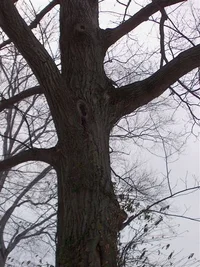
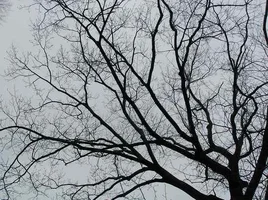
Here is a red oak that I inspected and strongly advised removal. To remove the tree I had to remove two small trees along the drive to get a crane into the work area. The homeowners did not want to do this and decided to just have the tree pruned. THe pictures are not the greatest but I think that you can tell what was cut in some areas.
 

Attachments

  • 45828-P1010008.webp
    45828-P1010008.webp
    82.7 KB · Views: 230
[ QUOTE ]
That looks like a good reduction job.

Why did you advise removal and then change the plan?

[/ QUOTE ]

What Tom said. Looks like a good job (as we'd expect from a bcma heyhey)as far as where the cuts were and what was left, but hard to say not knowing the tree's condition was.
 
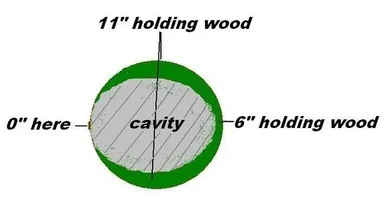
I didn't change the plan Tom. The tree owners would not alow it to be removed. I then advised that if they were going to insist on keeping the tree it should be reduced. I wouldn't feel comfortable rigging the tree down by hand. When I did a hazard evaluation it has less then 6" of solid wood on the compression side of the tree, no solid wood on one side of the tree and 11" of wood on the other two sides of the tree. Also there was extensive decay on some of the limbs from old pruning wounds and the tree has had branches fail previously twice. I gave them a report and release that clearly spelled out my recommendations and that in my opinion the tree could fail at any time and got a signature that they understood this and would not hold me responsible for any damage.
 
I like to throw some numbers around if I may. And please dont go getting all sensative and think I'm having a go at you I'm just extremely curious to see what the facts are.

According to Mattheck, 30% holding wood is enough. Using the 6" I get a DBH of 40" and using the 11" I get DBH of 72" .

Now, you may argue that one side has nil wood, but the USFD only brings into play a higher holding wood percentage when the open front of the cavity exceeds 40% of the circumference. Remember that 100% of the circumference is all the way around, but in this instance there's not really an open cavity.

I have attached a diagram of the holding wood example as you have described.

From what I can tell of the pics it appears the tree is similar height after pruning, looks more like a thin than a drop crotch to me.

So, what is the DBH of the tree?

Also, how much material did you remove do you think ...

... in weight?
... in sail area?
... in foliage?

Thanks. /forum/images/graemlins/smile.gif
 

Attachments

  • 45881-treemann.webp
    45881-treemann.webp
    11.4 KB · Views: 104
Good questions, Eric, for conversation's sake. Aside from strength loss in trunk we have previous branch failure from decay up there, so I too would not question the recommendation to remove.

But the 2 big numbers that seem to be missing on the strength loss calculation are dbh and width of area with no holding wood/open cavity.

In any case the reduction may buy them several years of safe--well let's call it "pre-critical"--useful life.

treemann, are you going to make annual/semiannual inspections?
 
Today we removed a tree that sort of sounds similar.

I video'd the base but should've video'd the top when we were up there, it was stuffed.

Some-one many years ago had done some horrific topping, big limbs as stubs perhaps 8 to 10" dia. There were dead branches, cankered branches, brackets up there, the crown was dying back and nowhere to reduce to really, just time for the ole chainsaw to do it's thing.

But originally I paid more attention to the fruiting bodies and decay at the trunk.

In the removal process it was really the crown that was the stuffed part. I couldn't tell the defect too well from the ground but once up in the tree many of the tops of branches were dead (perhaps scald?) There were some pretty dodgey unions too.

So I suppose it was good that it worked out that way, coz if the top was healthy lush I would have looked like a real [use a better word] when the base didn't scrub up as bad as I thought.

Anyway, I'll do the vid soon.

By the way Treemann, how did you measure the good holding wood??? Resistograph, drill etc? Just curious.

Also Guy, when dealing with basal decay and fruiting bodies we all know that decayed roots have ZERO strength ... so what do you think about the decision to leave a 35% good wood tree in when you know that the decay is only inches away from roots?? Just thinking out loud here.

 
[ QUOTE ]
when dealing with basal decay and fruiting bodies we all know that decayed roots have ZERO strength ..

[/ QUOTE ]True, but how do we know which roots are totally decayed, which are partially decayed, and how many are undecayed? Poking around with the tile probe and inducing and deducing and guessing is all I know to do, lacking radar and resistograph.

[ QUOTE ]
. so what do you think about the decision to leave a 35% good wood tree in when you know that the decay is only inches away from roots?? Just thinking out loud here.

[/ QUOTE ]

Good question; depends on the ID of the fungus, location of holding wood vis a vis the crown, mitigating and aggravating conditions, and other clues.
 
I have to say that sounds like a tree that we reported on the campus but to no prevail, the cometic looks is what they where concerned about, well it was one of the times I wish I had the camera, the tree failed and and decided today that it wanted to grow hrizontally. Thank god it was not a class change, and to all the fingure pointing going on I went into my truck pulled out a copy of the report and laid it on the trunk for all the uppers and some vps of the campus to see, that cometics are not the only thing out there to think about.
 
[ QUOTE ]
a tree that we reported on the campus but to no prevail, the tree failed ,to all the fingure pointing going on I went into my truck pulled out a copy of the report and laid it on the trunk

[/ QUOTE ]

Nice work; a little documentation goes a long way, eh? /forum/images/graemlins/cool.gif
 
[ QUOTE ]
the tree failed and and decided today that it wanted to grow hrizontally.

[/ QUOTE ]

Hmmm, did you <font color="blue">prop </font> it?

Or just cut it up ... coz you cant cut it down if it's already down but you can cut it up if it's down?

And, TAKE YOUR CAMERA WITH YOU EVERYWHERE EVERY DAY! Sheesh, now we missed out on a really good autopsy where we could have crunched the numbers. /forum/images/graemlins/umn.gif
 
The dbh of the tree was 55" the area with no live wood was 13".
the weight of the branches removed was approximately 6-800 pounds
reduced sail was about 3 to 4 feet
reduction pruning removes the larger branch to a lateral at least 1/3 dia of the parent limb. all cuts were recuction cuts
i have recommended to the client annual inspections
Ekka
the diagram that you attached was close but it was going clockwise from the 12o'clock position 11" then 0" then 6" then 11"
 

Attachments

  • 46188-Sieczkowski__Hazard_Inspection_015.webp
    46188-Sieczkowski__Hazard_Inspection_015.webp
    50.2 KB · Views: 63
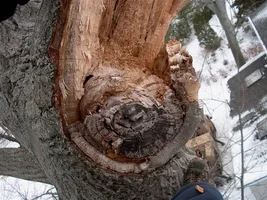
The last picture was of the column of decay starting at the base and extending up the trunk. Above where the column of decay ended there were several old pruning wounds on that side of the tree extending 20 more feet up the trunk. Here is the picture of the stub that remained from the last branch failure. This branch landed on the house.
 

Attachments

  • 46189-Sieczkowski__Hazard_Inspection_011.webp
    46189-Sieczkowski__Hazard_Inspection_011.webp
    87.2 KB · Views: 66
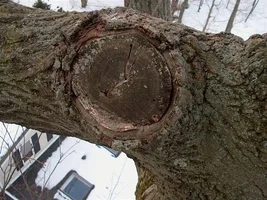
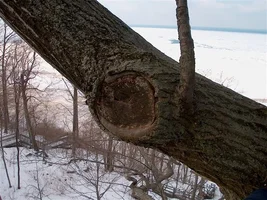
Here is a picture of an old prunning wound on a branch that was remaining. This branch extended over the house.
 

Attachments

  • 46190-Sieczkowski__Hazard_Inspection_008.webp
    46190-Sieczkowski__Hazard_Inspection_008.webp
    88.1 KB · Views: 69

New threads New posts

Back
Top Bottom