really stupid tree planting question

For starters, "real soil" would be something more typical to a local soil versus a near fine barkdust potting mix used by some nurseries.

You must know that already.

And the internet is so extensive, with reams of university extension websites and some rather decent forums, that pages on planting are not hard to come by.

Putting aside some **inconsequential questions like "interior circling"**, I find it much more important to retain the solidarity of what appears to be a sound rootball, especially around April or later in our area. We have had near 100 degree weather late May before. And at least here, get hardly any rain in summer.

Bare root sounds fine to me after the end of October to like the end of March.

**looks the same to me, but whatever. can you post OU pubs that are compliant with ANSI?
 
[ QUOTE ]


**looks the same to me, but whatever. can you post OU pubs that are compliant with ANSI?

[/ QUOTE ]


Basically, I'll post and apply whatever seems right. It's not like I show up to sites showing off badges and patches. Just get it done right, so it lasts for generations. That's my approach.

Guy ... you put the asterisks around the isolated part that you want to strain your concentration on. Try moving the asterisks outward about an entire sentence each direction.

I was trying to be polite ... but, I was converying that your question was inconsequential, because of the way you posed the matter. And referring to something important, which is the integrity of keeping a good root ball intact, if one need not be broken up. A good example, would be the huge root balls that Davey Tree spends days trying to hold together. Huge yes, but it seems like that's the kind of example needed to get the point to you in in a conversation.

Now, here's the kind of link I think anyone can enjoy ...

Kids Face Tree Planting Guide

It ain't too bad, and its not stamped all over with ANSI or some Pharisee kind of control.
 
Are we talking about huge B&B trees? If so this thread needs to be rewritten for the OP. The way you plant a normal sized tree is not the same approach you would take with HUGE rootballs, even large rootballs for that matter.
 
Bare root any tree no matter what size it or the ball is. Almost every tree I see from any nursery is way too deep in the ball. The first order lateral root should be within three inches of the soil surface. So often this is six or more inches deep in the ball. Not only will you be furthering the deep planting problem by keeping the ball intact and planting the top of the ball at grade but your tree has lost most of its root system.

We use a surveyers pin to locate the FOLR at the nursery before we accept the tree. If it is excessivly deep we look for another tree. This is a big pain in the !?/ as most of the trees are deep in the ball.

When you bare root you expose all the root problems and you can address any root pruning that is needed. You also remove the soil interface issues that cause hydraulic discontinuity.

One person can carry a 3" tree alone. This makes placement and positioning in the hole very easy.
 
I wish we could bare root every tree on planting day. We plant 60-80 trees per day with volunteers and a small crew.

B&B's bare root pretty easy, but containers are a bit tougher. We locate the true root flare, cut crossing, circling, matted or adventitious roots, and generally treat the root ball rough, but we could never bare root all of these.

We are having good success so far, been doing it for about 6 years to varying degrees (We've been getting more aggressive as we learn more).

-Tom
 
Many times, we see freshly dug field-grown in good soil. With firm intact balls. I never break apart those kinds of balls because there is no real need.

The link you posted about the large tree being bare root planted was pretty interesting. Hadn't seen that done before.

There is only one reason I would avoid it out here - settling of soil.

In all the years that I worked at country clubs and residential or commercial, the holes and trenches have always settled from several inches to up to half a foot over like 1 to 10 years, regardless of what we did to backfill.

We could stomp soil in an irrigation trench, run a tractor tire over the top and leave the soil a half inch high yet. After the cool season rains, it would still settle at least an inch if not two inches for a 24 inch trench.

In big holes or landscape mounds, we could flood with water and pack the soil, or we could just tamp in layers, you name it, the soil still settled.

Now ... I think there is a way to do it though, for this region. It would just need to be planted high. Like the tree you linked to, would just need to be planted about 4" to 6" high, and in about 6 years, it would settle downward to be even with existing grade. Then in the next years, I don't think it would settle at all, because extra root mass would fill in the planting hole, and the new roots extending outward would help hold it.

On another hand, I see no reason to bare root a tree that big if the soil is good and there is a way to ball it and move it.

Pretty good photos in the link.

In general, Oregon has a pretty exceptional source of trees. Not all growers are great. But there are a ton of fields and growers and nurseries to choose from. That means that bare root becomes an option here, rather than a rule of thumb or need.

[ QUOTE ]
B&B's bare root pretty easy, but containers are a bit tougher. We locate the true root flare, cut crossing, circling, matted or adventitious roots, and generally treat the root ball rough, but we could never bare root all of these.

[/ QUOTE ]

I'd much rather deal with field grown B&B than pots myself. One thing I don't like much at all, are these cloth-like bags being used now. They can be a bit of a nuisance to remove whether going the B&B route or not. Only a few nurseries are using them it seems.
 
[ QUOTE ]
Are we talking about huge B&B trees? If so this thread needs to be rewritten for the OP. The way you plant a normal sized tree is not the same approach you would take with HUGE rootballs, even large rootballs for that matter.

[/ QUOTE ]

No need for a new title bull.I was asking about planting trees in the 3" range,probably 8-10 ft. tall.
 
[ QUOTE ]
[ QUOTE ]
Are we talking about huge B&B trees? If so this thread needs to be rewritten for the OP. The way you plant a normal sized tree is not the same approach you would take with HUGE rootballs, even large rootballs for that matter.

[/ QUOTE ]

No need for a new title bull.I was asking about planting trees in the 3" range,probably 8-10 ft. tall.

[/ QUOTE ]

His question somewhat circumvented the reason "huge" tree root ball was mentioned in my earlier post. Your first post didn't give a size, but I didn't imagine that you were planning to plant huge trees. But it seems that this would be as good a place as any to add big tree planting too.

cool.gif
 
How large of a property are you planting 6t56? As most agree bareroot is better. Your 10' tree is probably around $100 with 90some% of the roots removed, and they say topping is bad. You could buy a couple of these and then buy a bunch of 2-3 year old bare roots for less than $5 each, easy to transport, easy to plant, a better tree in the end. As a tree person you should give spieces selection some thought. You could go native and dig your own in the forest. You could go with proven common urban trees, or you could go with rare exotics. Some nurseries will custom start your seeds, or you could play with tree propagation.
 
mario your 'not too bad" link says

"Place the tree in the hole, making sure the soil is at the same level on the tree as when the tree grew in the garden center."

This is the same rootball-to-grade crap that is the root of most planting evils. I repeat (last time): Can you post a biologically rational, flare-to-grade link from OU??
 
[ QUOTE ]
mario your 'not too bad" link says

"Place the tree in the hole, making sure the soil is at the same level on the tree as when the tree grew in the garden center."

This is the same rootball-to-grade crap that is the root of most planting evils. I repeat (last time): Can you post a biologically rational, flare-to-grade link from OU??

[/ QUOTE ]

You know why its there?

Just to see if you would start criticizing a kid's planting page. Which I sort of expected, cuz that's why I picked it.

I thought, hey, here's a not too bad kid's link. I'll post this one, and watch Guy the arborist jump in and start to criticize it.

LOL

It's not a pathetic page though.

And it would not be a surprise if a tree planted according to those 10 steps, lived longer than 2/3 the street trees in our suburb here.

I like step 10 where it opens the door for more advice too.

cool.gif
 
Mario you've proven 3 things:

1. You cannot find an OU pub that promotes proper planting.

2. You don't understand that if a pub does not guide the planter not to bury the tree, it's not "not too bad", it's worse than worthless, it's BS.

3. You come here to play games instead of learning or sharing arboriculture.

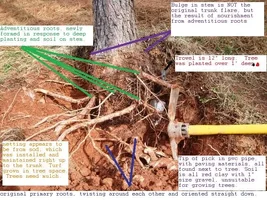
Why am I fixated on this? Continually being assigned to fix trees that are unfixable due to poor specs by University Authorities. See the attached. Dramamine recommended.

I was asked by Frank Hendrickson of Yardnique, Inc. to inspect pine trees near the southwest entrance and try to figure out why they were dying, and what to do about it. February 12 2010 I saw a row of seven pines above a parking lot that had progressively died, from west to east. The fourth tree from the west has a severe infection of fusiform rust, Cronartium fusiforme. Often fatal on stressed pines, this disease is pandemic at the RBC Center. Many trees in the adjacent grove have fatal infections, which will set billions of spores loose this and every spring. The other six trees in the row did not have this disease, yet they all turned totally brown before the infected tree did. This seems to rule out fusiform rust as the causal agent of this decline.

Next I inspected the stems and branches and needles for signs of insect attack, and found none. The foliage that was most exposed to the sun, and moisture stress, appeared to be turning brown first. The browning was thorough and even and sudden, which seems to rule out Lophodermella, Rhizoctonia, Coleosporium or any other disease. I peeled back bark and dissected branches and twigs. No signs of tip blight or feeding by Dendroctonus, Pissodes, or Neodiprion larvae, caterpillars, or anything resembling a worm was seen, aboveground or below. Having no evidence of a biotic disorder, caused by a living agent, I next looked at abiotic, non-living causes. A Root Crown Examination (RCX) is an essential step in plant diagnosis.

I chose the second tree from the east because it seemed typical of the group. I dug out 14” of red clay, with chunks of gravel of a fairly uniform 1-2” size about half the volume throughout. I encountered several small adventitious roots, formed in response to soil and moisture, growing away from the trunk. When I found the original trunk flare, the primary roots were twisted around each other and oriented straight downward. In nature, most of the roots extend outward into the upper layers of the soil, where oxygen and water are available. Near these roots I encountered sections of black PVC pipe, broken bits of ceramic pipe, and chips of smooth black material that resembled dried tar or asphalt. I collected a sample of the clay and submitted it for testing. I also submitted samples of bark and twigs and needles to the NCSU Clinic for analysis.
 

Attachments

  • 215533-RBCPineBuried1.webp
    215533-RBCPineBuried1.webp
    117 KB · Views: 26
[ QUOTE ]
Mario you've proven 3 things:

1. You cannot find an OU pub that promotes proper planting.

2. You don't understand that if a pub does not guide the planter not to bury the tree, it's not "not too bad", it's worse than worthless, it's BS.

3. You come here to play games instead of learning or sharing arboriculture.

Why am I fixated on this? Continually being assigned to fix trees that are unfixable due to poor specs by University Authorities. See the attached report; fastforward to the end for the planting part. Dramamine recommended.

[/ QUOTE ]

So let it be written, so let it be done.

I just got this flashback of Yul Brynner after reading your few sentences.

cool.gif
 
Call me Pharaoh, that answers everything.
tongue.gif


You want more? Here ya go.

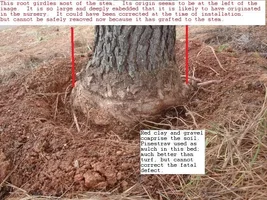
With the original roots deprived of oxygen, water and nutrients, and the adventitious roots competing with turfgrass, the growing trees could not get the resources they needed to live. Across Stroud Street from this site, one pine tree in the middle of a grove of pine trees is turning brown. It is the only one with a noticeably crooked trunk. After removing mulch and soil from the stem we found a large root girdling over 50% of the trunk. No other signs of pests were seen. The disruption in circulation and buttress development from this stem-girdling root may be responsible for both the disfigurement and the death. This root condition also does not meet industry standards for growing or planting trees.

American National Standards Institute (ANSI) Z60.1 Nursery Standard 1.1.1.1: “…the soil line, which should be at or near the top of the root flare.” And 1.6.3: “…Soil above the root flare…should be removed.” And the ANSI A300 (Part 6) Transplanting Standard 63.6.2.3: “The bottom of the trunk flare *shall* be at or above the finished grade.” The original landscape plans that I viewed for the site made no reference to proper growing, inspection or planting practices. Instead, it contained substandard (and biologically irrelevant) “root*ball* to grade” language. It appears that these trees were grown and installed in a substandard manner, due to substandard specification and oversight.

While on site I went near the front door of the RBC center. I saw a planting of about 50 thin-barked hornbeam trees. Some are dead, and many are dying. These trees have bark loss and wood decay, mainly on the south and southwest sides of the stems. These stems have no lower branches, so they are deprived of shade and nourishment. They do not have trunk wrap or other barriers to shade the stems.

DISCUSSION
Misinformation from NCSU Extension about tree planting is common, even in recent publications. The first two that came up in an internet search are: http://alamance.ces.ncsu.edu/files/library/1/Tree%20Planting%2010-07-09.pdf
http://wayne.ces.ncsu.edu/index.php?page=news&ci=LAWN+157
This next one is substantially compliant, but it does not have the standard “trunk flare shall be planted to grade” specification. http://www.cals.ncsu.edu/extgardener/tree.pdf
This basic condition for health and survival is visible to the untrained eye on trees that are not grown in nurseries or installed by landscapers. Without it, trees can be buried, original roots will suffocate, stems will be strangled by their own roots, and trees will continue to die from anthropogenic causes. All trees that are planted in the future should comply with ANSI standards, despite any recommendations to the contrary.

Other states such as Florida and California are adopting ANSI-compliant nursery standards that provide for healthier plants, and protect buyers from the expense of dealing with fatal defects: hort.ufl.edu/bmp/BMPbrochure.pdf and www.urbantree.org/specs.asp. If the industry in North Carolina adopts such standards, this state’s urban forest and urban populations might benefit greatly in the future. These standards also call for retaining lower branches while the tree develops, to thicken and protect the stem.

Should every dead pine tree be replaced with another pine tree? Considering the number of pines at the RBC Center, these eight dead trees may be just the tip of a very large iceberg that is rapidly melting. Considering the number of trees that are being lost, and the abundance of Pinus taeda on this site, it is not clear that every pine tree that dies has to be replaced by a pine tree. The row above the small parking lot could be replanted with small ornamental trees or shrubs, which might deliver more aesthetic, environmental, and sustainable benefits than seven more pines would. There is also the safety issue of planting pines on slopes near people and property. These “edge trees” tend to sprawl into the open and lean over the target area. Those with defects such as stem-girdling roots and fusiform rust are more likely to fail in severe storms, falling into the open, and possibly occupied areas.

Across the entire site, dozens if not hundreds of pines closely planted in rows have fatal (>1/3 circumference without substantial scar tissue) fusiform rust infections. Since pines are sun-demanding trees, they will not flourish under more established trees. In the short term, the loss of these trees will create gaps, but the sooner they are removed, the sooner the healthier trees can close these gaps. Retaining lower branches and expanding natural areas outward as the remaining trees mature will also mask these gaps, and improve tree health. The landscape plans were flawed from the start due to the lack of proper inspection and planting specifications. The impracticality of planting pines in shade, along with other costs, must be considered along with whatever perceived aesthetic benefits are associated with adhering to these plans.

Tissue death on stems exposed to the sun is known as sunscald. Bark tissues that were shaded in the nursery and suddenly exposed to sunlight can dry out and die. Without this protective covering, the inner wood is exposed to cracking and infection, causing a decline in health and stability.

NCSU once taught courses in the Physiology of Woody Plants and Arboriculture, http://joa.isa-arbor.com/request.asp?JournalID=1&ArticleID=1699&Type=2 but currently does not. Without sufficient education in the care of trees, graduates are not well equipped to manage trees, and this land-grant university fails to meet this essential part of its mission. The result is unhealthy and unsafe trees on large sites such as the RBC Center, and countless smaller sites across North Carolina.

RECOMMENDATIONS

1. Immediately remove all pines that have fatal (>1/3 circumference without substantial scar tissue) fusiform rust infections, before they sporulate this spring. Consult with NCSU Pathology professionals on this.

2. Treat infestations of southern pine beetle located at the margins of smaller infections. Consult with NCSU Entomology professionals on this.

3. Remove mulch and soil from the stems and examine the root crowns of all the other pine trees.

4. Remove stem-girdling roots.

5. Apply 2-4” of mulch under the branches, but not on the stems.

6. Install rattan shields like the below, without the wood and burlap, and painted in a shade of red somewhere between Wolfpack and Hurricane red, around the hornbeams.

7. Restore courses on arboriculture at North Carolina State University in the Forestry and Horticulture Departments.

8. Teach basic arboricultural principles to students in the Landscape Architecture and related departments.


This concludes my report. It is my hope that closer attention to the basic needs of the woody plants at the RBC Center and across the state will allow them to provide greater contributions at less cost, for the benefit of visitors and citizens in the decades to come.

 

Attachments

  • 215538-rbcpinegirdled100216.webp
    215538-rbcpinegirdled100216.webp
    117.7 KB · Views: 22
[ QUOTE ]
I'll be honest here,I don't plant trees so i don't have a clue what is right and what is wrong.I want to plant some maples,oaks,and possibly spruce or white pine around my property.What do i need to know as far as how big to make the hole,fertilizer,etc.

[/ QUOTE ]

Almost forgot something that came to mind when you posted the other day ... are you set pretty good regarding how to select trees?

Will you be ordering them, or selecting them yourself?

cool.gif
 
[ QUOTE ]
I completely agree with Will. And if you feel you need to plant a larger tree that you buy B&B you should bare root it before you plant it. And by that I mean remove all the soil surrounding the roots, not what bare rooting means to all our friends down under. Dr. Bonnie Appleton of Virginia Tech has been doing some compelling research backing up the benefits of removing all material and soil/medium at the time of planting.

[/ QUOTE ]

Dr. Ed Gilman recommended the same thing...
 

New threads New posts

Back
Top Bottom