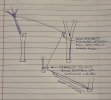
Questionable TIP

Dan Cobb

Been here a while
Location
Hoover
I was working on removing a pair of trees for a friend yesterday. I had a nice high TIP set with a basal anchor and had lowered a couple of branches. I was climbing up to my TIP to cut the top 3 branches (which could be bombed down) when I saw a former fork below my TIP. One branch had pulled out and left a cavity with decay, compromising at least a third of the cross-sectional area of the 6-7" diameter. Even though the TIP tested okay and I had hung from it for a while, I wasn't feeling good about climbing above the decayed spot and came down.

I can't bomb down the whole piece above the decayed spot, pretty hard lean towards a shed. Even with the decay, that spot probably has more cross-sectional area than where my TIP was (which is about 4" dia) but with the decay at a former fork, it's not good straight grain.

Currently thinking that cutting from below the bad spot will a pull line to force it roughly opposite the natural lean will be the safest route. Getting a pull line installed will be a chore - lots of privet and small trees in the way.

Anyhow, I welcome any opinions.

Blue dot is by the TIP I had. Red dot is by the decayed spot. (I don't normally leave stubs, but everything sprays outward, so they're a non-issue and leave open the possibility a setting a line again if need be.)
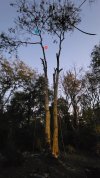
20211114_230556.jpg
 
A second tie in point on the right would be a good back up while working the original tie in point allowing you to get high enough.

If you only have one climb line you can use a short rigging rope to guy the two sides together to compensate for your weight above the decay. Preferably if only one climb rope, set it to the right and spur up to that original tie in point.


Also, with it being easy to isolate at this point, a canopy tie will half your weight on your rope vs your basal tie.
 
A second tie in point on the right would be a good back up while working the original tie in point allowing you to get high enough.

If you only have one climb line you can use a short rigging rope to guy the two sides together to compensate for your weight above the decay. Preferably if only one climb rope, set it to the right and spur up to that original tie in point.


Also, with it being easy to isolate at this point, a canopy tie will half your weight on your rope vs your basal tie.
Canopy tie crossed my mind to reduce the TIP load. I have lots of ropes, but the potential swing with a safety line in the adjacent top would put a lot of lateral force on some small wood.

Thanks for the advice.
 
Canopy tie crossed my mind to reduce the TIP load. I have lots of ropes, but the potential swing with a safety line in the adjacent top would put a lot of lateral force on some small wood.

Thanks for the advice.
I like the idea of a second TIP parallel to blue in the other side of the tree, both canopy tied. That would give me a lot of liquid courage if I were in your shoes.

Also don’t be afraid to adjust the clients expectations for turf damage, shrubs, etc. I’m not shy about telling a client plans need to change because of a hazard that could not be seen from the ground.
 
Never used it, but I've heard about canopy anchor at sound wood and then set webbing slings to clip as you go up. Kinda like lead climbing rock faces. If no other option.

With the second lead there, tie into that.
 
Tie into the other side, instead,

or


Rig it all into the other lead. You can peel the horizontal limb, or drop-cut.

No need for a perfect face and back-cut.

Reach above with a pole saw if needed.

Then swing the whole top into the other lead.
I like this solution the best, and the chain pole saw solution.

Also, does the decayed crotch have response wood? It can be hollow and be pretty sturdy if it is laying down new wood. I support you going with what makes you comfortable.
 
Species is super important!


IME, there are needless stubs and needed rigging points/ TIPs. Also, some in between.


I'm Not saying to climb anything questionable.
What forces would be different/ changing on the tree as you progress upwards to the TIP from where you have been? What forces on the tree have changed during the dismantling of the tree?


How would a canopy anchor affect the forces on the tree?


Beware the circle of death!!! Again, species specific! When I'm dismantling some bigleaf maples, we can hear and i can feel the wood popping.
I can't read angle and size on a phone.

Does your friend have pics?
 
So hard to tell from the photo. Looks like you could easily tie in to the other lead, or have one system in each lead, or pre-direct with a basal from “other” lead and go straight up to questionable lead and be pretty sorted. Span rig between the two? Tons of options have been suggested and they will all work. Do what you feel is best/safest and don’t be afraid to think outside of the square!
 
Don't forget the good ole pull test. Set some ropes in the top from the ground and pull laterally to your satisfaction.

Or

Set a pull line and negative rigging. Cut the notch and back cut, leaving the hinge a little big. Maybe even a wedge to hold it upright. Get out of the tree and pull it from the ground to be negative rigged.
 
Ended up pulling it over opposite the natural lean (away from the shed) so rigging it down wasn't necessary.
20211203_193359.jpg
Got the pull line taut and notched it. Put moderate tension on the pull line and made the backcut. Then got out of the tree and pulled it over. Went perfectly according to plan. Had a 17 y.o. family friend who was there helping move brush and logs. I let him pull the haul system to bring it over and drop it. I enjoyed seeing how much pleasure he got from doing that - "That was soooo cool!"
 
Ended up pulling it over opposite the natural lean (away from the shed) so rigging it down wasn't necessary.
View attachment 79085
Got the pull line taut and notched it. Put moderate tension on the pull line and made the backcut. Then got out of the tree and pulled it over. Went perfectly according to plan. Had a 17 y.o. family friend who was there helping move brush and logs. I let him pull the haul system to bring it over and drop it. I enjoyed seeing how much pleasure he got from doing that - "That was soooo cool!"
Nice work dude.
 
Point to ponder. I'd go two climb lines, original plus one on the right. But consider what happens if the left side fails and you're canopy tied. It'll take you down with it. Now consider your original basal causing 150% tip load (friction!!!!! Geeezzz!!!!) Sorry, it burst forth. Back on topic, if the left top goes it will slide down your climb line as you lose your support from it. Optimally right to your basal and the ground. No harm no foul. I've previously thought of fishing pole-ing a climb line with slings in case of a top failure, but the sling points would cause a hang-up as the top went down and you would get force loaded/yanked at that time. So mixed feelings about the slings. Maybe on a single stem tree like a conifer. Something to ponder.

edit - previous two posts done while I typed! Glad it worked out, but take the canopy plus failure to heart for the future.
 
Personally I am not a big fan of using a basal anchor during a removal , I bet you would be golden with a canopy tie in and you could have a second tie in as someone mentioned on that other stem. What state are you in ?
 

New threads New posts

Kask Stihl NORTHEASTERN Arborists Wesspur TreeStuff.com Teufelberger Westminster X-Rigging Teufelberger
Back
Top Bottom