
Navigation
Install the app
How to install the app on iOS
Follow along with the video below to see how to install our site as a web app on your home screen.
Note: This feature may not be available in some browsers.
More options
You are using an out of date browser. It may not display this or other websites correctly.
You should upgrade or use an alternative browser.
You should upgrade or use an alternative browser.
Put the Chips Back Under the Tree?
- Thread starter Knotahippie
- Start date

treebing
Been here much more than a while
- Location
- Detroit, Mi.
i have been mulching my vegies with woodchips and they seem to be doing fine. Mixing it into the soil is not so good though but mostly for texture reasons I think. I spread them out and then rake them aside to plant in the soil, the chips break down, amazingly quickly and become part of the soil. lots of life in the wood chips. I mix the woodchips with brew-waste from the local brewery, when I get it, that speeds up decomposition drastically.
6 inches of fresh wood chips with leaves equals 2 inches of woodchips within a couple of months in my experience.
6 inches of fresh wood chips with leaves equals 2 inches of woodchips within a couple of months in my experience.
treebing
Been here much more than a while
- Location
- Detroit, Mi.
My biggest problem that the soil test revealed is that my ph is too high. I thought wood chips are acidic but maybe not? I am going to try and score a pick up arrangement with a coffeshop for their coffee grounds to fix my ph. 8.1 right now and i guess 7.5 is where I want to be.
my nitrogen is 6 ppm which I guess isnt bad, it leaves room for fertilization. and I have a 7% organic matter reading which is not bad but will get better as I keep dumping woodchips and brew wast I presume. this is the third year I have been working the garden intesively. I have plenty of phosophosus and potassium.
I got the soil tested because I was somewhat worried about lead. I live and garden in detroit. But YAY, no worries.
my nitrogen is 6 ppm which I guess isnt bad, it leaves room for fertilization. and I have a 7% organic matter reading which is not bad but will get better as I keep dumping woodchips and brew wast I presume. this is the third year I have been working the garden intesively. I have plenty of phosophosus and potassium.
I got the soil tested because I was somewhat worried about lead. I live and garden in detroit. But YAY, no worries.

- Location
- Haddonfield, nj
[ QUOTE ]
[ QUOTE ]
I mix the woodchips with brew-waste from the local brewery, when I get it, that speeds up decomposition drastically.
[/ QUOTE ]
the dump we frequent told us a story about a woman who had called to sell him cat urine to help break down the chips, apparently this is a "well known" fact, but what adverse affects would it have on the soil itself? im guessing it would send the ph levels through the roof, but for a moment it almost made me run outside to pee on my japanese maple everytime i had to go to the bathroom

if im not mistaken, another plus to adding chips or mulch to the tree is that it helps deter soil compaction. please correct me if this is incorrect. i am studying for my isa certs so any help is a plus
[ QUOTE ]
I mix the woodchips with brew-waste from the local brewery, when I get it, that speeds up decomposition drastically.
[/ QUOTE ]
the dump we frequent told us a story about a woman who had called to sell him cat urine to help break down the chips, apparently this is a "well known" fact, but what adverse affects would it have on the soil itself? im guessing it would send the ph levels through the roof, but for a moment it almost made me run outside to pee on my japanese maple everytime i had to go to the bathroom
if im not mistaken, another plus to adding chips or mulch to the tree is that it helps deter soil compaction. please correct me if this is incorrect. i am studying for my isa certs so any help is a plus
- Location
- North of Boston
It seems that if you want the chips to break down and feed the soil, you should just compost them,and then use that? I agree that chips will keep the soil cool, but to me 6" is a touch too deep. And I agree with Allmark, especially here in the NE, that you do not want fiburous roots in the "mulch" zone. They will certainly freeze and die. Roots should stay in the soil.
Why is bark mulch such a bad choice?
I usually spread compst under my mulch 2x a year, and remove my mulch in the fall and spring and put some leaf matter under there as well.
Why is bark mulch such a bad choice?
I usually spread compst under my mulch 2x a year, and remove my mulch in the fall and spring and put some leaf matter under there as well.
- Location
- Haddonfield, nj
[ QUOTE ]
My biggest problem that the soil test revealed is that my ph is too high. I thought wood chips are acidic but maybe not? I am going to try and score a pick up arrangement with a coffeshop for their coffee grounds to fix my ph. 8.1 right now and i guess 7.5 is where I want to be.
my nitrogen is 6 ppm which I guess isnt bad, it leaves room for fertilization. and I have a 7% organic matter reading which is not bad but will get better as I keep dumping woodchips and brew wast I presume. this is the third year I have been working the garden intesively. I have plenty of phosophosus and potassium.
I got the soil tested because I was somewhat worried about lead. I live and garden in detroit. But YAY, no worries.
[/ QUOTE ]
As far as i know, and its not much, certain types of tree chips are acidic, such as walnut chips (with walnuts chipped as well) and mulberry. the reason these stick into my head is, whenever we work with these types of trees, on a hot day, the guys will get small "burn" on there forearms from dealing with the brush/wood.
I also remember because one day we chipped a walnut tree up, with fruit, and then got rained out. the next morning there was water leaking out of the truck bed onto our chainsaw box. the paint was stripped clean off the chainsaw box where the water had been dripping out. my guess is that the rain water had leached through all of the chips, mixed in with our urine (dont need to explain this to anyone, except maybe dooley, he brings a porta pot out to his jobs) and leaked onto the chainsaw box. The acidity was so great it stipped the paint clean to the metal
My biggest problem that the soil test revealed is that my ph is too high. I thought wood chips are acidic but maybe not? I am going to try and score a pick up arrangement with a coffeshop for their coffee grounds to fix my ph. 8.1 right now and i guess 7.5 is where I want to be.
my nitrogen is 6 ppm which I guess isnt bad, it leaves room for fertilization. and I have a 7% organic matter reading which is not bad but will get better as I keep dumping woodchips and brew wast I presume. this is the third year I have been working the garden intesively. I have plenty of phosophosus and potassium.
I got the soil tested because I was somewhat worried about lead. I live and garden in detroit. But YAY, no worries.
[/ QUOTE ]
As far as i know, and its not much, certain types of tree chips are acidic, such as walnut chips (with walnuts chipped as well) and mulberry. the reason these stick into my head is, whenever we work with these types of trees, on a hot day, the guys will get small "burn" on there forearms from dealing with the brush/wood.
I also remember because one day we chipped a walnut tree up, with fruit, and then got rained out. the next morning there was water leaking out of the truck bed onto our chainsaw box. the paint was stripped clean off the chainsaw box where the water had been dripping out. my guess is that the rain water had leached through all of the chips, mixed in with our urine (dont need to explain this to anyone, except maybe dooley, he brings a porta pot out to his jobs) and leaked onto the chainsaw box. The acidity was so great it stipped the paint clean to the metal
treebing
Been here much more than a while
- Location
- Detroit, Mi.
BB. that sounds like its way too much work your doing. compost happens. Bark is the outer "skin of the tree and it is specifically designed to withstand decomposition, fungus, and microbes. It will last a long time but it will not break down and provide nutrients.
The main thing to me is the idea of buying an outside source of mulch. In the big picture, it does not make sense. think of all that work put into debarking, shipping and moving around a material that should come from the tree itself and the surounding ecosystem.
Hauling away, leaves in the fall, grass clippings, and woodchips is just plain robbing the land of what makes it thrive. bringing back in a foreign material from possibly a whole nother state and biosphere, is unsustainable and perhaps dangerous. The movement of wood materials is what spreads disease.
Many times, if judged appropriate, I dont even tell my customers that they are getting the chips. They are so engrained with the brainwashing that tree companies are supposed to haul away wood chips that they almost always say no if asked ahead of time.
The cool thing is that when I am done, they almost never protest and are happy with all the beautiful wood chips they got as a bonus and ask for more. I'm sneaky that way. Its all about making it look nice. I am very confident that my woodchips are beautiful.
Its simply an unwritten code of the industry, (probably started by the truck companies) that wood chips should be always hauled. I simply disregard that code and pretend it does not exist. Its a dumb code.
The main thing to me is the idea of buying an outside source of mulch. In the big picture, it does not make sense. think of all that work put into debarking, shipping and moving around a material that should come from the tree itself and the surounding ecosystem.
Hauling away, leaves in the fall, grass clippings, and woodchips is just plain robbing the land of what makes it thrive. bringing back in a foreign material from possibly a whole nother state and biosphere, is unsustainable and perhaps dangerous. The movement of wood materials is what spreads disease.
Many times, if judged appropriate, I dont even tell my customers that they are getting the chips. They are so engrained with the brainwashing that tree companies are supposed to haul away wood chips that they almost always say no if asked ahead of time.
The cool thing is that when I am done, they almost never protest and are happy with all the beautiful wood chips they got as a bonus and ask for more. I'm sneaky that way. Its all about making it look nice. I am very confident that my woodchips are beautiful.
Its simply an unwritten code of the industry, (probably started by the truck companies) that wood chips should be always hauled. I simply disregard that code and pretend it does not exist. Its a dumb code.
Over the years David and I have seen rather miraculous results from the use of chips; from turning an old rock quarry into beautiful black, organic soil to our own backyard whose native soil has 12" of topsoil almost totally devoid of organic matter to being rich and organic housing worms and an abundance of vegetative growth in a high desert location.
One of the points that needs to be made is that it is important to leave the horizons alone as they mature and develop. The microorganisms that are alive and working are disturbed and in some cases destroyed every time you till. So layering and leaving it be is actually very important.
I mulch everything. From the annuals to the big trees. Whole tree chips which have all the nutrients necessary. Yes, the "pretty" dead limb/bark chips are popular with clients for the top dressing, but that can be added as the final layer (as Treebing described). Here at the house, we just spread everything out and it weathers to a uniform color in no time at all.
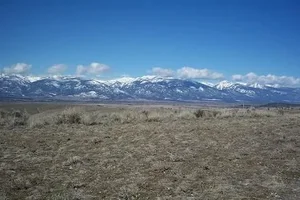
The first picture here is out our front door which shows the virgin land where we live. High desert, sage brush and not much else (9 - 12" annual rainfall).
The second picture will be of the back garden area.
Sylvia
One of the points that needs to be made is that it is important to leave the horizons alone as they mature and develop. The microorganisms that are alive and working are disturbed and in some cases destroyed every time you till. So layering and leaving it be is actually very important.
I mulch everything. From the annuals to the big trees. Whole tree chips which have all the nutrients necessary. Yes, the "pretty" dead limb/bark chips are popular with clients for the top dressing, but that can be added as the final layer (as Treebing described). Here at the house, we just spread everything out and it weathers to a uniform color in no time at all.
The first picture here is out our front door which shows the virgin land where we live. High desert, sage brush and not much else (9 - 12" annual rainfall).
The second picture will be of the back garden area.
Sylvia
Attachments
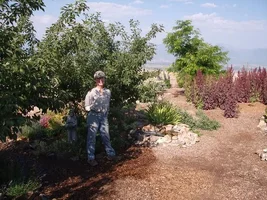
This second picture is of our back garden. We started accumulating chips in this area 6 or so years ago. As we have planted I just scoop the chips aside, plant and then replace the chips.
It IS important not to get raw chips down into the soil as this will be a factor in the nitrogen accessibility. This sometimes happens with my annuals and I then just use Miracle Grow to assist.
In this picture you see everything from the volunteer Orac in the background which is taller than I am to our young Honeylocust trees (2nd year). When the chips start getting low, we just add fresh whole tree chips to top dress.
We have cottonwoods in front of the barn with about 12" of chips in places. There are fibrous roots everywhere and we regularly go to -25 deg F. They are also exposed to high winds. They are doing fine.
One more thing, in an area of the back garden that is not shown, I have a spot where we "store" a large pile of chips for use. Totally exposed, no shade; last year we had 6 weeks of 90 to 100 deg weather, no rain. We put in a clothesline, dug down to bury the post in concrete and beneath the chips, the ground was moist. Really revealing on the moisture holding capacity of chips.
Sylvia
It IS important not to get raw chips down into the soil as this will be a factor in the nitrogen accessibility. This sometimes happens with my annuals and I then just use Miracle Grow to assist.
In this picture you see everything from the volunteer Orac in the background which is taller than I am to our young Honeylocust trees (2nd year). When the chips start getting low, we just add fresh whole tree chips to top dress.
We have cottonwoods in front of the barn with about 12" of chips in places. There are fibrous roots everywhere and we regularly go to -25 deg F. They are also exposed to high winds. They are doing fine.
One more thing, in an area of the back garden that is not shown, I have a spot where we "store" a large pile of chips for use. Totally exposed, no shade; last year we had 6 weeks of 90 to 100 deg weather, no rain. We put in a clothesline, dug down to bury the post in concrete and beneath the chips, the ground was moist. Really revealing on the moisture holding capacity of chips.
Sylvia
Attachments
- Location
- Haddonfield, nj
so i understand this a bit more, does the wood chips help or hinder the lively hood of organisms in the soil, ie worms and other aerating organisms, and, doesnt the heat singe the hair roots? some of what ive read says it can get up to 200 degrees while the decomposition stage takes place. does this have an adverse effect on the roots within the first 24 inchs of soil containing all the hair roots and absorbing roots? how about mytocorhize, is it effected by the temperatures? Or is returning the chips underneith the tree simply returning the organic layer to the tree that most sweep into a trash bag to be hauled away?
sorry for all the questions guys, like i said before, i am currently studying this and im trying to get a better understanding
sorry for all the questions guys, like i said before, i am currently studying this and im trying to get a better understanding

mdvaden
Participating member
- Location
- Beaverton. Oregon
[ QUOTE ]
It seems that if you want the chips to break down and feed the soil, you should just compost them,and then use that? I agree that chips will keep the soil cool, but to me 6" is a touch too deep. And I agree with Allmark, especially here in the NE, that you do not want fiburous roots in the "mulch" zone. They will certainly freeze and die. Roots should stay in the soil.
Why is bark mulch such a bad choice?
I usually spread compst under my mulch 2x a year, and remove my mulch in the fall and spring and put some leaf matter under there as well.
[/ QUOTE ]
I should correct one thing I wrote earlier, about how I don't apply more than a few inches. That's for landscaped areas.
But, about 18 to 20 years ago, when living on 2 acres, the lower acre was wooded.
Over the period of a few months, about 4 separate tree companies supplied me with like 30 loads of wood chips, that I spread into a 12" deep layer between trees in some of the clearings of the wooded area, tapering to about 3" approaching trunks. The layer settled to about 8" in a few months.
About 2/3 of the layer became fine compost-like in about 2 years. That's the main thing that caught my attention, was how quickly the thick layer decomposed, even though it was not in an actual compost "pile".
It seems that if you want the chips to break down and feed the soil, you should just compost them,and then use that? I agree that chips will keep the soil cool, but to me 6" is a touch too deep. And I agree with Allmark, especially here in the NE, that you do not want fiburous roots in the "mulch" zone. They will certainly freeze and die. Roots should stay in the soil.
Why is bark mulch such a bad choice?
I usually spread compst under my mulch 2x a year, and remove my mulch in the fall and spring and put some leaf matter under there as well.
[/ QUOTE ]
I should correct one thing I wrote earlier, about how I don't apply more than a few inches. That's for landscaped areas.
But, about 18 to 20 years ago, when living on 2 acres, the lower acre was wooded.
Over the period of a few months, about 4 separate tree companies supplied me with like 30 loads of wood chips, that I spread into a 12" deep layer between trees in some of the clearings of the wooded area, tapering to about 3" approaching trunks. The layer settled to about 8" in a few months.
About 2/3 of the layer became fine compost-like in about 2 years. That's the main thing that caught my attention, was how quickly the thick layer decomposed, even though it was not in an actual compost "pile".

[ QUOTE ]
so i understand this a bit more, does the wood chips help or hinder the lively hood of organisms in the soil, ie worms and other aerating organisms, and, doesnt the heat singe the hair roots? some of what ive read says it can get up to 200 degrees while the decomposition stage takes place. does this have an adverse effect on the roots within the first 24 inchs of soil containing all the hair roots and absorbing roots? how about mytocorhize, is it effected by the temperatures? Or is returning the chips underneith the tree simply returning the organic layer to the tree that most sweep into a trash bag to be hauled away?
sorry for all the questions guys, like i said before, i am currently studying this and im trying to get a better understanding
[/ QUOTE ]
FT, If you can get hold of the Volume 17, No. 3, June 2008 of Arborist News (which you should be getting if you are a member of ISA), there is an excellent article on page 12 by Jim Downer entitled Unraveling the Web of Soil Microbiology.
This knowledge is of extreme importance for every arborist to understand. Not necessarily to the level of a biologist but understanding the complexity and importance of what transpires under ground.
Soil without organic matter is just dirt. If you provide the shelter, food and protection that organic matter brings you will breathe life into the soil. This takes time. In most instances a minimum of 3 years. It is not the physical properties of the mulch that create the aereation of the soil, although that helps, but the movement of life within. This constant interaction can be a somewhat delicate balance because many of the involved parties are microscopic who are easily disturbed and damaged. Worms appear like magic with the addition of mulch. In areas we have mulched, you cannot put a shovel in without encountering one; in direct contrast to areas 50 ft away in the virgin soil you can't find a worm.
Six inches of raw tree chips will not create significant heat as opposed to six inches of say grass clippings. Heat is generated by a combination of oxygen, moisture and pressure. Without the pressure the microbial activity will take place, it just won't produce the heat.
Dave
so i understand this a bit more, does the wood chips help or hinder the lively hood of organisms in the soil, ie worms and other aerating organisms, and, doesnt the heat singe the hair roots? some of what ive read says it can get up to 200 degrees while the decomposition stage takes place. does this have an adverse effect on the roots within the first 24 inchs of soil containing all the hair roots and absorbing roots? how about mytocorhize, is it effected by the temperatures? Or is returning the chips underneith the tree simply returning the organic layer to the tree that most sweep into a trash bag to be hauled away?
sorry for all the questions guys, like i said before, i am currently studying this and im trying to get a better understanding
[/ QUOTE ]
FT, If you can get hold of the Volume 17, No. 3, June 2008 of Arborist News (which you should be getting if you are a member of ISA), there is an excellent article on page 12 by Jim Downer entitled Unraveling the Web of Soil Microbiology.
This knowledge is of extreme importance for every arborist to understand. Not necessarily to the level of a biologist but understanding the complexity and importance of what transpires under ground.
Soil without organic matter is just dirt. If you provide the shelter, food and protection that organic matter brings you will breathe life into the soil. This takes time. In most instances a minimum of 3 years. It is not the physical properties of the mulch that create the aereation of the soil, although that helps, but the movement of life within. This constant interaction can be a somewhat delicate balance because many of the involved parties are microscopic who are easily disturbed and damaged. Worms appear like magic with the addition of mulch. In areas we have mulched, you cannot put a shovel in without encountering one; in direct contrast to areas 50 ft away in the virgin soil you can't find a worm.
Six inches of raw tree chips will not create significant heat as opposed to six inches of say grass clippings. Heat is generated by a combination of oxygen, moisture and pressure. Without the pressure the microbial activity will take place, it just won't produce the heat.
Dave
- Location
- Haddonfield, nj
Thanks dave, I get a lot of magazines in one month, I try to read through them all but some are neglected. I'll make sure to dig up the article.
treebing
Been here much more than a while
- Location
- Detroit, Mi.
- Location
- North of Boston
How is the book "Up By Roots"? I have been looking for a good resource for soils, roots, organisms etc etc and this book has been mentioned. Andy good?

allmark
Participating member
I am currently dumping my chips in a pile and miking in horse manure and black clay/mud from a pond I dug. Hopefully in a few years it will be gold!
- Location
- North of Boston
[ QUOTE ]
I am currently dumping my chips in a pile and miking in horse manure and black clay/mud from a pond I dug. Hopefully in a few years it will be gold!
[/ QUOTE ]
Compost in some paperback sheetrock for the gypsum and lime content as well!
I am currently dumping my chips in a pile and miking in horse manure and black clay/mud from a pond I dug. Hopefully in a few years it will be gold!
[/ QUOTE ]
Compost in some paperback sheetrock for the gypsum and lime content as well!

Roger_Barnett
Participating member
- Location
- Seattle, in the PNWet
[ QUOTE ]
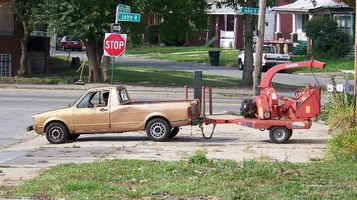
Treebing, There's a guy here in Seattle who pulls a 6" Promark with a tiny little mini-skid into backyards and the chips go right into the beds. I wish I had a picture.
[/ QUOTE ]
Yup, Tom,
Scott Mayer is quite the innovater, eh? And character.....
I oughta dig up the photos I have of his slick li'l rig....
Treebing, There's a guy here in Seattle who pulls a 6" Promark with a tiny little mini-skid into backyards and the chips go right into the beds. I wish I had a picture.
[/ QUOTE ]
Yup, Tom,
Scott Mayer is quite the innovater, eh? And character.....
I oughta dig up the photos I have of his slick li'l rig....
New threads New posts
-
test
-
-

-
 Alternatives to standard asphalt around roots
- Started by southsoundtree
- Replies: 18
-
-

-
