Pretensioning Crane Picks

It also depends on how accurate your estimates are.

If you estimate the weight but have no confidence in the number you're guessing.

If you have confidence you're either right or wrong.

On most picks, I put the pretension at my estimated weight or slightly below.
 
Theres a fast weigh to part the rigging and than have a 1000piece of loose lumber falling to the ground , or worse flip the crane backwards , alot of people forget about the boom passing the center pin and flipping over on its arse
 
I agree with the type of crane and the position of the boom being a factor.

Here's a question: If a standard boom style crane puts say 1000lbs of tension on a piece that weighs 2000lbs, what happens when the piece is cut off? I assume the operator has a brake for the winch, which I also assume would hold the piece in place, although the flex of the boom at a lengthy extension presumably would let the piece drop some too...that's a lot of -suming, anyone clear that up?
 
Depends on the situation, normally if you have 1000lbs on a 2000lb piece it will just pinch your saw, if it was a situation where the piece was allowed to drop, like say you were cutting a limb off, then the piece would drop, hitting the crane with a lot of force, if you had alot of boom out then there is a possibility that it could deflect enough to overload the crane and cause it to flip.
 
It also depends on the balance of the piece. I agree with classic it will pinch your saw if rigged balanced. If the CG is off though the piece could rotate or tilt of the cut which would allow it to shock the crane if the pretension was too low.
 
bigeyes.gif
Wow. I missed that thread.

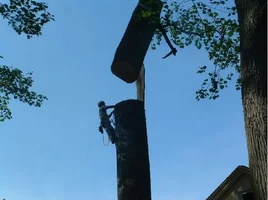
Was that due to pretensioning, or was the operator cabling up when the sawyer was cutting? (Looks like his saw is still proped up on top of the spar).

I've seen it happen when there is too many people in line to use hand signals when the operator is working "blind." The delay in hand signals can cause the operator to continue to cable up when the sawyer signaled 2 seconds ago to stop. I can see with a 175 tonner that a 2 second delay could be very dangerous. ---Just asking because I dont' know the full story.

Or, was it indeed the case of pretensioning way too much? Where he cut it and it popped...

255480-PoppedoffPickCrane.jpg
 

Attachments

  • 255480-PoppedoffPickCrane.webp
    255480-PoppedoffPickCrane.webp
    36.7 KB · Views: 44
Gord,

Like said above, it will depend on the orientation of the piece and how it is rigged. If it is a vertical pick (like your avatar) I would rather have too little on and then adjust it. It it is a horizontal, then I would say that close is alright as long as the operator makes the needed adjustment as it is begining to move one way or the other. The operator has to be involved as the piece comes to load the crane.
 
Lets just say that you were picking five ft. of the tree in your avatar , I would say that the only thing that would happen is the wood would settle on the saw or wedge til proper strain is taken , it would be almost the same as picking that wood off the ground , not really dangerous at all ..By the way that is a impressive hunk of wood there..
 
[ QUOTE ]
bigeyes.gif
Wow. I missed that thread.

Was that due to pretensioning, or was the operator cabling up when the sawyer was cutting? (Looks like his saw is still proped up on top of the spar).

I've seen it happen when there is too many people in line to use hand signals when the operator is working "blind." The delay in hand signals can cause the operator to continue to cable up when the sawyer signaled 2 seconds ago to stop. I can see with a 175 tonner that a 2 second delay could be very dangerous. ---Just asking because I dont' know the full story.

Or, was it indeed the case of pretensioning way too much? Where he cut it and it popped...

255480-PoppedoffPickCrane.jpg


[/ QUOTE ]

Jamin, this is a picture from a few years ago that someone posted on the Buzz. I don't remember the full story other then the climber saying that there was way too much tension at the beginning of the cut and that this was how high it popped.
 
A fellow I've worked with nearly died a few years ago when the butt pick of a large fir popped off the cut so hard it jumped over his head and pounded into the ground beside him. A number of factors caused the incident. Sloppy cut (bypassed cuts, possibly not actually severing the non-vertical grain in the stump), operator blind to the pick (no idea the size of it), miscommunication and/or poor estimation of the weight of the piece. Using a crane that was very overpowered may have been a factor. I'm not certain how experienced the crane operator was with lifting wood (guessing not very.)

And last cut of the day.
 
almost every pick is different and those differences are what is going to be dictating the amount of tension you want to put on the work. sometimes the boom tip isn't even going to be over center because you need the work to move from where you picking it. sometimes you want less on the line to allow the work to sit into the boom.

there are so many different variables that there isn't really a right answer to the question.

almost every pick is going to be different until you start working the butt picks. then there it starts to get the same-ish on pick'n.
 
Well, maybe not every time but most of the time, that's how I like to do it, shows me that I have the crane boom in the right spot.
 
Both of you are wrong. Not "one (1) cut everytime"....you two likely spend a lot of time stuck in your cut while you flap it with the op about which way to pull to get your poor little (censored) outta the cut.

And wasn't there something about you dropping a brand new 46 Mag or something like that OD?

Hey make a cut half way into the piece on the boom side....then make a perfectly matching cut on the back side into the first cut and ..........pop....off goes the piece no matter where the side pull is. Just keep yo head below the cut at detachment. Just like opening a can of coke.

Let's get her done....quit with all the drama lol.
 
and yes, sometimes I do get the saw pinched, usually just for a moment until I adust the boom a little, but last week I had it pinched really good in a very odd shaped piece and had to ask for another saw.

I feel that most of my problem was because I had gone 3 weeks without using a crane though, so I was rusty.

I like the straight through cutting because it helps me adjust the boom to just right so the pick doesn't move much when it comes off.

Which on a really big crane, movement isn't as much of a big deal as long as the crane has plenty of extra capacity I suppose.

I guess I don't feel our crane is "big" enough to be snapping off cuts.
 
[ QUOTE ]
and yes, sometimes I do get the saw pinched, usually just for a moment until I adust the boom a little, but last week I had it pinched really good in a very odd shaped piece and had to ask for another saw.

I feel that most of my problem was because I had gone 3 weeks without using a crane though, so I was rusty.

I like the straight through cutting because it helps me adjust the boom to just right so the pick doesn't move much when it comes off.

Which on a really big crane, movement isn't as much of a big deal as long as the crane has plenty of extra capacity I suppose.

I guess I don't feel our crane is "big" enough to be snapping off cuts.

[/ QUOTE ]

Also good (one cut method) when you are straightening up a cut, trunkwood or leader, that is leaning past you away from the crane until the tip is in line with the sheave and the cut (depending on the balance of the piece). Just wanted to point out that there are other cut alternatives. You and Justin saying ALWAYS make one cut.
 

New threads New posts

Back
Top Bottom