












Navigation
Install the app
How to install the app on iOS
Follow along with the video below to see how to install our site as a web app on your home screen.
Note: This feature may not be available in some browsers.
More options
You are using an out of date browser. It may not display this or other websites correctly.
You should upgrade or use an alternative browser.
You should upgrade or use an alternative browser.
Preferred method for solo rigging
- Thread starter Mcsmith
- Start date


evo
Been here much more than a while
- Location
- My Island, WA
Yup double whip the majority of the time. Using zip line slings, I’ve been enjoying the scarab from concurent or a big dan carabiner with a munter, 3/8s stable braid. My go to is natural friction and stub wraps though. Rarely rigging anything big enough to worry about burning it the bark solo.

Jehinten
Been here much more than a while
- Location
- Evansville
I just picked up some 3/8 stable braid myself. Really liking it so far. Are you saying you NC with that rope? Typically I avoid natural crotch with stable braid. Does it handle it ok? Mines only been used a couple of times and I can already see it getting fluffy from rubbing against a limbYup double whip the majority of the time. Using zip line slings, I’ve been enjoying the scarab from concurent or a big dan carabiner with a munter, 3/8s stable braid. My go to is natural friction and stub wraps though. Rarely rigging anything big enough to worry about burning it the bark solo.

Mick Dempsey
Carpal tunnel level member
- Location
- France
Anyway, climber doing the lowering, I’m a big fan.
Frees up a groundsman, keeps the job moving at a good rhythm.
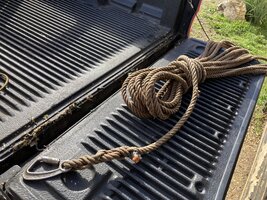
Here’s my weapon of choice, no one needs an aerial friction device, you’ve got stubs and wraps and what’s between your ears.
I love this rope, light and durable, cheap as chips, gives you more friction, both in the hand and around the tree, won‘t glaze and you can run stuff when you get confident.
Doesn’t need to be long as it only has to reach the ground with enough tail for the climber.
I spliced in a fixed eye Krab on one end.
This is only for light to medium stuff, big stuff gets the POW etc.
Frees up a groundsman, keeps the job moving at a good rhythm.
Here’s my weapon of choice, no one needs an aerial friction device, you’ve got stubs and wraps and what’s between your ears.
I love this rope, light and durable, cheap as chips, gives you more friction, both in the hand and around the tree, won‘t glaze and you can run stuff when you get confident.
Doesn’t need to be long as it only has to reach the ground with enough tail for the climber.
I spliced in a fixed eye Krab on one end.
This is only for light to medium stuff, big stuff gets the POW etc.
Attachments

Muggs
Been here much more than a while
- Location
- Canuckistan
Agreed, 3-strand is perfect friction up top. That's quite the splice there mate, new one on me...Here’s my weapon of choice, no one needs an aerial friction device, you’ve got stubs and wraps and what’s between your ears.
Mick Dempsey
Carpal tunnel level member
- Location
- France
Ha ha! I know, seems to hold though.Agreed, 3-strand is perfect friction up top. That's quite the splice there mate, new one on me...
Mcsmith
New member
- Location
- Alexandria
Anyway, climber doing the lowering, I’m a big fan.
Frees up a groundsman, keeps the job moving at a good rhythm.
Here’s my weapon of choice, no one needs an aerial friction device, you’ve got stubs and wraps and what’s between your ears.
I love this rope, light and durable, cheap as chips, gives you more friction, both in the hand and around the tree, won‘t glaze and you can run stuff when you get confident.
Doesn’t need to be long as it only has to reach the ground with enough tail for the climber.
I spliced in a fixed eye Krab on one end.
This is only for light to medium stuff, big stuff gets the POW etc.
This is what I’ve been thinking but have had too many people pushing to recommend all the fancy tools. I feel there is a place and time to have rings all over the tree to spread out the forces but for my purposes it just keeps making sense to keep it simple. I was taught with a three strand and wraps on the tree and it took some time before I even ever seen a POW. I just bought a new climb line and planned to just use my old one for a natty rope on double whip but maybe another short three strand will solve this easier on these small jobs.
I really appreciate all the input. Always looking to learn more and keep improving.
Sent from my iPhone using Tapatalk
Last edited:
Merle Nelson
Been here much more than a while
- Location
- SF Bay Area, CA
Mcsmith I could have "bit my tongue" and just moved on but, you just had to put that last sentence in there didn't you. 
In my opinion three strand has its place and I'm glad Mick brought it up. I tend to forget about it. I'll keep it a little more top of mind as an option. (I just bought a specific hank of 3/8s three strand for this.)
Some of the advantages of fancy devices include: not damaging bark on keeper trees, reduced twisting and hockeling of rope, less wear on rope, more consistent friction, mid line attachable with the right devices, quicker turn around for the next turn - especially when rigging multiple turns from the same area and etc.
Also after doing something 10 times, 100 times, or 1,000 times, at some point learning and improving may be a vital part of what keeps the next day fun and interesting.
In my opinion three strand has its place and I'm glad Mick brought it up. I tend to forget about it. I'll keep it a little more top of mind as an option. (I just bought a specific hank of 3/8s three strand for this.)
Some of the advantages of fancy devices include: not damaging bark on keeper trees, reduced twisting and hockeling of rope, less wear on rope, more consistent friction, mid line attachable with the right devices, quicker turn around for the next turn - especially when rigging multiple turns from the same area and etc.
Also after doing something 10 times, 100 times, or 1,000 times, at some point learning and improving may be a vital part of what keeps the next day fun and interesting.
Mcsmith
New member
- Location
- Alexandria
Mcsmith I could have "bit my tongue" and just moved on but, you just had to put that last sentence in there didn't you.
In my opinion three strand has its place and I'm glad Mick brought it up. I tend to forget about it. I'll keep it a little more top of mind as an option. (I just bought a specific hank of 3/8s three strand for this.)
Some of the advantages of fancy devices include: not damaging bark on keeper trees, reduced twisting and hockeling of rope, less wear on rope, more consistent friction, mid line attachable with the right devices, quicker turn around for the next turn - especially when rigging multiple turns from the same area and etc.
Also after doing something 10 times, 100 times, or 1,000 times, at some point learning and improving may be a vital part of what keeps the next day fun and interesting.
Definitely the devices have advantages but for my current situation I am mainly doing removals and the rigging I am doing is just enough to avoid small obstacles. The company I’m joining did not have a tree service side and mainly focused on lawns and landscaping so we don’t have the budget to dive into tons of gear up front and I’m building from a small client base so I have to get the work load up to justify all the new equipment. More of our budget is being focused on more saws and a chipper so most of the gear has been provided by me and I’m not in a spot to keep buying yet. Really want to make sure the purchases I can make are very thought out and not on equipment I won’t use.
Sent from my iPhone using Tapatalk

southsoundtree
Been here much more than a while
- Location
- Olympia, WA
Double-whip tackle and speedlining can sometimes be done with a natural crotch instead of a false crotch (sling and biner).
Mcsmith
New member
- Location
- Alexandria
Double-whip tackle and speedlining can sometimes be done with a natural crotch instead of a false crotch (sling and biner).
I’ve done this a few times. Saves on slings for future pieces when you leave strategic stubs to hang them by. Forgot about it until you brought it up. I have a good tree tomorrow to give some new techniques a test run. Thanks guys. So thankful for the community here.
Sent from my iPhone using Tapatalk

Guys talking about double whipping and using 3/8" rope had me wondering. In a typical double whip set up what are the forces on the devices and ropes? Using the smaller ropes and friction devices? What if you moved up to larger pieces and redirected down a spar to a porty?
Merle Nelson
Been here much more than a while
- Location
- SF Bay Area, CA
Lawrence Schultz does this a lot when getting up to log size weights to lower. Frequently Hobbs device on the ground rather than porty.
Oh, I just went back and see I'm outside the focus of the thread on that.
Oh, I just went back and see I'm outside the focus of the thread on that.
Mcsmith
New member
- Location
- Alexandria
Guys talking about double whipping and using 3/8" rope had me wondering. In a typical double whip set up what are the forces on the devices and ropes? Using the smaller ropes and friction devices? What if you moved up to larger pieces and redirected down a spar to a porty?
What Merle said for sure. The double whip does decrease forces but I normally use a 1/2 inch rope because it’s what I have and nothing I rig is big enough to concern too large of a force. But I will switch to a method like you are describing if I have a ground guy who is capable of running ropes and the tree is a good candidate for the system.
Over the past week I’ve tried a few different solo techniques and I feel basic natural crotch double whip is the best to fit my needs in most trees. One this morning I even used a neighboring tree to move my pieces to a better drop zone to clear an intersection of fences. All solo rigged and low stress
Sent from my iPhone using Tapatalk

Treetopflyer
Been here much more than a while
- Location
- Coastal N.J
I’d be double whipping/ span rigging under these circumstancesI do a bit of both. Most of the solo is side jobs that any rigging isn’t highly critical situations but just to add some help in tight spots. I don’t solo rig anything in a situation that would allow a major failure like large pieces over a house. Right now im teaming up with a lawn company with tons of clients who need tree work but the company doesn’t offer trees. So I climb and handle the bidding while the company sends guys out to drag brush and use their equipment/trucks to haul away debris. It’s a pretty sweet deal but I don’t get a ton of time with these guys to train them so it makes it more practical to rig solo what I can and let them untie or send up slings in between trips with brush.
I’d like to just look at it as if I’m on my own because the experience level of some of the guys is going to be low enough that I don’t want to risk them causing any other problems for me to solve.
Sent from my iPhone using Tapatalk
Mcsmith
New member
- Location
- Alexandria
I’d be double whipping/ span rigging under these circumstances
That’s what I’ve been doing since discussing it more. I used the technique in the past but have always been in the mindset that there may be a better way to do things. And the guys and girls on here have some genius ideas and some old school tricks so it makes sense to ask around. Thank you
Sent from my iPhone using Tapatalk
Mike H
Participating member
- Location
- Boulder County
I use 1/2" lowering lines and two rigging rings. One ring below the cut as my primary rigging point and the other below my feet as a friction device. I let it run without having my hands being too close to the rigging
Muggs
Been here much more than a while
- Location
- Canuckistan
Clever solution. Easy to do when one-handing the top handle saw. I might have to try that...I use 1/2" lowering lines and two rigging rings. One ring below the cut as my primary rigging point and the other below my feet as a friction device. I let it run without having my hands being too close to the rigging
Mcsmith
New member
- Location
- Alexandria
I use 1/2" lowering lines and two rigging rings. One ring below the cut as my primary rigging point and the other below my feet as a friction device. I let it run without having my hands being too close to the rigging
Just so I’m picturing this right, this would be on a single lead with the rings about 6-8 feet apart but in line with each other?
Sent from my iPhone using Tapatalk




















