Possible reason for the Akimbo Delay.

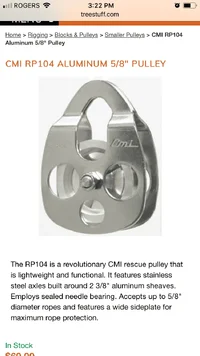
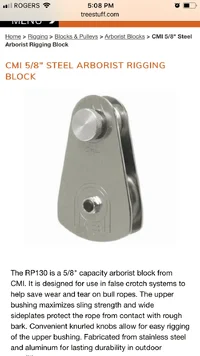
Not trying to pick apart this new pulley it looks great. But what makes it so much better and worth the extra cash over this comparable com pulley.
I know they’re different but being on the cmi now and looking what’s the reason to go for this upgrade?
A quick look shows almost double the breaking strength (16000lb vs 30000lb) , a larger rope diameter capacity (5/8 vs 3/4), a swiveling attachment point (unless you've used one you don't really appreciate just how nice that is), you can put the rope into and out of the pulley WITH OUT disconnecting it from it's anchor point (which is awesome to not have something extra to drop), and it has a tab on it to mind a progress capture prussik which is absent on the cmi pulley

whether it's worth the price difference is up to you (me personally i'm not sold on it, I'm content with the smaller omni blocks for the time being)
 
I run these and when it comes to shock load I bring out my xrrs.

As far as swivel how much improvement do you noticeably get compared to just letting the twist of the sling,biner,block work it out?
 

Attachments

  • B402ED37-663B-4EA2-87B7-A48572406B15.webp
    B402ED37-663B-4EA2-87B7-A48572406B15.webp
    73.5 KB · Views: 18
  • 1EFD59D5-2CCE-4D16-A521-5D5BA2A40B5D.webp
    1EFD59D5-2CCE-4D16-A521-5D5BA2A40B5D.webp
    76.8 KB · Views: 17
The OmniBlocks really shine when you use redirects on the rigging line. When every pulley in the system between the friction brake and the primary block swivel to self-align, the rope isn't dragging (under load) across the side plates of multiple devices, and rope wear is reduced. Friction is less, which matters if you need to lift the piece a little or keep tension applied. It all just runs smoother, and you can tell it... the noise level of rope-on-metal is lower.

I usually am using my wife for the groundie, and I don't want her in the landing zone, so I redirect the line so that she doesn't need to enter it until the piece is on the ground. Since switching to the OmniBlocks, we can set up for this pretty quickly (the pulleys are all midline attachable) and I can keep the riggling line redirected so that it can't interact with the load, as it can when it goes straight up to the block and the load is swinging. It only takes a little bit of tension to pre-align the redirect pulleys and pull them out from against the tree, where you can get a quick visual of the whole setup and spot any issues (such as a branch that dropped across the line somewhere, a stub that might be an issue, etc.) which I rather like. I can also immediately see if the redirect above the friction brake needs to be reset, as this one can sometimes twist around the trunk to where the feed into the brake isn't good. Little stuff that I found just makes them nice to work with.

There certainly isn't anything they do that is required... lots of ways of getting the rigging done, they're just nice to use because of their feature set. Negative blocking, I always switch the primary out for an impact block. Otherwise, I use the 2.6" OmniBlock, and the 2.0" ones for the redirects.

They are extremely useful for other, non-tree stuff, as well. I think this new, big one is being marketed primarily as a lifting block in non-arbor industries.

 
The OmniBlocks really shine when you use redirects on the rigging line. When every pulley in the system between the friction brake and the primary block swivel to self-align, the rope isn't dragging (under load) across the side plates of multiple devices, and rope wear is reduced. Friction is less, which matters if you need to lift the piece a little or keep tension applied. It all just runs smoother, and you can tell it... the noise level of rope-on-metal is lower.

I usually am using my wife for the groundie, and I don't want her in the landing zone, so I redirect the line so that she doesn't need to enter it until the piece is on the ground. Since switching to the OmniBlocks, we can set up for this pretty quickly (the pulleys are all midline attachable) and I can keep the riggling line redirected so that it can't interact with the load, as it can when it goes straight up to the block and the load is swinging. It only takes a little bit of tension to pre-align the redirect pulleys and pull them out from against the tree, where you can get a quick visual of the whole setup and spot any issues (such as a branch that dropped across the line somewhere, a stub that might be an issue, etc.) which I rather like. I can also immediately see if the redirect above the friction brake needs to be reset, as this one can sometimes twist around the trunk to where the feed into the brake isn't good. Little stuff that I found just makes them nice to work with.

There certainly isn't anything they do that is required... lots of ways of getting the rigging done, they're just nice to use because of their feature set. Negative blocking, I always switch the primary out for an impact block. Otherwise, I use the 2.6" OmniBlock, and the 2.0" ones for the redirects.

They are extremely useful for other, non-tree stuff, as well. I think this new, big one is being marketed primarily as a lifting block in non-arbor industries.

Yep, great points. Such a well written/knowledgeable post. People underestimate the value of the swivel and the quality/James Bond operating smoothness of the omnis, all of them.


Sent from my iPhone using Tapatalk
 
Not trying to pick apart this new pulley it looks great. But what makes it so much better and worth the extra cash over this comparable com pulley.
I know they’re different but being on the cmi now and looking what’s the reason to go for this upgrade?

The omni 2.0 is my most versatile piece of kit - redirects (uncommon because I have just one and it is usually used at the termination of my system), terminal 1/2" rope rigging, span rigging (super useful), and speedlining. When it is hard to maintain good work position, the omni 2.0 on a tenex sling makes up for it by requiring little set up. I just chuck it around the branch, facecut if necessary, run the rope through and click shut with one hand. That often saves me a lot of lactic acid buildup, especially if the tree has several branches where work position is hard to maintain.

On a side note, once they figure out the double push release, new groundies have an easy time getting it off a branch and sending it back (and with other things attached).

The pictured CMI would never come out unless I really needed 5 pulleys. There is no number of them that I would trade for one omni 2.0, unless I could sell them and buy two omnis. :)
 
Yeah, you get spoiled on them real quick. I use the 1.5 OmniBlocks for DdRT canopy anchor, so I never use them for rigging... so, now I want two more of the 2.0 ones...

Nothing like the speed of installing or changing your setup with OmniBlocks on an UltraSling. Once you get the hang of that double clicky opening system, you can do it blind.
 
So did RE come out with two of these MHP's? I'm seeing a "MHP-55" model & it's a 2.6" design.

While were talking about RE, does anyone use the Buckinham OX Block that I'm assuming RE makes.
 
2.6 mh has been out for a while now. At least a year probably longer

Oh ok.. that's why there's no one buzzing about it in this thread.. gotchya..

So what's going to be the difference between the normal Omni 2.6 & the MHP 2.6? I breifly looked at it & quickly saw the 1/2 limitation as well as the unit of measurement being in LBF vs the Omni being KN.. I didn't have the patience of doing the calculations at the time so i moved on to finish what i was actually on the site for..
 

New threads New posts

Kask Stihl NORTHEASTERN Arborists Wesspur TreeStuff.com Teufelberger Westminster X-Rigging Teufelberger
Back
Top Bottom