Piggy Piggy Pull

TreeCo

Carpal tunnel level member
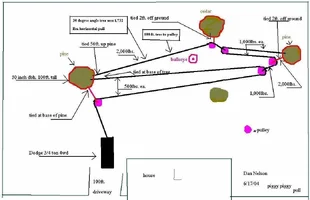
A couple of years ago I pulled over a large pine that had some backlean. The house was in striking distance and there was only one open spot in the yard for the drop.

Before the first cut was made the rope was tensioned so all of the rigging would be set in place and the amount of sway produced in the tree could be observed. Tension was then totally released and then reset so a small amount of sway was produced. The wedge and back cut were then made leaving 3 inches of hinge wood and then the tree was pulled over.

All comments are welcome.
 

Attachments

  • 63646-TreePull4.webp
    63646-TreePull4.webp
    54.1 KB · Views: 255
Hey, I know whats going on here!

Its a 'Who can fox the rest of us with the most complex rigging drawing' competition.

Why make it a 2 horse race...any others entries?
bud.gif


(You did say ALL comments welcome, TreeCo
grin.gif
)
 
Pretty slick 4x. i think that the center line to target pine could be placed on load from anchor position on that same tree.

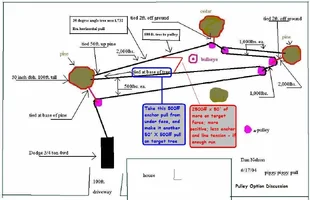
Of curse this is more of my underhanded/ 2handed strategies; only with insetting to make a kind of Double Spanish Burton(?); by virtue of both ends of the first sytem working on load/ not directly on anchor. But none the less; would be more power(5x instead of 4x); less truck slippage; less line tension; less anchor loading etc. dangers and a straighter pull to target; with the flip of this 'switch'.

But; i still want to keep it fer my collection!

edit: The Cedar position is a pulley position that because of the rope angle; the pulley has leverage over line tension. Instead of the line tension having leverage over/ less than the pulley (2:1) in U shape/ Zer0 degree pairallell. As the pulley tension and line tension each cause the other; in this degree range pictured the; pulley has leverage over/ is less than the line tension. (as example of previous discussion)

orrrrrrrrrrrrrrr sumetin like that
crazy.gif
 
i altered pic to show what i meant. This alteration uses the initial pull as a 2/1 compounding into another 2/1 as Dan laid out; and also as another pull on the target tree; with just as much line. Free Power!

Another thing about using pulleys like this and ol'man's setup; is that even using one pulley as 1:1/ no power increase/ low redirect helps IMLHO by just pulling equal and opposite straight back on the truck by the tree force. Rather than if same line tension pulling down straight from tree top; which then in response pulls back on truck and also at an upwards angle as equal/ opposite. This lightens back of truck for less traction on rear wheel drive; along with the backwards pull on truck for a compounding effect.

i all ways load truck, and look for good ground; and try for this redirect at least; all for positive traction.
 

Attachments

  • 63817-treecodanpiggypulley.webp
    63817-treecodanpiggypulley.webp
    70.8 KB · Views: 153
Now that's what I'm talkin' about. I've never used the base of the tree being felled as an anchor, it never occurred to me, maybe never needed to, but I'll definitely remember that option in the future.

Spyder, I also liked your suggestion. In fact, at first glance at Treeco's diagram, I thought that's what he did.

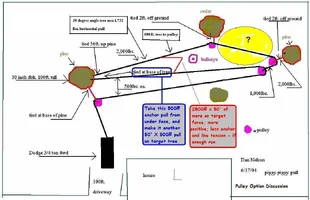
We can assume his rigging was adequate for getting the pine down, so, if we use your revision, Spyder, can we eliminate the moving block rigged to the other pine? Or will we end up having to pull harder than with the original rigging? (see attachment)
 

Attachments

  • 63818-63817-treecodanpiggypulley.webp
    63818-63817-treecodanpiggypulley.webp
    72.9 KB · Views: 128
That is some pretty complex rigging. It must have been really large with quite the backlean.

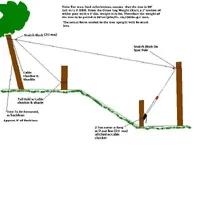
A few years back I did a pine takedown for someone with a lake house out on an island. Very much like what you did only there was no way to drive out on the island so I used come alongs instead. I used a Tailhold block at the base of one tree, a block in the pull tree, and another redirect block in an adjacent tree.

Could barely feel the pull in the come along as I was pulling it over. See the diagram.
 

Attachments

  • 63821-pull-tree.webp
    63821-pull-tree.webp
    42.1 KB · Views: 132
i think Dan did fine; but in discussion; i think that eliminating the yellow area in ol'man's reprint and anchoring the free ends would eliminate the 4x link to target tree (Dan's original line pull). Placing pulley in where the 2 pull lines on taret are would remake that into a 2x; but a spread 2x, which is good directionally for target hitting mark; and bad for power drop?


Chris gives good perpendicular angle of line to tree. If just playing 2nd guessing devil's advocate of Monday Mourning Footbal fame:

The angle of 2x pull is open; would consider closing it by rising anchoring on psot on hill higher; this places more leverage agaisnt that anchor; so would fortify that position with line to short post on ground. Now, the pull towards target by that reinforemeant; in itself reinforces post some against the come-along pull as an added extra to clsoing the angle on tree pull. Of course i'd consider reinforcing the main spar comealong pulls so highly leveraged on; with a line to opposite direction of pull; especially if the lean / head weight wasn't to that direction aleady.

Come-along's main power is in 1st, lowest turn on drum; starting 2nd tier on drum gives power ratio drop. But, we want round turn on drum at least, so that pull doesn't go directly to cable termination in drum. So, always keeping round turn on drum, i like prusik on line to comealong; to pull, lock off line and re-extend comealong into it's power band as much as possible right before main pull.

An insetting/ 2Handing Spanish Burton/ closing the system more type pull here wouldn't gain anything. If we placed pulley under comealong and extended the line from hill post to pulley under comealong we would get the pulls from both ends of the comealong(main pull and it's equal/opposite); so double force, but then we'd 'lose'the double force on tree pulley to break even!
 
Thanks for the feedback fellows. Good job Spider, you did find 500lbs. of free pull!

Attached is a photo of the gear I used in this solo felling job.

1) 200ft. 7/8 inch Sampson rope
2) 150ft. 5/8 inch Sampson rope
3) 150ft. 5/8 inch Sampson rope
4) 40ft. 5/8" Sampson rope.
5) One 2Ton swl Crosby block 1" capacity.
6) One 2Ton swl Buckingham block.
7) Three 2Ton swl Crosby blocks 5/8" capacity.
8) Two 20ft. 7/8" chokers for blocks.

There was about 1/2 hour set up time from the throw line to the felling cut. Milk crates work great for storing large ropes. I use eight for rope and gear storage. Crates are free, allow visibility, promote drying and they stack nicely too.

Dan

63839-Ropes.jpg
 

Attachments

  • 63839-Ropes.webp
    63839-Ropes.webp
    96.3 KB · Views: 109
Sorry but We stick a line up said tree, and attach a large winch to it, Most trees come over nicely on the 5 Ton PTO Winch at 540rpm. Some have to be pulled a bit quicker at 1000rpm.

Maybe we have the power behind us not to have to wory about mechanical advantages.

We have used 2 snatch blocks once but that was due to not being able to get the tractor in the garden. first block up high to cross the fence, second to align with the backleaning tree.

I would never dream of felling a tree that needed pulling on my own. I want a winchman to adjust the wire if the cutter needs it. Wee bit extra tension here or there.

One guy felling and winching in critical situations aint good. Sorry

Jamie
 
Ok, even better than just commenting, If i was given that situation i would have done this

that is purely based on what your picture said to me, i obviosly dont know what the garden layout was like, if you could get a vehicle into that space etc?

sometimes i think that less is more.

the wood cutter would exit to the top of the picture away from the flight path of the snatchblock in case it failed. Our kit is very unlikely to fail but safety first huh?

Jamie
 
[ QUOTE ]
Ok, even better than just commenting, If i was given that situation i would have done this

Jamie

[/ QUOTE ]

Jamie,

I would use a Unimog with a winch too if I had one.
 
Efficiency

o heck; i'll take 2 their small!

i like milk crates too; they drain and breathe; but then must use their 'drawer' effect for protection overhead from cats and contanimants.

Large blocks with large sheave to axle ratio are very good for system efficiency. A pulley's efficiency is determined by the type of friction at axle (bushing or bearing); and then the sheave's diameter to axle diameter ratio leverge over that friction. Thus a larger wheel barrell tire on same axle will be easier to push, make less revolutions and thereby last longer (but; less drop to ground angle may make it harder to start though!) IMLHO.

Pulley efficiency compounded in a system is so important that a bearing pulley can sell for a couple of times more than a bushing one (bushing more friction, but survive impact forces when bearings won't; making expensive pulley worse than cheap one after impact); yet sometimes there is only 5-8% more efficiency in the more delicate and expensive choice! But, high efficient pulleys also have a 'silkier' feel to the system.

Pull angle is also a power loss variable; good at a non moving anchor end (less anchor load) but bad on a moving input/output pulley position. Whereby the losses by friction matter at all points to the system power.

Efficiency loss from compounding pulley (and line rubbing it self) frictions in a system can really rob power quick; maybe not so much individually; but in the compounding of these resistances and their lessened multipliers output pulling on target.

A rope Z-rig with no metal parts/accessories may only have an actua output of 1.5x from 3x pull potential; subsequent frictions(like extendign rope only z's 3x to 5x) after that really add up with even greater magnatude to quickly get less than 1x power output after frictions. But, sweating purchase from each line and using the friction to keep purchase changes all that.

This of course if pulling/lifting/tensioning/compressing is target. For holding or lowering/stretching/extending friction is friend, but angles and 2handing help

Reusing pulls, looking at 2Handing and insetting/Spanish Burton type strategies of the same using output force and it's equal and opposite to target can give more power with less frictiona nd angle loss risks IMLHO. System efficiency is can be very important; less loading of anchors, lines, traction loss etc.; giving higher SWL and less elasticity.

 

New threads New posts

Back
Top Bottom