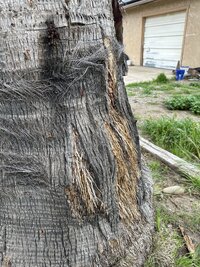
Palm Tree Help!

Hey Y’all,
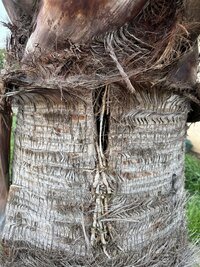
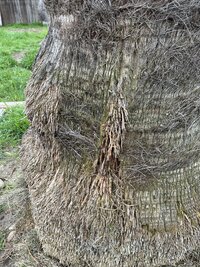
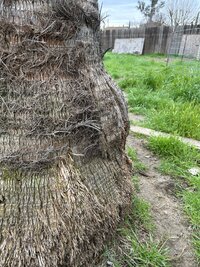
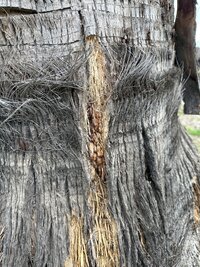
Can anyone help me figure out what is going on with this Mexican Fan Palm?? It appears to have been damaged .. there are rusty nails around the trunk and holes from a hammer. Tree is starting to lean towards a house. The fronds appear in good health still. There are budging areas along with root type strings coming out of holes and bulging areas… never seen this before and can’t find anything online. All this is taking place in the bottom 5ft of the trunk.
Any help or ideas on what this is would be greatly appreciated!
 

Attachments

  • 51298DA8-F054-4FF0-B58E-E5CF40DF30DE.jpeg
    51298DA8-F054-4FF0-B58E-E5CF40DF30DE.jpeg
    1.1 MB · Views: 17
  • FC49756F-C4B8-489D-AFBA-F948E9BB4C10.jpeg
    FC49756F-C4B8-489D-AFBA-F948E9BB4C10.jpeg
    1.3 MB · Views: 14
  • D5D75139-42C9-4E14-8968-4A38E9C25E3A.jpeg
    D5D75139-42C9-4E14-8968-4A38E9C25E3A.jpeg
    1.2 MB · Views: 15
  • 1DBA9188-E6AC-4C5E-A33E-9CF5025D7DAB.jpeg
    1DBA9188-E6AC-4C5E-A33E-9CF5025D7DAB.jpeg
    1.1 MB · Views: 15
  • EEFCDC4C-91CB-4E88-A605-70546CD352A7.jpeg
    EEFCDC4C-91CB-4E88-A605-70546CD352A7.jpeg
    1.1 MB · Views: 15
I've seen that happen when they're consistently hit with the irrigation. Check the yard maintenance situation for ignorant landscape maintenance practices.
 
I've seen that happen when they're consistently hit with the irrigation. Check the yard maintenance situation for ignorant landscape maintenance practices.
Thanks, no irrigation system.. the only water it receives is from rain or from the dog water dishes that are placed right next to the tree.
 
Bamn, sound like that might be it man....... Been one hell of a winter eh, summer temps were below normal which now seems like it was some kind of weird prelude of what was to come
Do you know what it is though( like a disease )? Or is the trunk just expanding due to so much moisture? Concern is if it fails would fall into the house onto a room where kids are, also taking out their satellite dish. I’ve personally never seen this before so not sure how to proceed or what to recommend. Thanks!
 
Yeah from expanding too fast but that could be an infection site also ya know, if it was just vertical cracks I don't think they worry too much. Looks like it might have a history of cracking and the large one doesn't look very new. Maybe someone on here is a palm guy and might know more, there is PalmTalk.org you can check in with also.
 
Last edited:
Yeah from expanding too fast but that could be an infection site also ya know, if it was just vertical cracks I don't think they worry too much. Looks like it might have a history of cracking and the large one doesn't look very new. Maybe someone on here is a palm guy and might know more, there is PalmTalk.org you can check in with also.
Thanks, i appreciate all your help! I will check that site out too.
 
This appears to be new and higher root initiation areas. This may or may not be due to moisture fluctuations, and is often considered a "normal abnormality" in a healthy palm. Root initiation will create fissures in the trunk to accommodate the new roots. Compare to examples in this document:


As to the purported lean of the palm, do you see soil heaving on the side of the palm opposite the lean? Have you documented actual movement in the palm stem? Palms are very phototrophic and long lived, so their stems may lean in different directions due to the influence of other trees, some of which may no longer be there. Look for corrected lean in the upper part of the palm. If it has curved straight up, then you can infer a well anchored palm which has adequately adjusted to its environment.

If you really think it's moving, again look for soil heaving on the back side of the trunk relative to the lean. You can also tack a flat piece of steel stock (or anything else providing a flat surface) to the trunk with a couple roofing nails (they have big heads and are easy to find and remove afterward). Use the piece of steel as an index, against which to lay a digital level, or if you have a leveling app on your phone, you can use that. Note the degree of lean and check it again at an agreed upon interval of no more than a week. As long as your base plate index hasn't moved and nothing is changed on your housing of your phone or your level, you'll immediately know whether you're getting a different reading, implying movement and high risk of failure, or if the palm simply has a lean which has been corrected over time.
 
This appears to be new and higher root initiation areas. This may or may not be due to moisture fluctuations, and is often considered a "normal abnormality" in a healthy palm. Root initiation will create fissures in the trunk to accommodate the new roots. Compare to examples in this document:


As to the purported lean of the palm, do you see soil heaving on the side of the palm opposite the lean? Have you documented actual movement in the palm stem? Palms are very phototrophic and long lived, so their stems may lean in different directions due to the influence of other trees, some of which may no longer be there. Look for corrected lean in the upper part of the palm. If it has curved straight up, then you can infer a well anchored palm which has adequately adjusted to its environment.

If you really think it's moving, again look for soil heaving on the back side of the trunk relative to the lean. You can also tack a flat piece of steel stock (or anything else providing a flat surface) to the trunk with a couple roofing nails (they have big heads and are easy to find and remove afterward). Use the piece of steel as an index, against which to lay a digital level, or if you have a leveling app on your phone, you can use that. Note the degree of lean and check it again at an agreed upon interval of no more than a week. As long as your base plate index hasn't moved and nothing is changed on your housing of your phone or your level, you'll immediately know whether you're getting a different reading, implying movement and high risk of failure, or if the palm simply has a lean which has been corrected over time.
Thank you so much for this.
Soil hasn’t moved at all. I will definitely try the level thing and check it periodically and see.
There have never been any trees surrounding this one, it has always been by it self behind a house. Was transplanted to its current spot maybe 27 years ago.
Again thank you for all this, it was very insightful and helpful and I will look at that link you sent too.
Your help is much appreciated!!
 
Thank you so much for this.
Soil hasn’t moved at all. I will definitely try the level thing and check it periodically and see.
There have never been any trees surrounding this one, it has always been by it self behind a house. Was transplanted to its current spot maybe 27 years ago.
Again thank you for all this, it was very insightful and helpful and I will look at that link you sent too.
Your help is much appreciated!!
You are very welcome. If the palm hasn't been subject to phototropism, what you may be seeing is thigmomorphogenesis. Plants will also alter their growth to respond to load stimuli (like wind). Please post in here as you continue your site assessment and let us know your findings!
 
Looks like cracks associated with rapid growth and/or arrested root development which is a sign of maturity that in general appears to be expedited by frequent irrigation hitting the trunk. Typically not a structural concern or weakness but probe, sound and perform your own assessment.
 
From the pictures provided, it looks like this is a response growth to drought seeing that root growth is coming out of trunk area, above soil level. Some of our palms also develop like a "root skirt" above ground level, maybe to catch moisture not being caught from within soil.
Do let us know what you find out.
 

New threads New posts

Kask Stihl NORTHEASTERN Arborists Wesspur TreeStuff.com Teufelberger Westminster X-Rigging Teufelberger
Back
Top Bottom