Overthinking, a Minimal Friction Hitch model

TheTreeSpyder

Branched out member
Location
Florida>>> USA
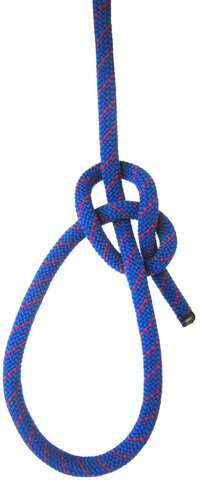
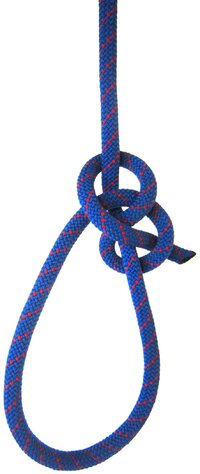
This has been a great friction hitch for me for UTILITY use;
It is a Blake's -1 turn as pre-fix and post-fix of uninterrupted Round Turn(RT) as work horse.
i recommend using for life/rescue proven hitches, this is easier to make tho for other stuff.
Actually before "Blake's" was popularized thru Arborist's, it was shown as what now is called Pro(h)Grip by Heinz Prohaska in Nylon Highway for Austrian guides.
So, i call/kiddingly this internally as a Half-Pro(h) , made more intense by adding a ring back, but not to the interrupted turns that would be a Blake's again, but rather to the un-interrupted turns to take from workhorse of Round Turn(RT) to a Double Round Turn(DbRT?), so kiddingly in head is a Double-Half Pro(h)(jest as kid at self in calling thread overthinking)! Very manageable, and especially easier to make in smaller stuff.
.
No one has told me before these are pre-named etc. can let me know if so, to name if necessary to even name..to me these are jest mechanical parts make a build with, can be the only start in show or a component of a system etc.
But really my focus is a more 'transparent'/cleaner view of a minimized friction hitch to understand the rest of the non-tresse types/parts by. Knots to me are simply geometries of mechanics made in rope material.
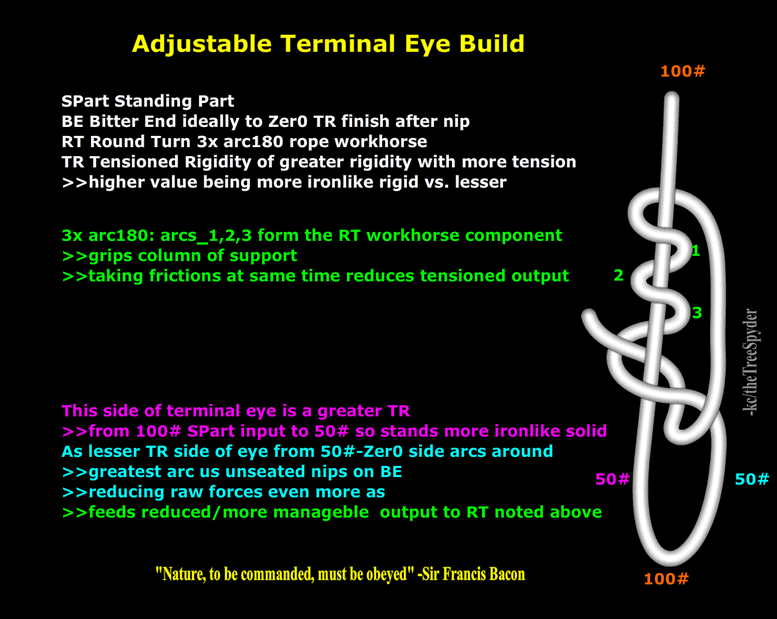
adjustable-terminal-eye-build.png

i highlight TR/Tensioned Rigidity as a major, overlooked, don't see other references, very active part of the mechanics, expressed very cleanly in this build, especially in legs to eye being equal pulls, but the one with the full load at opposing end of eye is much more rigid, so other leg MUST be the one to give way, and bend to it, not from it.
.
Another view of this as kind of a close relative inversion of Adjustable Hitch (shown slipped),
330px-Adjustable_grip_hitch.png

but for me not as clean, as self crossing to give a bind by adding some Awning Hitch spice (shown with with Midshipman's and Rolling type Friction Hitches from ABoK lessons as numbered)
Awning-midshipmans-rolling-knot-functions-and-differences.png


.
For me, this "Half-Pro(h)" is just a cleaner draw, to see and digest better, the simplest, minimal required workings, to then expand outward understandings to rest(hopefully).
RT is the workhorse required, can almost do alone. Proper pre and post management to workhorse, favorably tipping the scales. But adjusting the workhorse RT is the critical adjustment i think. i usually screw it down tighter purposefully like a bottlecap in forming. This habit once realized is very extensible to other forms.
.
i do like the crossing self jam effect for extra grip for a pair of spaced Cloves in throw line.
Favor simply Slipped Anchor for ring on bag stage.
.
 
Linear, focused axis of single dimension (also as sole benchmark/cos rest is measured from), vs.
Radial, dispersed axises broken out to now 2 dimensions(from single linear 1D benchmark), is always of great importance to consider. This matters mostly to architecture loaded rope has, but then even so to if rope is more round rope vs. opposite profile of flat rope/webbing.
This is again and again how important DIRECTION of force/distance of an input is, and then how that input is carried/conducted thru rope etc. in flow of tension force to it's equal&opposite.
.

The hitch shown above, as many other, performs better in round(er) rope than flat(ter).
So performs less well in standard, 7strand 550# paracord(amz), that can lay flatter(so needs more dressing/setting care and/or increase a turn, +1 disturbed would give back Blake's, but instead +1 to undisturbed flow of arcs far better grip in any rope, but more subject here to mitigating some non-radial influence/loss of full function .
But above hitch, as many will be better in a rounder 12strand 1000# paracord(amz) really like; where virtually the same 'sausage casing' is more overstuffed to swell from flatter/focused to 'opposite' of rounder/dispersed geometry profile. Radial(evenly dispersed) vs. Linear(focused/not evenly dispersed) matters in all things the Ancients tried to lend. Even expressed in these small things, then again in how they are placed when loaded w/force.
.
This is very true in points of nip at a specific point in a Hitch on round host. Linear faced host like 4x4 would have more of a small nominal nip of 2sine xTension(nominal) at a flat point on host(in common rope to host diameter ratios) ; but then 2cos xTension(strong) factor ONLY at the 90degree corner Apexes of the 4x4. Radial faced host by contrast strong nip points more abundant as an organic range of such apexes! Where the 4x4 corner is a harsh, immediate, un-natural CHANGE of direction, the arc is a cleaner, more organic flow of force. Linear are simpleton/base form, can only use greater cos down length of rope to support loading induced; nips,frictions ,grips only from deformity from cos benchmark of pure linear. Radials, have far more tricks, as a natural rolling range of apex deformities AND endpoints pull in SAME not opposing directions(like linears do) or crossing conversion of axis like corners.
.
This is even more so true/principle compounded on self; when employ not just a single nip point, but using all the nip points math at once for the prize of radial frictions as same math scale on steroids ! For this now takes same numbers, to then the exponential level of influence in the capstan equation(essentially)! That a 4x4host can only approach at the corners.

.
When decoding/translating always and all ways consider dispersed axises radial vs. focused single axis linear. Even in lil'paracord or larger 4x4 as host giving shape to paracord final architecture when loaded! Because that is the way everything is, so not an exception, but is rule! Yet so common, not seen immediately w/o study. As just another how that material (rope) architecture is formed and intersected to same percentage scales of alignment(cos) or crossing(sin) potentials of influence. Ancients tried to show as of universal pattern that Earth is small speck of, and so subject to the rules of this reign.
 
You asked about other names ... The first picture, the Adjustable Terminal Eye Build, looks exactly like a 3-wrap Michoacan, only left-handed.
 
Thank you for your post TheTreeSpyder.
In the spirit of the title of your original post - a minimal noose hitch is the 'Gnat noose hitch' - or my own modified 'Gnat 8 noose hitch'. Refer to images below.
These are 'noose hitches' - which is a distinct subset of 'hitches'.
Noose hitches form around its own S.Part - thus being its own 'host'.
Another subset is the 'slide and grip' hitches - notable examples being the Prusik hitch, Klemheist hitch, etc.
And another subset is the 'binder hitches' - notable examples being the Clove hitch and the Constrictor hitch.

With regard to your math equations using sine and cosine, this makes no sense. Sine and Cosine are trigonometric functions, which are derived from the 'unit circle'. The sine function is assigned to the 'y' axis, and the cosine function is assigned to the 'x' axis. Within the 3D geometry of a knot (which is curved) - you would have to use spherical trigonometry. Knots aren't flat 2D objects. The angles of a spherical triangle don't add up to 180 degrees!
You would also need to assign a coordinate direction for the observer - from which all measurements and changes of direction are relative.

The Gnat noose hitches are efficient (and here the term 'efficient' does not refer to MBS yield strength) - because less cord is required to form the hitch. Your mileage will vary according to the design parameters of the accessory cord used. Sterling cords have frictive sheaths (often known as 'cover' in the USA) - and grip well, although must be properly set and dressed before use.
 

Attachments

  • Gnat-hitch.JPG
    Gnat-hitch.JPG
    144.5 KB · Views: 4
  • Gnat-8_hitch.JPG
    Gnat-8_hitch.JPG
    130 KB · Views: 4
Wow ty Dan Thorton, that puzzle piece intersects exactly to where i go from "Half-Pro" to "Double Half Pro" (kinda making fun of naming as i do), following naming of another full wrap around after workhorse Round Turn upgrades to Double Round Turn(4th wrap around would be Coil by this naming convention ). i still look at original Adjustable Terminal Eye Build\Half-Pro\1 legged Half Michoacan\rose as any other name as most minimal form\thus more transparent somehow including point where less arcs fail revealed.
.
Minimals, being the pivotals, that then rest build on! So to more of the overthinking part of the titled promise...
.
To me, tho tied same visually, there is a difference in force flow i always try to purposefully squint past visual form to see more internally like a wiring schematic/flow chart of working guts. Such as following model of tensioned rigidity of open /single leg pull Prussic (more like Tautline as a Clove Base as continuous direction, where Prussic is Cow/Girth base of reverse/Backhand direction) vs. closed both legs pulled Prussic. Greatest tension potential in open/1leg forms is load itself, but only half so loaded potential for closed/2leg forms. In Prussic/other friction hitches, this loss of tension and rigidity of grab can affect grab on host rope.
Matching-or-denser-force-nipping-other-friction-hitches.png

Tensioned Rigidity is what i call the changing rigidity with tension in flexibles/non-rigids. Mentally Model to compare : can increase leverage of bolt cutters, but if same jaws much softer than target is still game stopper(target displacing against jaws in any deformity under pressure). So Tensioned Rigidity is a double whammy with tension increase in flexibles giving more output force leveraged and more rigid clamping jaws too.
.
i also find the 'Zer0 point'/end of force flow; equal and opposite of the initial /load's force pull, to be at Bitter End of force flow in open/1 legged stance. But internal to force flows in 2 legged stance/pulls, classically midway in Girth then to Prussic as a major mechanical difference to observe in same lacing pulled by 1 or both ends/legs.
.
edit/gave above several diets to keep shorter: see another post now, ty for that agent_smith must say that Gnat is more minimal as far as rope usage ty. Perhaps even as a more complex, 2nd stage lesson form of 'compound arc-ing'(?) vs. still seems (to me) less complex and so more transparent as a beginning view of knot workings with original thingy i posted. i do favor/lean towards it also for highlighting Round Turn in original pic for more basic knotting of turning many commoners to pro level knots : Half-Hitch to Anchor or from each leg upgrade from Turn 1arc180 to 3arc180 Round Turn in Prussic, Clove to Tautline etc.
.
Clearly (even i) can see 3D possible in rope displacing spatially/distance as basic geometry teaches.
>>but find cos/sine more simple directional as force flow within flexibles/rope cross-section instance slice where cos can be rope core direction , sines then as any 90degree deflections from this sole benchmark/to external sides of rope/varying points. Also, i visualize rope w/o native cross-axis resistance, our tension device can only pull load to inline and then can take on cross-axis byproduct to 2nd Dimension, but not 3rd D force wise in simple models like rigids class can.
.
Thus i contend cos/sine applying more directional axis in force input to apex of resistance vs. i think what see in rigid axis of spatial(as opposed how displaces against force) examinations. i see equal weights hung over branch as spatially 2D in cross section, but still a more linear 1D support pull system of jointed pulls against opposing direction apex. Bend linear leg of 1 weight towards center, still maintains directions of the other mains, just as if idler pulley used between main pulleys. More grip at loss of strength efficiency column(cos).
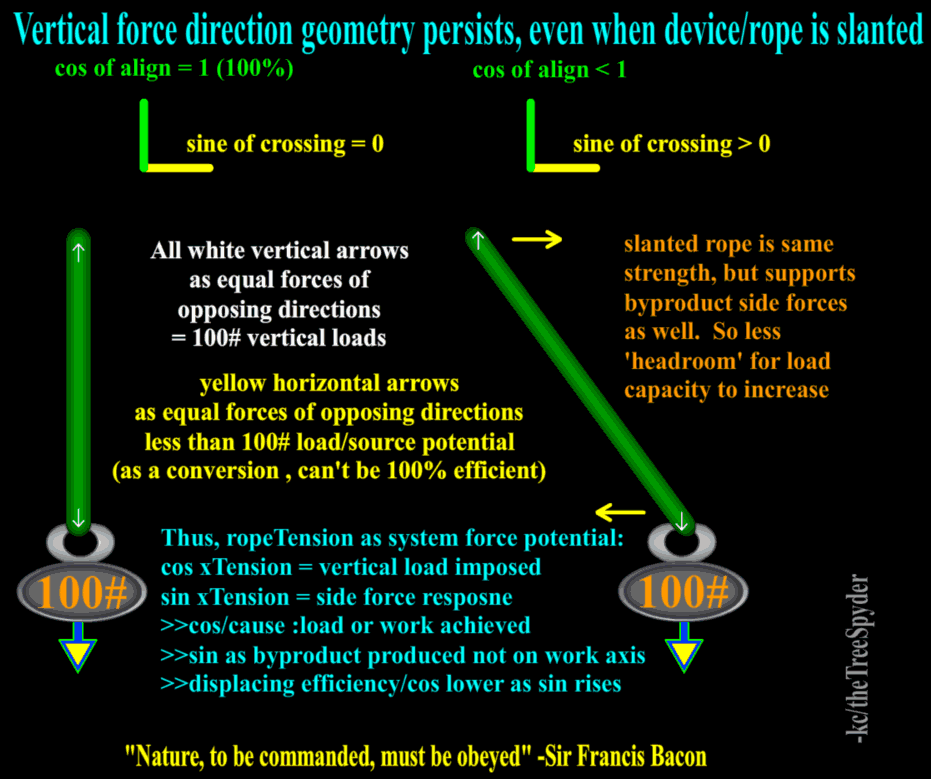
Truck_A pulls Truck_B uphill with a pure straight line rope or slanted. Slanted is same only less efficient(so less pulling capacity and reach from same potentials respectively), YES spatially changes dimension in a drawing, but force wise Truck_A still pulls forward directionally as Truck_B pulls back in opposing direction per view of works done(say 1000# each). Slanted rope link between is less efficient conductor (so Tension is > 1000#) and then so also carries new tax of overhead from sine across (can feel in steering) as a byproduct from striving for main target work from input on a single directional axis of pull and response at outer 'mains' of equal/opposite of truck pull input/output endpoints for rope.
Inline-and-deformed-loaded-pulls-for-truck-as-knot_600px.png

.
 
Last edited:
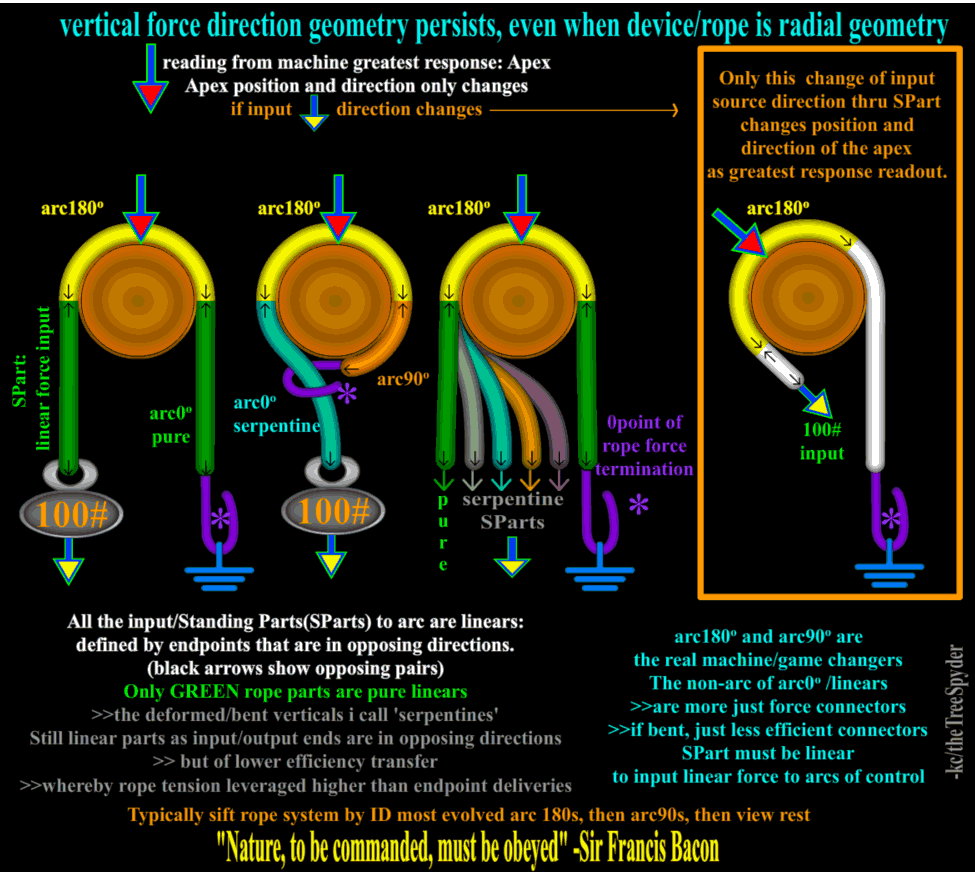
Linear Direction is own geometry quantity that persists from input , even after linear conversion to radial arcs of rope device that force ports thru.
i find these things to be true, and have given me truest answers in my searchings over decades.
For i have purposefully and constantly worked to prove that they are not true; to then have them simply fall into place. So cannot outrun them especially in the simple, clean rawness of round spar and round rope. That there is something special to, as a bit of what sailors saw when that is all they had(too).
.
The Ancients showed that the Universe has a domain of reign which Earth is a small speck of/totally subject to. The Universal organic pattern/law of change that decodes into cos/sine is ever present. Aligned/cos vs. Crossing/sin(e) define all displacements singly against space(free travel) and/or in confronting pairs of then 'force' (space displacer vs space displacer instances) to define all associated in scenario. The connection points are positional on graph paper, but flow of linear force focus is directional, to same cos/sin maths tho. Even ported thru radial rope arc, the linear force as a type of input; and the directional axis as a factor both persist(until pass thru arc90 to reassign force axis/swap with cross-axis w/linear force) in basic models.
.
To me x/cos/horizontal vs. y/sine/vertical on drafting table/graph paper drawing is a fair view w/many truths simply revealed, even where counterintuitive. But that is just 1 aspect/facet to find the cos/sine pattern in(perhaps easiest reveal silhouette to then see pattern in other things). The Universal organic cos/sine simply persists thru all.
Can show statically on graph paper of fixed x/y or more dynamically align cosine to linear force, support etc. as benchmark, but SAME answers. Can even calc either way to be parity check between. Dynamically aligning cos as benchmark to studied linear force or receiving support usually is shorter math, true just the same.
vertical-force-direction-geometry-persists-even-when-device-rope-is-slanted.png

Here we can see same force response as long as input direction as a 'quantity' is same. For me making a more directional geometry trace for force
>>changes to cos/sine as spatial placement do not change outcome as much
>>only direction of linear input does.
Then calc rope controls of support, frictions, nips and grips from there, of the directional linear input dispersed into radial arcs(conversion).
These are full potential so of Zer0 Friction models.
>>friction then like a volume knob that would increase, but maintain same model logic.
vertical-force-direction-geometry-persists-even-when-device-rope-is-radial-geometry.png

Use same cos/sin maths to show force, but more directionally applied. Where with gravity force is a vertical axis of equal/opposites occurrence geometry. If load on support column(like rope) that is not spatially inline with load; support is less efficient support column, that requires more work input for same work output against imposed loading.
.
i try to psyche self to re/l-earn what think i know of force, starting fresh with ropes as easier...
Rigids seem more intuitive, but rope/flexibles class actually less considerations:
>>ropes do not support on the cross axis of the loaded linear form as rigids doin this model;
>>ropes only support on the inline axis of the 1D rope length, and then only in the tension direction on that axis/not compression direction as rigids can.
 
Last edited:
Kenny, you ever get anywhere with that chinese finger trap math model paper that had an unexpectedly complex math modelling equation? I know my brain basically threw up its arms and gave up at the time.
 
No have not, see that as a dizzying wormhole chase.
Am not formally trained, beyond some trig when also training in gymnastics to apply numbers and feel them somewhat too.
.
i consider a right angle pull on host as a 1D directional force pull, 'lengthwise' as 2D(1D for grip, another D for the pull.
This making a rolled fabric , then pulling perpendicular is where i see this go to 3D and out of scope to most my experience in that way, or need. But good puzzle!
.
Natively, rope simpler, 1D w/2D deflections, so i kinda keep to that framework. In only given cos/sine tools; i find that cos is unique 1D direction force, pure sine crossing to next D then. Then to get 3rd D, i take 2D as now the alignment cos and sine as again the deflection from to last, 3rd D. So usually stick to 2D in 1D device(rope) especially..
But either way, emphasize cos as unique benchmark,
sine as deflections from. So, always try to call out cos as sole, benchmark;
when breaking from 1D to 2D w/ sine, or from 2D to 3D w/sine.

edit: i still use cos vs. sine as percentage of pure alignment vs. percentage of pure crossing to decode force expressed in tension trace from input axis. Direction input as benchmark, then types of arc that apply it.
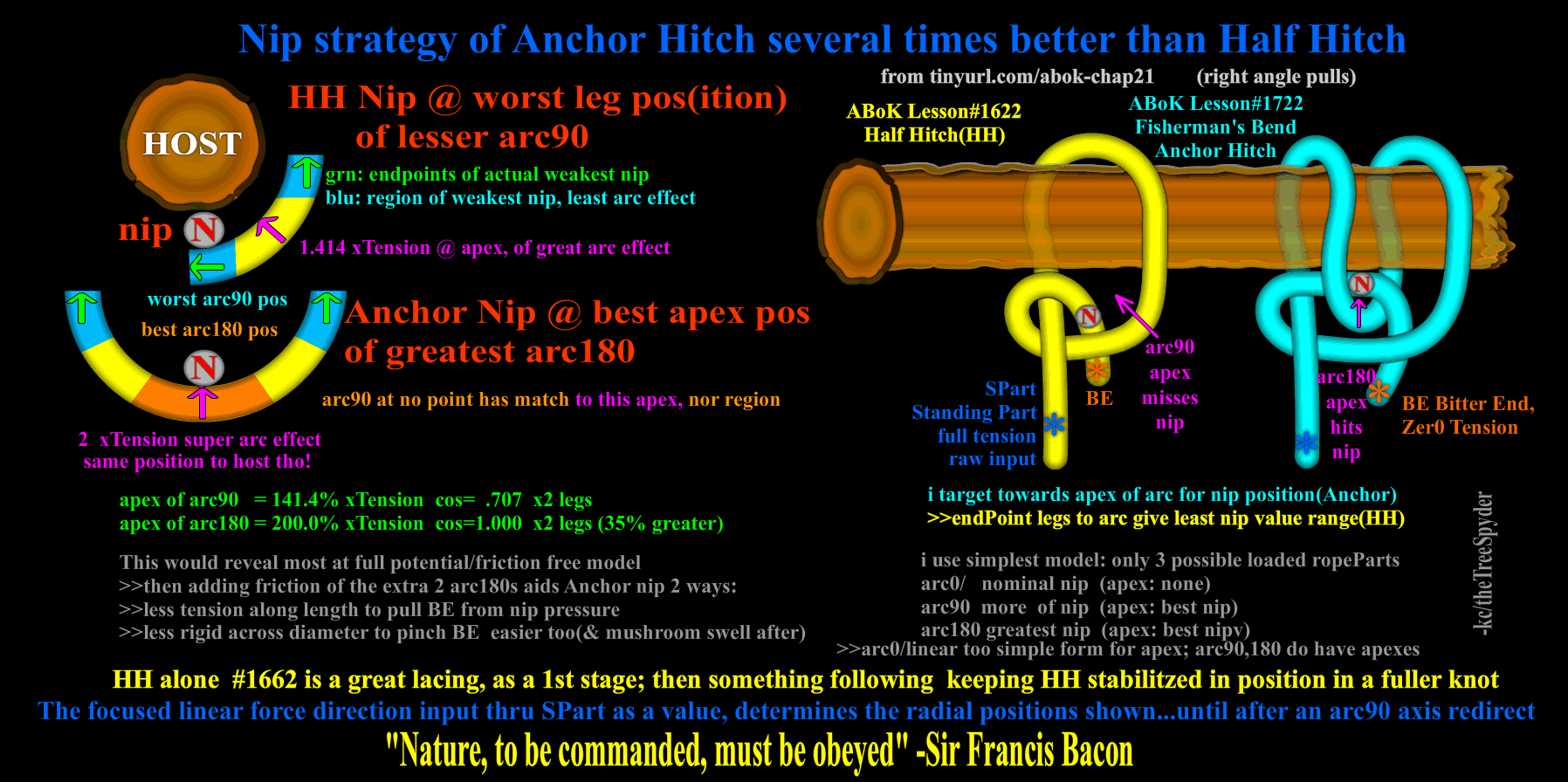
nip-strategy-of-anchor-hitch-several-times-better-than-half-hitch.png

Try to pry the nip open of a: HH(arc90) vs. Anchor Hitch(arc180)!
 
Last edited:
@TheTreeSpyder I love your posts...and I mean no disrespect by this but when I read them my brain starts backfiring. I can tell you are touching on genius and see things differently than most folks can conceptualize...and it's awesome! If I sit down long enough to really soak in what you are saying it's starts clicking, but man it breaks my brain.

I don't know if you do your own artwork for the diagrams, but wow...and thank you.
 
TY/YW, i don't have every chapter so marked of venerable tinyurl.com/abok-online / the knotting bible, but did mark chap21 as so often used and can sit down at any computer and jump in. There is very natural progression of thoughts/forms extending from previous starting with Half Hitch, that becomes Timber of several forms each. Timber immediately refuted in chap22 for lengthwise pull unless other kind of Half Hitch (dual end loaded, not terminating) pre-fix to make Killick
.
It took a long time in fields, factories, gymnastics, trees and relating all to math study to gather this to my present view of common intersection of pivotal points. Many things had to L-earn in stages, as can't see next range of peaks and valleys, until crest present level of understanding. Much of this is/has been part of my ongoing internal dialogue of what, when, how, why for each action in a build; and where most critical points to polish for highest returns/as like pressure points, and not the reverse allowed, we play by higher stakes than that. Different models to catch different facets of same central truths, someways as different forensic colored lenses, to catch an aspect of X, to then trace whole journey of.
.
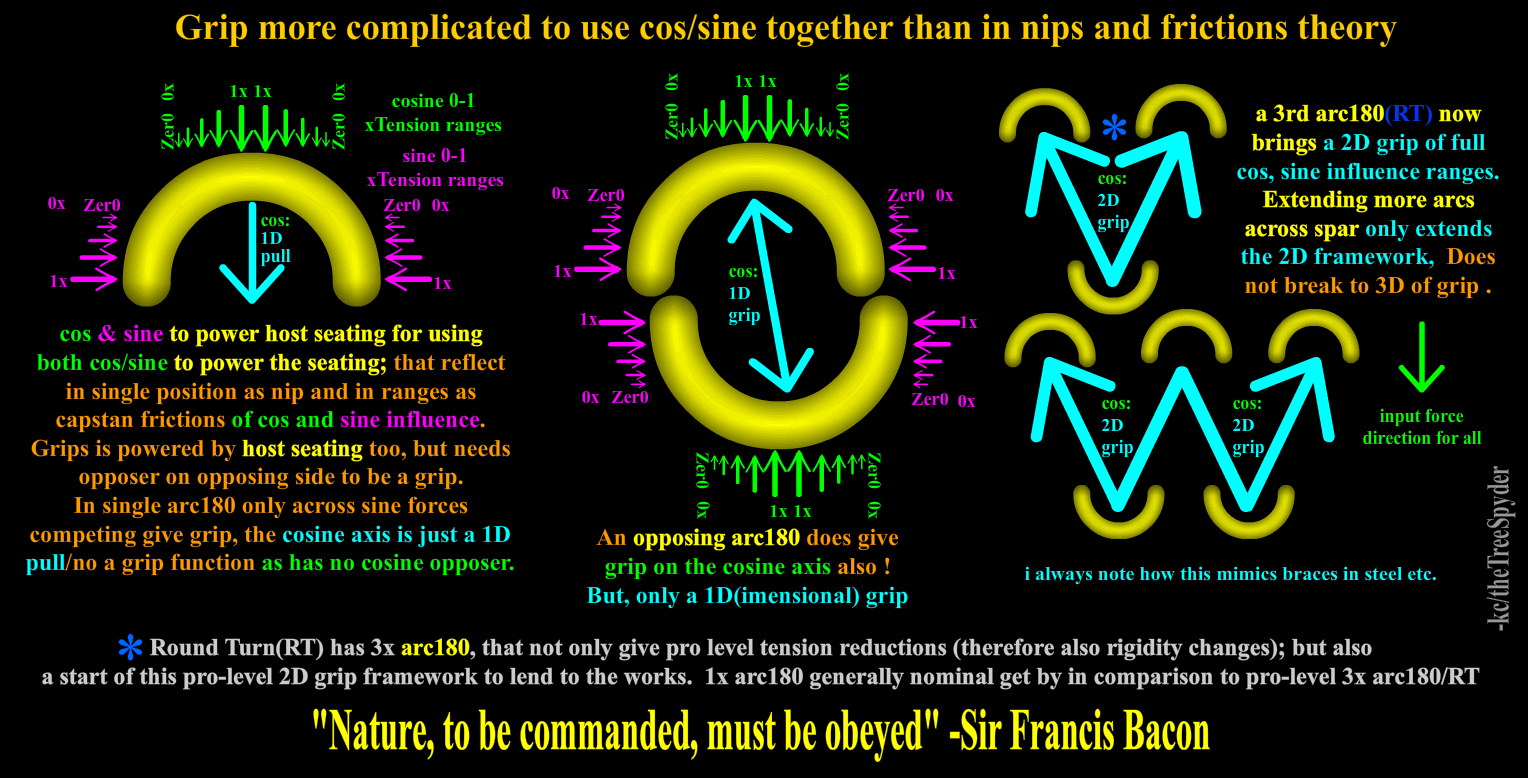
The original 'Half-Pro' adjustable terminal eye knot posted here to me is great example of single arc180 in 1 point of greatest nip within the arc180. Then also just above that arc180; the 3x arc180 for grip where the whole arc is used/not just nip point; and breaks from 1D grip of 2x arc180 of full complement of cos, sine forces(sine only grip in single arc180 model), to 2D grip of Round Turn, that also has more appreciable xTension reduction, which also then is rigidity reduction. These things show on a stretched not crossed(like Awning or Adjustable have crossing reach that pulls back into) for better visibility of their clean actions.* arc180 is the greatest machine conversion rope element in my view of only recognizing 3 loaded ropePart elements: arc0,90,180 that comprise all else.
grip-more-complicated-to-use-cos-sine-together-than-in-nips-and-frictions-theory.png

The RT of 3xarc180 gives the real pro level grip as the workhorse in this build onto the SPart. RT is also the greatest tension and rigidity reducers to make sure Bitter End is most 'nippable'(less likely to pull out and easier to pinch).
.
To show how incredible arc180s are at nips, grips and frictions; we have
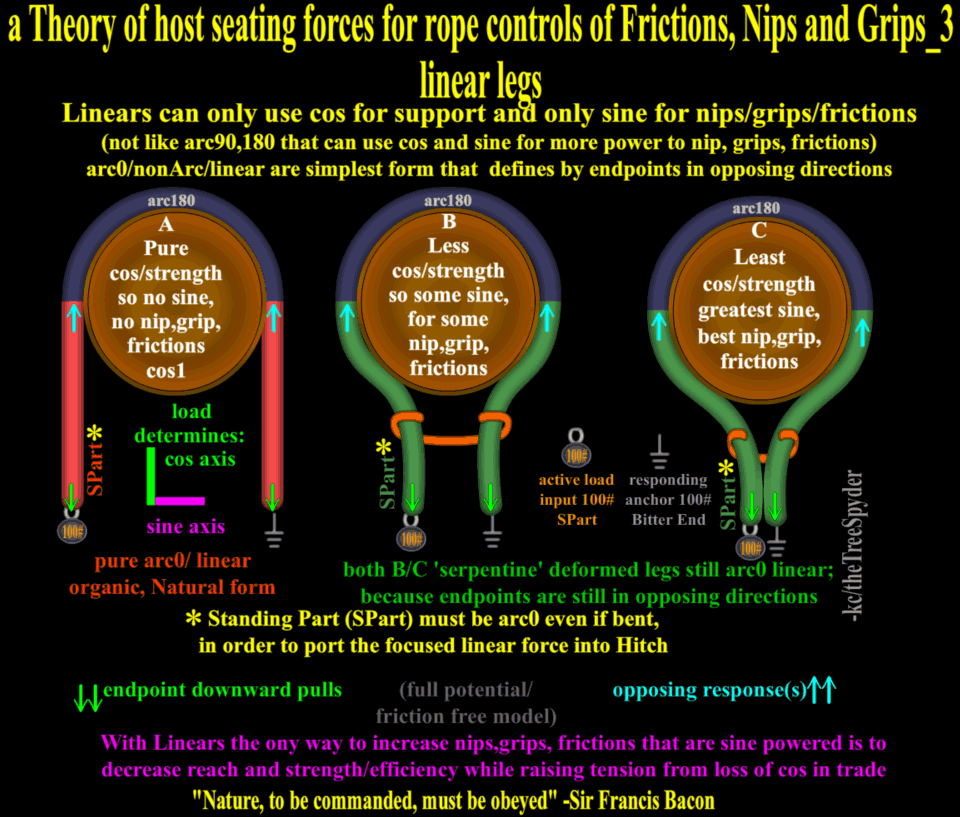
Linears/arc0s as much simpler mechanisms. So simple that can only use cos to hold load down internal 'core' of rope/imagery, and only host seating forces are perpendicular to core(cos force) at external skin(sine force) to power any host seating rope controls of nips, frictions or grips. This simplicity and weakness of linears , really shows how much more than nominal that arc180s etc. scream out their collective usable forces like no linear can.
So hear we ignore the arc180s(very unusual) and focus on arc0s.
a-theory-of-host-seating-forces-for-rope-controls-of-frictions-nips-and-grips-3-linear-legs.png

~With Linears/arc0s the only way to increase nips,grips, frictions that are sine powered is to
decrease reach and strength/efficiency while raising tension from loss of cos in trade~ (w/serpentine only)
arc0 linears are mostly connectors, not force manipulators/machines.
arc90, arc180 specialize in force direction and conversions of more real machine of change.


*'Half-Pro' has roots in Blake's/ProhGrip, Adjustable etc. but also built to the ideals i try to highlight, in clean, unobstructed, uncrossed, simple more open reveal to me of what happens in a tighter, more crossed, complex so more hidden microcosm of a knot. i have nothing against the 3 other fine knots presented for their utilities etc. each very respectable. 'Half-Pro' shines most to me personally as clearer view of principles i personally try to highlight that even persist at worst angle to pull at is my only point that tried to show more loudly from start, other than just made a knot claim. i guess that is part of the overthinking part!
 

New threads New posts

Kask Stihl NORTHEASTERN Arborists Wesspur TreeStuff.com Teufelberger Westminster X-Rigging Teufelberger
Back
Top Bottom