Options for cracking 5-stem silver maple

semifnordic

New member
Location
Northeast OH
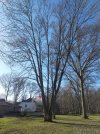
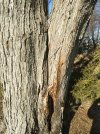
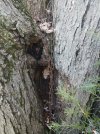
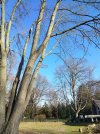
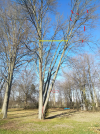
My backyard has a silver maple which splits into 5 stems around 4-6 feet off the ground. In yesterday's windstorm (northern Ohio), I noticed that as one of the stems waved in the wind, it made visible a crack extending from where that stem joins another down toward the base. I don't think the crack is new, just that it was made more visible when the wind opened it up. That stem is also rather not vertical, definitely unbalanced weight-wise, and roughly aimed at the back of my house... Trying to decide my best course of action:
  1. Figure it's been like that for a while, make sure insurance is up to date, ignore :p
  2. Remove the cracked stem. My concern with this approach is that removing a fifth of a tree this size will be about as good as killing it -- though I don't know how fast it would decline, or if there's any way to minimize damage from such a substantial cut.
  3. Bite the bullet and remove the entire tree (just a faster version of 2?)
  4. Try to reinforce somehow?

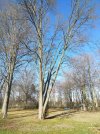
Photos of the tree from a couple different angles, as well as the junction, below; offending stem indicated with red arrow. The crack extends at least halfway down from the crotch.
IMG_20201116_135938.jpgIMG_20201116_140007.jpgIMG_20201116_140032.jpgIMG_20201116_140044.jpgIMG_20201116_143747.jpg
 
Get a tree risk assessment from an ISA-qualified tree risk assessor. Go to treesaregood.org and use the find an arborist dialogue. The questions you are asking are good questions and need to be examined on site by a qualified tree risk assessor.
 
It is hard for a professional to answer the questions accurately without being there. I want you to feel welcome here, and listened to. There is also associated liability for anyone who would answer here, because there is intrinsic liability plus the added liability of saying something without having seen the tree in person. Lastly, we have liability insurance that costs a bit, and make our living by giving advice about these things. All of this points to you getting an appointment with someone who will meet you at your residence. Wish you success in managing your tree.
 
Yeah, I get it -- it's a bit like asking for medical advice on the internet :D

Let me try removing the liability a bit:
A) If roughly one-fifth of a silver maple with 5 codominant stems is removed, is it basically killing the tree a couple years down the road, or are there methods to preserve the health of the rest of the tree?
B) In a situation with "messy" tree structure, are there methods to effectively reinforce a codominant trunk that's already partially split off from the rest?
 
In most circumstances, arborists have great capacity to identify and communicate risk, suggest mitigations, communicate anticipated post-mitigation risk, and look after the health of a tree. They usually have game and you can pay one with the knowledge that they will probably give you non-removal options. If they only recommend removal, you may wish to get a second opinion. Some trees really do need to be removed, but most have a range of options that must be matched to the balance of your tolerance for risk and the value of the tree to you.

Shop for some ISA BMPs that look like they might bear on your tree, to get a feel for things. But, you should not rely on what you learn because it is easy for a non-professional to mess up because they "got 80% right". That is what a good certified arborist is for.

It's fun to speculate but at day's end you really need that TRAQ certified arborist.
 
Pay for a consult with a qualified and certified arborist. Having someone come for a free estimate i wouldn’t be surprised if they just recommend removal to make the trip worth it without exploring preservation options.
 
Where in NE Ohio are you? We can get you some names (I'm in NW Ohio...others here are in NE)

Simply/broadly:
a) removing that stem will not kill the tree...it may introduce undue rot into the rest of the trunk...but you aren't taking so much that the rest can't thrive.
b) there are support systems to install to help keep pieces together.

back to what @colb said - hard to say based on a few pictures what the best course of action is for your tree - but both (or neither) of those may (or may not) for your tree.
 
I think @Jzack605 hit the nail on the head -- I've run into this in the past, people just sending an "estimator" to glance at a tree for 30 seconds and write up an estimate. The key, I think, is that I'd not be looking for a "free estimate" but a "paid consultation."

@ATH Thanks for the broad answers. I'm in Westlake, so a bit west of Cleveland (and have a yard full of oaks & maples that I haven't yet had time to pay the attention they deserve)
 
Looking back to an earlier post in this thread:
No, I would not expect that removing the one obviously cracked stem would kill the silver maple. Tree survival is often not the issue.
The question that needs to be considered is: What do I want from this tree in this landscape? Will I get what I want in the landscape with a partial removal or complete removal? Can I afford to ignore the situation entirely?
Yes, on-site consultation is what you need, but the silver maple is not going to roll over and die right away, even with co-dom removal.
 
  • Like
Reactions: ATH
Looking back to an earlier post in this thread:
No, I would not expect that removing the one obviously cracked stem would kill the silver maple. Tree survival is often not the issue.
The question that needs to be considered is: What do I want from this tree in this landscape? Will I get what I want in the landscape with a partial removal or complete removal? Can I afford to ignore the situation entirely?
Yes, on-site consultation is what you need, but the silver maple is not going to roll over and die right away, even with co-dom removal.
@KTSmith Very respectfully, "right away" is probably not a consideration for the OP, and the meaning of part of this post rests on that premise. As time accrues past "right away", any conditions present but not observed in the photo likewise accrue risk for rolling over and/or dying. I like the questions you pose.
 
It's easy to either unfairly condemn the tree through stating potential issues, or unwittingly give it a free pass by noting its assets. The actual state can likely be determined by having a qualified professional go look at the tree. Some trees and pictures are pretty straightforward and we all chip in to the OP. To me, this tree looks like it has too much variability in its actual state to chime in - mostly associated with the condition of the butt and/or roots where all of the codominance may converge and extend into, of which we have no close-ups or on-site first-hand professional-grade information. It might be perfectly suited to preservation via hub and spoke + prune. It might be a candidate for removal due to basal decay. Those outcomes are perfectly disparate - a whacked house or a tidy 30 year shade tree with a treehouse while the replacement tree grows up. I hope the OP does not do a knee-jerk removal like so many people do, but rather I hope that they obtain good information upon which to base a decision.
 

New threads New posts

Kask Stihl NORTHEASTERN Arborists Wesspur TreeStuff.com Teufelberger Westminster X-Rigging Teufelberger
Back
Top Bottom