nice butt !!!

robinia

Participating member
Location
Ontario, Canada
This is one of my patients at work that keeps me up at night. Fagus sylvatica in a fairly busy location. Full healthy canopy, but the base... eeek!
I'll spare you the long story and bureaucracy, but it would be nice to hear some totally-off-the-record opinions on this one...

IMG_0434.jpg


IMG_0432.jpg


IMG_0430.jpg


IMG_0431.jpg
 
I see the root rot fungi and all, but I want to address something else that I witnessed and learned.

With so much circumference dead near the base, that tree has very little vascular system left.... or "road blocks" due to the mechanical damage or whatever happened to it.

So.... the caretakers of it need to keep in mind and be aware of any times of drought and give that thing water in times of draught.

I had a beech I worked on. 1/2 of it's cambium circumference was dead, but it died off so slowly, that the entire crown was alive for years.

Then, spring of 2008 when the buds were starting to open, we had a terrible spring draught, no rain for like 3 weeks during that critical time.

I didn't think of the tree and the homeowners didn't think about it either. half the tree the leaves never emerged, the other half, came out with tiny leaves, then they wilted and died. That whole beautiful tree died. It was probably 140 to 200 years old.

Anyway, my opinion was that due to the vascular system "road block" and the lack of water at such a critical time, and it was a HUGE crown that needed 100's or 1000's? of gallons of water to push those leaves out, that's what caused it to die.

But water will also grow that root rot more, right?

My plan:

Install 4 guide cables to this tree, 3/4 the way to the top, to ground anchors, or to the base of other big trees. spaced around the tree evenly, also with springs in-line in the cables. anchored through the tree trunk with through rods with amon eyes.

second, add water in times of drought.
---------------------------
Perhaps my thinking is wrong, it's just self experience I'm going on and not textbook info.

Guy M or some others on here would be good to hear from on this beech.

 
Seems to be within striking distance of an electrical box, picnic tables, and stone archway/ building.

I'd be curious what the fungus is that is infecting the tree, and the decay in the trunk, and the prognosis of the fungal infection.

If it is a public area where liability is a concern, I'd say cull it, most likely. Looks like a school or gov't setting.


If its on a private residence, it would have to be where the owners are okay with the risk.

The stone structure looks like it is within striking distance and can't be moved. That target may only get hit with the tips of the tree and be fine, or could be where the trunk could crush it. Or maybe its just the picture.

Maybe a steel protective structure/ box could be framed over the electrical with concrete footings.

Move the picnic table.
 
Oh yeah, maintain appropriate mulch, water, monitor crown dieback, and the guy lines, if they want to keep it. I'd guess that there is soil compaction if there are picnic tables. Address that, too.

All of this with the idea that money is no object.

Don't know about a crown reduction to reduce leverage on a compromised trunk. Maybe thinning trees that may be shading the beech if you want the tree to be able convert more sun energy.
 
I doubt that the trunk is compromised in regards to strength, but the decayed roots could give way and uproot I think.

but that's probably what you meant anyway.
 
Has any one of you ever seen a European Beech fail at the base of the trunk?

I have not. I am sure there's a first time for everything, but I have a pretty photographic memory, and I always try to access what I have seen when these questions arise.

I really need to access and use the tree failure database more often.

http://svinetfc2.fs.fed.us/natfdb/

-Tom
 
Yes, I've pull tested at 3:1 and couldn't make it move, also watched in good winds. What I'm hearing is that this tree seems more likely to uproot than snap at the base?

I'm leery about crown reduction especially with Beech and sunscalding, but I could see the benefit.

Guy wires are not an option. This is at my work on a university campus and some drunk student would be far too likely to trip or get closelined on guywires, not to mention vandalism.

How about cabling tree-to-tree? There are at least 3 trees close enough to anchor on horizontal spans, but I've got lots of factors with that: clearing pathways; making sure a failure doesn't pull apart an anchor tree, so probably lower instalation than the ideal; also material and degree of tension. I would lean toward Cobra with shock absorbers but I'm not sure about what the proper tension would be in this case.

The good news is that money is not really an issue. The administation seems to be able to find money for the things they deem important. That stone structure is where all the graduates get thier photos taken and this tree is the background - really the only reason I haven't dismantled it yet.
 
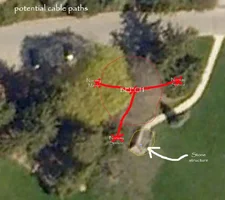
here's how the cables would lay out:
(sorry about the crappy drawing and google earth image!)

My higher-ups are not going to move the stone portico. The picnic tables I can probably move...
tongue.gif
 

Attachments

  • 219852-Untitled-1copy.webp
    219852-Untitled-1copy.webp
    51.5 KB · Views: 86
Cable spans would be 10 meters running to the west (N. maple), 10 meters to the east (N. Spruce), and 13 meters southwest (N. spruce). Winds from the west, sheltered by big N. maple.

Cobra would eliminate the need for drilling and even the springs in-line. Maybe even add in extra shock absorbers?

How about the crown reduction?

Or should this just plain come down?!?!
 
[ QUOTE ]

The good news is that money is not really an issue.

[/ QUOTE ]

then call urban forest innovations in mississauga and get a tomograph done. Philip is the best in the world at this and he is next door to you. see attached
 

Attachments

Philip is a friend. We've worked together before.
Although money may not really be an issue for a "serious problem", convincing of the need is! The current viewpoint is that as the tree is fairly sheltered it isn't a serious threat, and therefor the consult an expense not required. I disagree but don't hold the purse strings.
See where I'm a little stuck?
 
[ QUOTE ]
here's how the cables would lay out:
(sorry about the crappy drawing and google earth image!)

My higher-ups are not going to move the stone portico. The picnic tables I can probably move...
tongue.gif


[/ QUOTE ]

I like it!

If you put the cables about 4 feet up the spruce trunks (if they are substantial size) then it would not put much leverage on the spruce. and people would not trip over, maybe take their head off, but not trip over.

i can send you pictures of a big oak i did like this on a river bank. did it like 6 year ago. two cables to two big trees, third anchor we dug a 4 ft. by 4 ft. pit and filled with concrete and rebar.

i just visited it a week ago, doing very nicely, and the anchor trees as well.

hey, how big of a diameter is this beech anyway? I tried to tell from the picnic tables. seems pretty big...
 
[ QUOTE ]
A portable ultrasonograph has been invented. Would this work on trees?

[/ QUOTE ]

Is that for the trunk wood? or does it show roots?

because the trunk wood is totally fine.
 

New threads New posts

Back
Top Bottom