New Hitch for the Hitch Hiker X and other things.

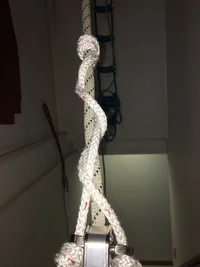
Just in from a try of Brocky's friction hitch.

Don't have a Hitch Hiker so I used it with a Rope Wrench on a Blue Moon Rope. Cord was an Ocean 10 mm , Eye to Eye 24" long and used same number of wraps as Brocky's photo.

This knot shines. No sit back, Tends very easyly, grabs perfectly.

Could even tend it without the hitch hiker pulley although it goes better with the pulley.

So thanks! to Brocky for a great knot.
 
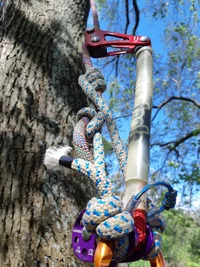
Maybe it's not which hitch works best, but which cord does. This is the standard HH hitch extended as long as the length of the cord would allow. It morphs into something else, but it would only slip a very little if the carabiner was dropped onto it. Otherwise, weighting it, fast or slow, it grabbed each time. You wouldn't use it this way, it just demonstrates how well it grabs.
IMG_2171.webp
The cord is NER Regatta Braid on Sterling 11mm Super(not so)Static. The Regatta is a hollow braid so I added a 1.75 Vectran core for more strength and heat resistance, as well as a slightly larger diameter. The combined break strength is 4100 lbs.
The combination of cords is around $.95 per foot.
 
Just submitting this picture for experts' consideration/critique.

Climbed on the Innovation Hitch today for the first time, using my normal Vortex with 9mm RIT. No failures to engage, which was my main concern, having recently used a Distel hitch with the HH(2) that would fail to engage when weighted after 30' of ascent or so; scared the crap out of me to be weighting the climbing line 70' up at the bottom limbs of the canopy, seeing the coils collapsed on top of the HH body not even attempting to engage.

Those top 'Distel wraps' of the Innovation Hitch, as Mr. Mumford calls them, did indeed tighten up and get stiff, but if I gotta err to one side of things, I definitely would rather deal with having the hitch be reluctant to disengage, than having failures to engage. However, tending was excellent with the IH.

Like everyone else, I'm looking for the mysterious and fabled hitch that results in zero setback, guaranteed engagement, and frictionless tending.

The exploration of alternatives to the regular Valdotain wraps found in the HH2's instructions (i.e., simple wraps up, then last wrap on top and bottom go to the dog bone) was prompted by the Valdotain being difficult to tend when setting it as was recommended in the literature, which means that it is set with <2" between the bottom wrap and the top of the HH body; it's gotta be tight as crap to maintain that after weighting it and tending it a few times. I usually have to go through a few cycles of weight-tend-tighten on the ground to achieve the 2" guideline. I've seen very few people who run the HH with any hitch having that little distance between the bottom wrap and the HH body (not sure why the distance would be critical with the Valdotain but not with other hitches).

I'm going to go back and try all of the hitches I've already used, but with 9.3mm epiCORD, 10mm Ocean, and 10mm Flex that I received in the mail today instead of 9mm RIT, to see if cord diameter or material alleviate the "issues" I'm having.
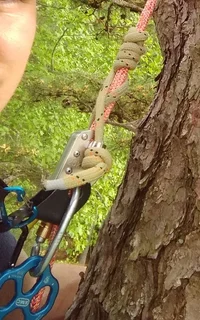

IMG_20190417_171325141~2.webp
 
Like everyone else, I'm looking for the mysterious and fabled hitch that results in zero setback, guaranteed engagement, and frictionless tending.
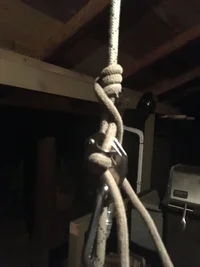
Excuse the horrible picture and the hasty setup in the dark but this is the best hitch I have found for the HH2. Once dialed in it offers all the virtues that you seek. It is basically a 3 & 2 VT with the last cross over above the bone. This setup is working so good for me that it has become my go to setup. The fact that my Wrench and BDB have been getting no love and are just sitting in my gear back should tell you something.

IMG_1440.webp
 
Thanks, rico. Was hoping you'd weigh in. Isn't that literally a slightly stretched out version of the recommended knot in the HH2 instructions?! If I don't do the tie-weight-set-weight dance and just leave whatever slack is in there from the initial tying, it ends up looking just like that, if I'm not mistaken. And, as such, it had always performed pretty well, if I remember correctly. When weighted, yours just lengthen considerably if you tie it initially that loose, right?

I just never leave it with that much gap between the lowest wrap and HH body, due to the warning in the instructions. It seems like folks pay that no-nevermind, which if it's fine, I'd like to know why.
 
FWIW: The HH instructions prefer the last "cross-over" to be on the 'spine' side. This is in order to mitigate the possibility of the 'dog-bone' getting stuck in its slot which might not allow the dog-bone to fully pinch the climb-line.
 
The official HH hitch is 5-6 wraps with one cross over on the climbers side of the HH, which puts the tails of the hitch cord on the spine side, opposite of the bone.
The hitch I am using is a VT with 3 wraps with 2 x overs, with the final x over on the opposite side of the spine, which put the tails of your hitch cord on the same side of the bone.
2 very different hitches that react very differently. One is ok, and the other is fucking awesome!
I set it just like any other hitch on the HH. I initially tie it as tight as I can, followed by sitting in the hitch and repeatedly descending then taking up slack while dialing in the hitch. Once I get it where I like it I head on up.
 
FWIW: The HH instructions prefer the last "cross-over" to be on the 'spine' side. This is in order to mitigate the possibility of the 'dog-bone' getting stuck in its slot which might not allow the dog-bone to fully pinch the climb-line.

The official HH hitch is 5-6 wraps with one cross over on the climbers side of the HH, which puts the tails of the hitch cord on the spine side, opposite of the bone.
The hitch I am using is a VT with 3 wraps with 2 x overs, with the final x over on the opposite side of the spine, which put the tails of your hitch cord on the same side of the bone.
2 very different hitches that react very differently. One is ok, and the other is fucking awesome!
I set it just like any other hitch on the HH. I initially tie it as tight as I can, followed by sitting in the hitch and repeatedly descending then taking up slack while dialing in the hitch. Once I get it where I like it I head on up.


100%. Thanks for correcting me, guys. I don't have much of an eye for knots yet. It's obvious once you point it out tho that the hitch ends on the side opposite the side the HH hitch does.

So, barring that distinction, rico, if you you rotated your hitch around 180deg on the rope and dressed it a little differently, you'd have the HH hitch, right? Specifically because both crossovers have the top wrap on top.

Apologies in advance if you feel like you are beating your head on a wall. I could solve the confusion on my part just going and playing with rope, but I'm tied up at the moment.
 
Clarification: by "dressed a little differently", what I mean is that you would just introduce more slack into the leg going to the top wrap, and dress so that on the descent down to the dog bone, the top wrap goes around the wrap stack at the proper place.

This is one reason I've always wondered about the validity of building a Valdotain Tresse without alternating over-under-over-etc. on the braids. Some places I've seen the VT explained, they don't specifically call out alternating over-under on the braids.
 
If you move the hitch 180% the 2nd x over will be on the spine side. This mean your hitch cord tail will not be over the bone. In this configuration it adds a little more friction, which means it will bite a little harder but will not tend as buttery smooth as the way I run it. I spend a lot of time running up and down conifers so it is very important that the HH tends and follows me around as effortlessly as possible. Brocky really hipped me to the fact that when your hitch tails load directly above the contact point of your device it generally tends much better. Thanks Brocky!
 
Last edited:
I prefer a hitch with some kind of pinch point to help with the slack coils not grabbing. I tie the "bust a knut" because there is a direction change in the wrapping right above the hardwear that makes it sticky when you are ready to sit back down after a ropewalk. And i cross the tails the tails on the open side of the HH for improved tending.
I often will adjust the slack out of the hitch during a climb, it is really hard to tie it tight enough for so many weight cycles at the beginning, especially because my HTP is super firm.
I think you will really like the 9.3 epicord....
 
Last edited:
... Brocky really hipped me to the fact that when your hitch tails load directly above the contact point of your device it generally tends much better.

I respectfully disagree with this assessment as it applies to the HH. The HH2 had its spine side top edge angled to be more perpendicular to the dogbone slots specifically to enhance tending. When tending is done from that side, several things happen. The hitch tails are less likely to slide from that position stopping excess movement. The flat edges of the dogbone slide along the slot, again, perpendicular so there is no tendency to catch an edge on the slot. The tails of the hitch move less but that movement is inline with the slot and moves the dogbone directly away from the rope with little effort and hitch movement.

Obviously, both ways will work, and work well at that, so use whatever works best for you.
 
I respectfully disagree with this assessment as it applies to the HH. The HH2 had its spine side top edge angled to be more perpendicular to the dogbone slots specifically to enhance tending. When tending is done from that side, several things happen. The hitch tails are less likely to slide from that position stopping excess movement. The flat edges of the dogbone slide along the slot, again, perpendicular so there is no tendency to catch an edge on the slot. The tails of the hitch move less but that movement is inline with the slot and moves the dogbone directly away from the rope with little effort and hitch movement.

Obviously, both ways will work, and work well at that, so use whatever works best for you.
I have had better tending on both the Wrench and the HH when the tails are directly above the contact point. This might have something to do with the fact that there is a little less wrap which causes a little less contact between the hitch cord and the climbing line? I will play around with it the other way for a while on the HH and see if I come to a different conclusion. Your argument was very convincing so its the least I could do. Either way the HH2 truly is a work of bulletproof simplistic genius, and it has become my main squeeze these days!
 
Last edited:
Such a trip going over past posts and seeing what you missed and what you got right. I like the hitch setup in post #7 except I prefer a different pulley. Having a becket is less important to me as I rarely use an MRS.

In fairness, having an ultra short hitch can be frustrating if you are not into making fine adjustments as things change. I have been using hitchs so long that I sometimes don't even realise I am doing it.
 
Such a trip going over past posts and seeing what you missed and what you got right. I like the hitch setup in post #7 except I prefer a different pulley. Having a becket is less important to me as I rarely use an MRS.

In fairness, having an ultra short hitch can be frustrating if you are not into making fine adjustments as things change. I have been using hitchs so long that I sometimes don't even realise I am doing it.

Agree about the hitch on post #7. When I was using the standard HH hitch I too used the 4 wrap variety. I believe I got the idea from you somewheres on the inter webs ? Really nothing to complain about and when run with a pulley it was near perfect for me. I have just found my current hitch choice to be slightly better on both ascent and descent.
Funny but I was just talking to a buddy yesterday about the fact that I no longer view trees in term of a MRS system. Its amazing how quickly MRS became a last resort for me.

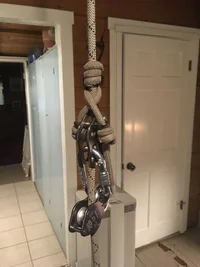
My current working setup. Love it!


IMG_1443.webp
 

New threads New posts

Back
Top Bottom