New Device to Manage Throwline Midline

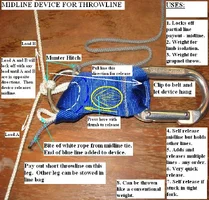
This device regulates the length of throw line paid out, keeping the balance in the line bag. During the throwing process, it can be deployed as a weigh for limb isolation or a grapnel to pull-back the thrown end. Should the limb isolation require that it be dropped, another line is added. Once hoisted in position, the first line is pulled tight from both directions. This releases the weight. Because a second line remains attached, limb isolation occurs. In terms of this picture, the device is dropped by the white line and then caught by the blue line. The rapid release of the line by the climber is an outstanding attribute. This device combines the steps of the line setting process and offers new features.

 

Attachments

  • 70676-MidlineHitchDevice1.webp
    70676-MidlineHitchDevice1.webp
    138.7 KB · Views: 395
Jimk

I am struggling to grasp this post, perhaps its just my lack of understanding/experience of more intricate throwline techniques.

I'm just having a hard time following what your saying for some reason, let alone relate it to the picture. Do you have a video or pictures of what your describing. Although please bare in mind that this query is coming from probably the worst throwliner on the entire forum. Thanks
 
ContractClimber,

Thanks for trying to wrap your mind around my representation of the device. I'm taking responsibility for the complexity. You're accurate in saying that a taped demonstration is needed. If I was the reader, I'd have a difficult time - with no prior experience on this specific device.

Let me single out two features:
1. A weight that comes off the throw line by contact with the thumb - as if it has a release button.
2. A weight that can drop from one line and keep a second line attached. In other words, a climber drops a second throwline mid-air on a target in the canopy to isolate a limb.

I'm working on an illustration of limb isolation. I'll pursue the video concept.

Again, thanks for tackling it.

Regards,
Jim
 
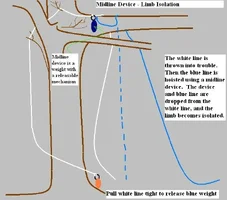
This attached diagram illustrates the capability of this midline device to be dropped mid-air for a limb isolation.

I like how multiple lines can be added and taken off in any order. It's like a junction box for throwlines.
 

Attachments

  • 70863-midline2.webp
    70863-midline2.webp
    41.4 KB · Views: 226
Thats better Jimk, I can now appreciate your point. Great drawing.
Although, the white line would actually represent one of my better shots, so as a whole I'll try to keep it in mind as either an achievable option or contingency plan. Thanks again.
 
So the white line can release the blue throw weight so that the blue weight can bring down the end of the blue line, isolating the branch?

Now if I could just figure out how to make it work!

love
nick
 
Hi Nick,

It's an easy device to make. Run webbing through a ring and wrap it back around on itself, so it goes through the ring twice. Tie a Munter Hitch on the top of the ring with the throwline. Run the line underneath the webbing low side and out the high side, pulling the tail through the ring. Once you wrap the webbing, you'll understand the high v. low side.

You can prove the concept by attaching a conventional throw weight with a Munter Hitch to a throwline. Pull the line tight. The weight locks in position. Relax the line, and the weight flows down the line - eventually falling off of it.

With this new device, the webbing is the brake pad. The tension in the line is the brake pressure. The Munter Hitch shifts the mechanical advantage to the webbing. A throwing motion locks the device on the line. If you press the ring, the mechanical advantage is lost. The device comes off line - rapidly.

To drop a device, it has to be connected mid-line. The attachment is the same, but it uses a bite of line to form the Munter Hitch and wrap.
 
I like the innovation. Its tools AND techniques.

>> "A throwing motion locks the device on the line. If you press the ring, the mechanical advantage is lost. The device comes off line - rapidly."

When is this throwing motion employed? I'm on the ground and its up there, so the pinching is for loading and unloading the loop?

So why or not just put a split ring on the bottom of certain throw bags that have a loop?
 
Well Tree Limb Jim and all,

I've got videos made. I'm just uploading them - slowly. It will take another day to complete.

To answer your question, here are some of the physics - as I understand it. If you have a device dangling in the tree that weighs 14 oz, then the webbing is transferring that load into gripping the line and the Munter Hitch becomes locked. The force of the grip is a percentage of 14 oz. The downline of the Munter hitch has the mechanical advantage. Your weight is being held mid-air with ~14 oz of gripping force.

If you twirl this device, the acceleration makes your weight increase from 14 oz to a larger value like 28 oz. Your device is gripping the line with ~28 oz of force.

This isn't a strong hold. It always builds enough grip to just hold. Thus, when you hold the weight in your hand and contact the ring, the holding force goes to zero and the device slides off.

The mid-line drop occurs because the Munter Hitch is formed with a bite of line (i.e. 2 strands of line). When pulled tight, the two strands move in opposite directions, opening up the Munter Hitch. The line below the hitch flows out. The device drops.

The Big Benefits:
1) quick releases
2) release from tight forks
3) controlled drops for limb isolation

I'll usher in the videos as soon as I can.
 
Having the videos sure helps! Now I have to digest the idea and decide how to incorporate it into my repertoire.

Is the webbing connector necessary? Can the same thing be accomplished with a plain throwbag?

The idea to use bands cut from bicyle inner tubes seems like it might be incorporated into the release system. I have to keep my eye peeled for a tube...
 
Tom,

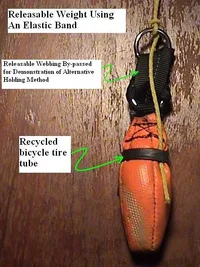
As you indicated Gary Layton, aka pantheraba, devised the simplest solution on making a conventional throw weight releasable. A cut bike inner tube provides a band that tightly holds the tail, yet it can be released. In two minutes, you have a new feature added to an old weight. He initially used thick rubber bands to test the concept.

Since that last discussion, the ability to drop a weight mid-air in the canopy evolved. This occurs by forming the Munter with a bite of line. When the line is pulled tight from both ends, this double line Munter drops the weight. With a second line previously attached, a limb can be isolated as if you placed it there with your hand. Gary's configuration works. I use webbing, because it's something that I can make from scratch. Also, I'm headed in a different direction with it.

This system has been extended to drop a bag of line on one side of the limb and the weight on the other side of the limb. Actually there's no need to work with weights for this one. Two bags of line could be dropped to isolate a limb.

Always good to interact with you, Tom.
 

Attachments

  • 71409-2007ReleasableWeightUsingElasticBand.webp
    71409-2007ReleasableWeightUsingElasticBand.webp
    67.6 KB · Views: 71

New threads New posts

Back
Top Bottom