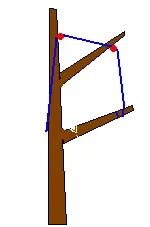
My first major tip-tie-good but....pic added

Well, it was major for me - it would have been child's play for you guys. The limb was partly over a road so I didn't want to just drop it, plus it was an opportunity to work with a tip tie.

It was our secretary's tree, she's a widow, and a limb had broken out of her tree, so she called me because she knew I loved to do tree work. I removed the broken limb with no problems.

The second limb was probably 35' long, located in a difficult place to reach because there were not a lot of good TIPs. I shot a line over the tip of the limb, actually as far out as I dared, and cinched it with a rope.

Since I'm a one-man crew, I took my small Porta-Wrap III up with me. I found a crotch way up a suitable leader and installed the rope over it, pulled a bit on the rope and cut a wedge on the top side of the limb with my Zubat hand saw. Then I applied a bit more tension to the line and locked it off.

When I got the back cut pretty close, I started really pulling, and the limb raised right up, snapped at the hinge just as it went vertical - just like the "book" describes it.

Suddenly the limb was beside me. It came so fast I couldn't even react. Fortunately I had already moved out of harms way. But I'll admit, I could have been hurt.

Part of the problem was my 'anchor' crotch was below the limb tip when I straighened it. That meant there would have to be a short drop when it broke free - I just didn't mean for it to come down on my side of the tree.

I lowered it to the ground; had to cut a few branches/twigs to get some clearance, but it was pretty straight forward.

I was pleased with my first tip tie all except for it coming down on my side of the tree. I'll have to work on that. But that's why I wanted to try it with a smaller limb for the first time.

I'll take all the critique you got!
 
Re: My first major tip-tie-good but not good enough

only critique i got for you is never work alone. even if u have someone there that knows nothing about tree work, they should still know how to dial 911. other than that, congrats on a successful tip tie
 
Re: My first major tip-tie-good but not good enoug

I use the GRCS for that.
If you don't have one you could use a pulley system in conjunction with the rope brake.
A redirect to a higher branch then to the main stem could keep the load from swinging back at you.

190496-redirect.PNG


Try to find someone to work on ground while you are in the tree, it's much safer.
 

Attachments

  • 190496-redirect.webp
    190496-redirect.webp
    2.9 KB · Views: 114
Re: My first major tip-tie-good but not good enough

The angle of the dangle has to meet the heat of the meat ! allright ? or just place a butt tie on it and forget about it . Always watch those crazy handsaw cuts , killers . Stay safe , three tie in's and two hands on the saw . Your rigging failed , strike one . Your rigging crotch held . Ball one . The rigged limb almost hit you . Strike two . The anchor point was below . Strike three , your out . Good job , first inning . Game is till on .
 
Re: My first major tip-tie-good but not good enough

Rigging alone can make you very creative.
It can also be VERY dangerous.
We are not supposed to work alone but Ill bet at least half the people on here (including myself) do it on a regular basis.
Be careful out there.
 
Re: My first major tip-tie-good but not good enough

A clarification:

I noticed a couple of comments regarding having the anchor point high enough to allow the branch to come fully vertical so it can't drop.

That would always be my first choice as well, but in this case, there was no higher point to use. The tree spread out with smaller leaders, it had been topped some time back, and I would have been much more uncomfortable climbing on the small leaders than I was knowing there would be some drop.

As it was, I had to throw for a narrow crotch about 20' above my TIP. I was a little surprised I got it, esp. in about 5 trys.

I kinda had to take what I had and make it work. I had the thought to tie the butt, but for some reason decided not to. That was a bad decision and I'm very fortunate to have learned the lesson without getting injured.

But to all, thanks for your thoughts; keep 'em comin'.
 
Re: My first major tip-tie-good but not good enough

Tip tie is useful in some situations but it's more dangerous than butt tying for that very reason. I default to a butt tie unless tip tying is the only alternative.
 
Re: My first major tip-tie-good but not good enough

Ron-

I think that you are learning from all the problems of the situation (anchor location, tie the butt of cut branch to stub of branch).

Your Zubat is a CURVED BLADE. A straight blade in this situation would be better. You presumably ended up cutting your corners more than the middle of the hinge as a result of the curved blade, resulting in an uneven, nonparellel--weaker--hinge.

This may or may not have been a precipitating factor in the hinge breaking, as it sounds like you were pulling with no more force than bodyweight, and however much you could pull while holding yourself in place--no mechanical advantage. This, in conjuction with the Zubat, leads me to wonder about the hinge strength.

A Silky Gomtaro is the straight-blade handsaw that I use to complement my mainstay Zubat.


Were you using the method of one perpendicular cut and one horizontal cut to get your angle right?

Keep on going, but do it with someone, anyone, present in case of a worst case scenario injury where you are not able to call on your mobile phone yourself.

Best of luck.
 
Re: My first major tip-tie-good but not good enough

Good thought about curved blade of the Zubat - I have wondered about that, but dismissed it. But, since you mentioned it I guess I should have thought that through a bit more. I have a Ginga which has a straight blade so I'll use it perhaps in conjunction with the Zubat.

I pretty much had the vertical and horizontal cuts for the proper notch and actually, I had no trouble at all with the hinge. It broke almost into just as the limb went vertical. A small section, probably the middle, due to the curved blade, remained so I cut it a bit more. Then I had this near vertical limb sitting on the splinters of the stub. The anchor point wasn't high enough to lift or hold it where it was, so when I moved it a bit, it was suddenly beside me, well on my side of the tree. I had already moved out of its path if it did come down on my side.

But, I knew the limb would have to fall some before the anchor would catch it, and I think my biggest mistake was not securing the butt so it could not come down on my side, or at least not far.
 
Re: My first major tip-tie-good but not good enough

I keep both of those handsaws available for that very reason. If I have a job with lots of notching and back cutting, I bring the Gomtaro, otherwise I use the Zubat.

-Tom
 
Re: My first major tip-tie-good but not good enough

This was when I stopped tip tying unless I absolutely needed to. I was taught different, the guy tip tied most stuff, but we never did any big bare wood.
 
Re: My first major tip-tie-good but not good enough

Ummmmmmm nice drawing on the last felling direction choice-upwards(!). But to my eye, we'd want the pulley over hinge; and the faces scheduled to close just before then, to give good sweep to that point, then positive tearoff. Also, i'd want the running Bowline with preceding Half or Marl to have line come around tip end, then under thru a notch (as keeper/alignmeant) then Half/Marl. So that the line cranks (and cradles) the load thru rotation and tearoff more positively. Would be best to walk reverse hinge (for upwards felling) to point of flex/failure; then climber hides as load is then cranked rest of the way thru rotation and tearoff- with enough experience and power so climber doesn't have to go back out after it.

If done right can pivot up to straight/ almost vertical, start to tear off ,and then finally tearoff at vertical and raise up just a mite, then hang 'quietly' before lower. To do this, this cleanly, pulley over hinge or just before, face close, and rope on backside with power and angle to rotate too far. -But doesn't have to; just has more power and angle right before at final tearoff for positive action.

Of faces are too wide open, can near close sneak out and drop something into face 'pocket' to then have faces closed effect and get tearoff=possibly quicker than backcutting upwards more. Same stuff applies on hinge mechanics, taper hinge if there is a heavy side for more balanced lift before tearoff, and too to adjust if support/redirect is not centered over hinge etc.

As with all rigging points, especially out from parent connection; watch for support defects like codoms etc.
 
Re: My first major tip-tie-good but not good enough

Ron,


What kind of tree was this?


If some such situation occurs in the future and again you realize that your pulley point is too low, you can attach another rope (or the bottom end of your rigging rope to the tree and to the lifted limb near your hinge before lifting to the breaking point. Crisis averted, climb up and fix it.

You might be able to natural-crotch rig the butt of the branch rather than attach the butt to the trunk, if a suitable crotch exists.

If you have a pulley on you and a suitable sling, you could set a false-crotch rigging for the butt of the limb.
 
Re: My first major tip-tie-good but not good enough

[ QUOTE ]
Ron,

What kind of tree was this?

If some such situation occurs in the future and again you realize that your pulley point is too low, you can attach another rope (or the bottom end of your rigging rope to the tree and to the lifted limb near your hinge before lifting to the breaking point. Crisis averted, climb up and fix it.

You might be able to natural-crotch rig the butt of the branch rather than attach the butt to the trunk, if a suitable crotch exists.

If you have a pulley on you and a suitable sling, you could set a false-crotch rigging for the butt of the limb.

[/ QUOTE ]

True, and good point(s), however in this case, the <u>only</u> reasonable and suitable limb for the anchor was too small for me to climb, especially to the height I'd have to go to get the ideal height for the limb.

As you (and others) have pointed out, a good and doable option would have been to secure the limb so it couldn't fall on my side. I hear ya; I've learned my lesson well, both from you guys, and I deeply appreciate your sound advice, and from the experience itself - which I didn't appreciate much, LOL.

Edit:
I completely forgot to address what kind of tree - I'm not good at tree id yet, this was a hardwood with somewhat of a shaggy bark.

Also, the tree had been topped; the 'leaders' were actually the new growth that forms on topped trees. They were around 8 inch in diameter at the base and tapered pretty quickly. Those things always unnerve me - just seems like they wouldn't be as strong as the original growth.
 
Re: My first major tip-tie-good but ...pic added

Some pics:

I only have some close ups of some problem areas, but you can see the 'leaders' are pretty small to be climbing on. You can just imagine how small they'd be about 20 or so feet up.

3874565750_b4522c5f9e.jpg
 
Re: My first major tip-tie-good but ...pic added

This may be a more telling pic:

3874566000_2e0fa7c7f3.jpg


And, the reason she called me, the broken limb was already down, but hung in the tree.

3873779807_e940a9054e.jpg
 
Re: My first major tip-tie-good but ...pic added

I figure that a good test for a tie-in point set from the ground is to have two people's weight on it, with a bit of bounce. If it hold twice plus my bodyweight, then is should hold the force of my bodyweight plus the force of bouncing a little bit while climbing.

If you have a tie-in that needs to be tested that you set from the tree, then set, and have two on the ground hang.

I know that you say you were solo. Another reason to have at least the homeowner around.

Be safe.


Good luck on future endeavors. Try to learn your trees, as different wood has different densities (differing weights per same sized limb--which you probably had some idea of the weight and force involved) and characteristics (e.g. brittle wood, strong cambium that allow something to be top-cut and hinge down on the holding wood on the bottom (not meaning a face-cut hinge) that can reduce force on rigging when you hang it by the hinge until some of the kinetic energy is dissapated, then load your rigging fully by completing the cut, some can be swung to the side with a face-cut, helping to avoid limbs or targets below). All with study and experience.

I got a laminated double sided tree guide to the PNW for $5--Mac's Field Guide. Cheap, and easy. Might be local as it is produced in Seattle, however, you might be able to find a similar small reference to help learn.

This will also help you to learn about disease and pests, as some things do/don't affect certain trees, such as Oak Wilt and white oaks, or Blister Rust and 5-needle pines.

Good luck. Be safe. The early experiments are the most dangerous.
 

New threads New posts

Back
Top Bottom