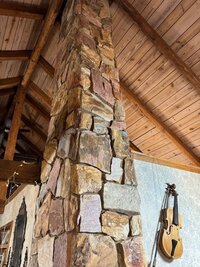
Monitoring Fireplace Insert Burn

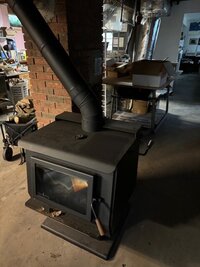
That is some beautiful kindling and wood shed ! In dads log cabin I had built a double flue chimney through the middle of the house, with a fireplace chimney at the gable end. The central chimney extends to the basement and we had a double barrel stove there when we move in. It was very effective and would gradually heat the whole mass of the double flue chimney until it was warm to the touch so it acted as a huge radiator. This lasted for about 30 years until we had to replace it. My sister had found a Kodiak stove she salvaged from somewhere that replaced the double barrel stove which had a bimetallic heat gage. we could throw large pieces of coarsely split wood in both the barrel stove and the Kodiak and tune the burn with the front draft. We have just replaced the Kodiak (which had an 8 inch stove pipe plumbed into the 6 inch flue) with a high efficiency stove with a lever bypass through the catalytic converter and draft control at the back of the stove. It also has the glass front door which is very nice to monitor the fire, and a trap door to remove the ashes into a bin below. So far I like it.

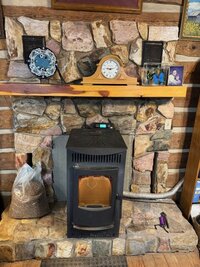
Upstairs I have replaced the fireplace used with a wood pellet stove. It is plumbed to draft fresh air from the outside, and has a timer which is currently set to go off about 5 am and cut off about 10. which is nice as it self starts. The only problem is if the power goes out it does not function.
 
Last edited:
Looks like I'm years late to the party. Found a guy who used raspberry pi and did an excellent job incorporating flue temp, stovetop temp, fan speed, air feed and I think finally room temp. Holy learning curve Batman.
 
I run a blaze king Chinook 20- it's a cat stove. It's great when it's -5c or warmer. It heats the whole house no problem and I can get some awesome burn times ( best I had was 18hrs of usable heat) . But once it gets colder out I'm burning it a lot hotter and not getting a full burn cycle before reloading. Last winter we went 2 months of not having to light a fresh fire- always enough coals to get it going no problem. The only reason I let it go out was to clean the chimney!
If you want to dive down the rabbit hole even more check out the forum on hearth.com. Lots of knowledgeable members there!
 
So to the original question, to me knowing when to refill a woodstove is just based on a feeling you get with experience using it, no need for any fancy gear. As you use and learn the system, you get a sense of timing in terms of how long a certain load of wood will last, in addition to visuals like a glass door obviously, or simply feeling the current heat output as you walk through the room it's in. And at the end of the day, as long as the box is still warm and you've got some coals to kick it back up again, that's all you really need to aim for if you need a constant heat source.

As long as this has turned into a general firewood heat discussion, guess I'll share mine as well, and honestly I pretty much have it down to a science.... The house is a funky 60s thing, stoves are 90s era Avalon I got free from a customer, and I don't own the house so it's not exactly what I'd do given the choice, but what I have works great. To move heat from the stoves into the room and around the house, I have fans blowing across them. My record is the fire not going out for 3 months straight, and I live alone so no one else to keep it fed when I'm away 12 hours at a time.

Kindling is old cedar fencing from a customer. Not used often, because once I start burning in the fall I keep it going until spring basically, unless I go away from the house overnight or accidently fall asleep on the couch watching a movie or something. I start it with some non-flareup woodstove juice and don't bother with that newspaper nonsense.... On that goes the small split doug fir which burns longer and hotter than the cedar obviously, and this is the next step to getting the box hot. I also use this to kick up coals fast before adding the bigger wood if needed. Then the actual firewood is all doug fir, sourced within a few hundred feet of the house. Down for ~2 years, split in size ratios of how much medium wood I want when I'm home and awake, and larger pieces for when I'm away at work or sleeping and need longer burn times. 100% bark free.

I do get a lot of creosote buildup because I mostly run the primary stove dampered down all the way, and the houses design of the metal pipe that goes straight into a large masonry chimney causes rapid smoke cooling, which leads to buildup on the insides of the masonry. I sweep it once a year, and it's not a big deal. Generally I only run the one stove which is in the kitchen, and the second stove in the living room when it gets below freezing, which isn't often here. Next to that stove though is a large in-house wood storage area, and that gives me about a week of wood before I have to go outside to get more

View attachment 90858

View attachment 90859

View attachment 90860

View attachment 90861

View attachment 90862

View attachment 90863

View attachment 90864
That is Beautiful kindling and wood shed !
My grandparents did the same.
I have not nearly been that good !
 
Well I followed in the footsteps of a guy on Hearth.com who already did it and have a few observations. One of his objectives was to not lose too much heat up the flue. Boy, does the flue temp go up fast. Without doing the thermodynamics, a basic approach is hot enough for good clean burn but no more, so the gizmo throttles back the air pretty quick after starting the fire, different than the usual 15 or 20 minutes hi air/part door cracked too. The stove iron temp just kept slowly creeping up with some disregard for gusto or lesser fire. You could immediately tell when changing to burning down diminishing coals but the stove metal basically stayed hot and slowly crept downwards.

Guess the initial observation is that monitoring stove top temp is ok for preventing gross overfiring but flue temperature really tells you the stress you're subjecting the stove to, I guess meaning primarily the firebox structure.
 
Further observation. If I lose track and check on the stove to find only a bed of coals the air is turned up because they don't burn as hot as flaming wood. Mixed feelings because it helps burn the coals down but it also reduces the time that the coals will persist for the purpose of restarting the fire. Not sure how much temperature gain the extra air gives but in general coals burn substantially less hot than open flames.
 
Noticed another observation lately. Still running the computer gizmo. When you want peace and quiet to say watch a movie you leave the forced convection fan off. The steel stove body heats up nice and hot and drives "hot air rises" natural convection. With the same burn rate/flue temperature but the fan on the stove top sits at a much lower temperature as the passing air sucks the heat out of it. This has implications to reading s stovetop thermometer to monitor burn. I suggest flue temp is more meaningful.


When I'm really bored I watch the two temperatures and figure out which one has control of the air. Most often I see the air% creep down as the flue temp gets up towards the high limit. Post-nerd-alert!:)
 
Different info nugget. My insert is firebrick floor, sidewalls and backwall with insulating baffle roof. I get outer stovetop temps 100 to 200 deg C. My neighbour just revamped a 1981 Napoleon 1600 with a chimney liner and we bench marked a bit with an IR gun. Gun matched within 10 deg to thermocouple on my stove. 1600 has fire brick floor, partial lower height bricking of sidewalls and rear wall. Any reasonable, non-huge not roaring low chimney smoke fire produced 350 deg C stovetop temp! The amount of convection air flow was like a fan on very low speed! Totally different characteristic. 250 deg stovetop temp matched a dwindling or poorly burning fire. 1600 has no secondary burn.

Different stoves, different temps. We had no access to flue temp.
 
Sourcing a stove for my friend, I came across this tech nugget about burn conditions and emissions:


the nuggets are post attachments of a scientific study done in Canada
 
Question: for a 2 cubic ft +/_ a bit firebox woodstove, non-cat

lo heat but still hot enough maybe some secondary burn, 3 to 4 hrs useful heat perhaps 15,000 BTU/hr EDIT - epa #'s suggest possibly 6 hrs

hi heat - more like 2 hrs near high heat output 50-60,000 BTU/hr


Does this ring practically true,? vs sales claims. might correlate with epa tests
 
Last edited:
CAT stove owners - I've read on Hearth that cat activity correlates with cat color, orange or red glow and users try to use this to diagnose over/under burn conditions. Apparently cat stoves can be finicky and have partial cat function as an added bonus.

Is this your experience?
 

New threads New posts

Kask Stihl NORTHEASTERN Arborists Wesspur TreeStuff.com Teufelberger Westminster X-Rigging Teufelberger
Back
Top Bottom