
Navigation
Install the app
How to install the app on iOS
Follow along with the video below to see how to install our site as a web app on your home screen.
Note: This feature may not be available in some browsers.
More options
You are using an out of date browser. It may not display this or other websites correctly.
You should upgrade or use an alternative browser.
You should upgrade or use an alternative browser.
Monitoring Fireplace Insert Burn
- Thread starter Bart_
- Start date


TreeCo
Carpal tunnel level member
For 13 years we had a Jack Russel and he would lay so close to the stove on the floor that I called him 'sizzle' in the wintertime. He'd get up panting and move a foot further away. He loved that heat for sure. 'Sizzle', I still miss him.

- Location
- Retired in Minneapolis
This is from a past Christmas.
Cooking and heating with wood would sure change the pace and rhythm of a person's life.
That's a beauty

That is a beautiful stove!
I really wanted a stand alone stove but the house we bought just didn’t work with that plan, got this Timberwolf insert and I really love it.
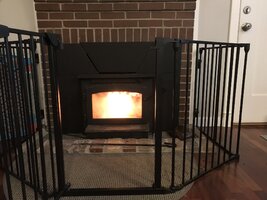
To the op- it’s not really a big deal to me on when and how to reload- I just go based on the inside air temperature and time of day, but then again I live in a place where it’s rare to go below freezing for more than 2 days straight so it’s not a good example.
I really wanted a stand alone stove but the house we bought just didn’t work with that plan, got this Timberwolf insert and I really love it.
To the op- it’s not really a big deal to me on when and how to reload- I just go based on the inside air temperature and time of day, but then again I live in a place where it’s rare to go below freezing for more than 2 days straight so it’s not a good example.
DSMc, nice stove! Reminds me of my grandmother frying eggs and bacon so hot on a plainer version of your stove that we were instructed to stand back from the grease spatter and the eggs were both a bit runny and had crisp light brown edges. In an actual shiplap faced log house.
Cold here is -20C. Average type day -10C. I guess I'm trying to condense the mental activity into one design followed by mindless use. And have it wake me up if so desired.
Cold here is -20C. Average type day -10C. I guess I'm trying to condense the mental activity into one design followed by mindless use. And have it wake me up if so desired.
- Location
- Chardon, OH
Stove on hearth, "TempSure.net" probe is on top, between water / stock pots.
Digital readout is blue, in bottom Right hand corner of pic.
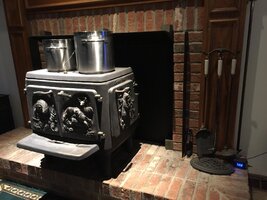
Digital readout is blue, in bottom Right hand corner of pic.
Last edited:
- Location
- Chardon, OH
Morso wood stoves look very nice !
 morsoe.com
Wood Burning Stove by Morsø
The traditional woodburning stove by Morsø is as loved as it is well-known. The timeless, yet modern, design combined with genuine, Danish craftsmanship is the basic essence of Morsø.
morsoe.com
As I've thought more about this, it occurred to me that when it matters most - cold day/night - is when you yield to the temptation to add some wood, not a full load, to a say 1/2 or 3/4 spent fire, so you never let it get close to a full burn cycle. Kablooey goes the pretty burn cycle temperature curve. The fancy unit might be simplistic if it always expects a full burn cycle.
Are you guys partial stokers or burn-almost-out-ers?
Are you guys partial stokers or burn-almost-out-ers?
- Location
- Chardon, OH
As stated above: I burn small hot fires. More consistent temp & less creosote.As I've thought more about this, it occurred to me that when it matters most - cold day/night - is when you yield to the temptation to add some wood, not a full load, to a say 1/2 or 3/4 spent fire, so you never let it get close to a full burn cycle. Kablooey goes the pretty burn cycle temperature curve. The fancy unit might be simplistic if it always expects a full burn cycle.
Are you guys partial stokers or burn-almost-out-ers?

Bucknut
Carpal tunnel level member
I’m a “burn almost outer”. As long as it’s hot enough to self-ignite whenever I reload it I’m good. The room is still warm when the stove is cooling off anyway.
I don’t worry too much about creosote either. Or I should say, it’s no big deal to get on the roof and send the bristle brush down the chimney once a year. Then again, my roof slope is tolerable.
I don’t worry too much about creosote either. Or I should say, it’s no big deal to get on the roof and send the bristle brush down the chimney once a year. Then again, my roof slope is tolerable.
Top level craftsmanship and beautiful looking. Super efficient non- catalyst stoves that are incredible heaters. And the secondary burn combined with the air wash system makes for the best viewing I have ever had from a wood stove…Can sit around and watch these things burn for hours…Morso wood stoves look very nice !
Wood Burning Stove by Morsø
The traditional woodburning stove by Morsø is as loved as it is well-known. The timeless, yet modern, design combined with genuine, Danish craftsmanship is the basic essence of Morsø.
I categorize wood as one of three: gopher wood (avoid), or medium density that burns mid heat mid speed or dense wood like oak that nearly refuses to season adequately. All dense wood releases heat too slowly unless its split smaller and otherwise I control the fire partially by number and size of pieces I add. Sometimes mix mid and dense. I seem to get medium density wood like maple most often.

southsoundtree
Been here much more than a while
- Location
- Olympia, WA
Surface area-to-volume ratios are important for the fire at hand.
I forgot another method. Stack criss cross for max air/flame room or stack parallel to reduce airflow/flame for a cooler longer fire. Number of facing surface (each other) vertical gaps is another heat/speed control. Too wide of gap size and the effect is lost. Gap size self increases with the burn.

So to the original question, to me knowing when to refill a woodstove is just based on a feeling you get with experience using it, no need for any fancy gear. As you use and learn the system, you get a sense of timing in terms of how long a certain load of wood will last, in addition to visuals like a glass door obviously, or simply feeling the current heat output as you walk through the room it's in. And at the end of the day, as long as the box is still warm and you've got some coals to kick it back up again, that's all you really need to aim for if you need a constant heat source.
As long as this has turned into a general firewood heat discussion, guess I'll share mine as well, and honestly I pretty much have it down to a science.... The house is a funky 60s thing, stoves are 90s era Avalon I got free from a customer, and I don't own the house so it's not exactly what I'd do given the choice, but what I have works great. To move heat from the stoves into the room and around the house, I have fans blowing across them. My record is the fire not going out for 3 months straight, and I live alone so no one else to keep it fed when I'm away 12 hours at a time.
Kindling is old cedar fencing from a customer. Not used often, because once I start burning in the fall I keep it going until spring basically, unless I go away from the house overnight or accidently fall asleep on the couch watching a movie or something. I start it with some non-flareup woodstove juice and don't bother with that newspaper nonsense.... On that goes the small split doug fir which burns longer and hotter than the cedar obviously, and this is the next step to getting the box hot. I also use this to kick up coals fast before adding the bigger wood if needed. Then the actual firewood is all doug fir, sourced within a few hundred feet of the house. Down for ~2 years, split in size ratios of how much medium wood I want when I'm home and awake, and larger pieces for when I'm away at work or sleeping and need longer burn times. 100% bark free.
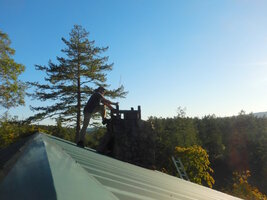
I do get a lot of creosote buildup because I mostly run the primary stove dampered down all the way, and the houses design of the metal pipe that goes straight into a large masonry chimney causes rapid smoke cooling, which leads to buildup on the insides of the masonry. I sweep it once a year, and it's not a big deal. Generally I only run the one stove which is in the kitchen, and the second stove in the living room when it gets below freezing, which isn't often here. Next to that stove though is a large in-house wood storage area, and that gives me about a week of wood before I have to go outside to get more
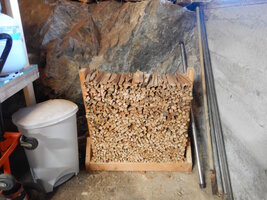
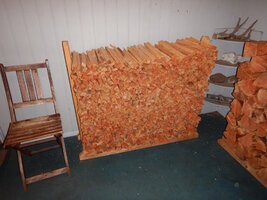
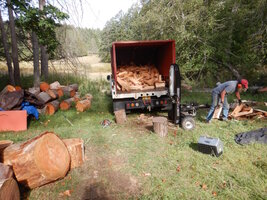
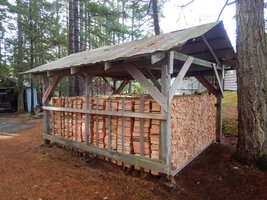
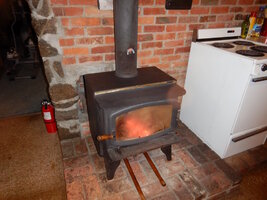
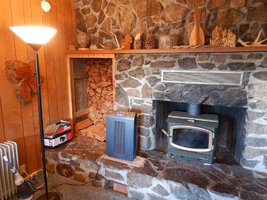
As long as this has turned into a general firewood heat discussion, guess I'll share mine as well, and honestly I pretty much have it down to a science.... The house is a funky 60s thing, stoves are 90s era Avalon I got free from a customer, and I don't own the house so it's not exactly what I'd do given the choice, but what I have works great. To move heat from the stoves into the room and around the house, I have fans blowing across them. My record is the fire not going out for 3 months straight, and I live alone so no one else to keep it fed when I'm away 12 hours at a time.
Kindling is old cedar fencing from a customer. Not used often, because once I start burning in the fall I keep it going until spring basically, unless I go away from the house overnight or accidently fall asleep on the couch watching a movie or something. I start it with some non-flareup woodstove juice and don't bother with that newspaper nonsense.... On that goes the small split doug fir which burns longer and hotter than the cedar obviously, and this is the next step to getting the box hot. I also use this to kick up coals fast before adding the bigger wood if needed. Then the actual firewood is all doug fir, sourced within a few hundred feet of the house. Down for ~2 years, split in size ratios of how much medium wood I want when I'm home and awake, and larger pieces for when I'm away at work or sleeping and need longer burn times. 100% bark free.
I do get a lot of creosote buildup because I mostly run the primary stove dampered down all the way, and the houses design of the metal pipe that goes straight into a large masonry chimney causes rapid smoke cooling, which leads to buildup on the insides of the masonry. I sweep it once a year, and it's not a big deal. Generally I only run the one stove which is in the kitchen, and the second stove in the living room when it gets below freezing, which isn't often here. Next to that stove though is a large in-house wood storage area, and that gives me about a week of wood before I have to go outside to get more
New threads New posts
-
test
-

-

-
[CLOSED — AD WITHDRAWN] Experienced Tree Service Sales Representative — Sell in Your Own Town (Nationwide)
- Started by BlossomExteriors
- Replies: 14
-

-
 Lyme disease is a man-made military biological weapon developed on Plum Island
- Started by Daniel
- Replies: 12
-
-
test2
-

-

-

-
 Lyme disease is a man-made military biological weapon developed on Plum Island
- Latest: Maplegeddon213
-
