Maintaining Saws

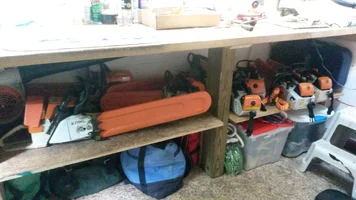
We have 9 saws. Three of them were not operational since I've been here. Two of those were in pieces. One was a 200 that fell 70'.
Eventually, only three of the saws were running right.
I didn't want to think about trying to find someone reliable to fix 6 saws. Couldn't afford it anyway, so I decided to fix them myself.
It's been a journey. Learned a ton.

I got the last one operational today. Feeling accomplished.

20160527_144650.webp
 
I started by asking around for service manuals and exploded parts lists for each of the saws. They are not easy to find online, but you can usually find someone who has a PDF to share. Forums and FB groups.
Lucky to have a good set of basic tools already at hand and that really was all.
Oh. YouTube! Learned a ton from that, especially on rebuilding carbs.
 
Arborist site is a great resource for assistance, manuals and past experiences of others. You saved a lot of money fixing those saws yourself. Did you have to do any major repairs? Top end? Bearings?


Sent from my iPhone using Tapatalk
 
We have 9 saws. Three of them were not operational since I've been here. Two of those were in pieces. One was a 200 that fell 70'.
Eventually, only three of the saws were running right.
I didn't want to think about trying to find someone reliable to fix 6 saws. Couldn't afford it anyway, so I decided to fix them myself.
It's been a journey. Learned a ton.

I got the last one operational today. Feeling accomplished.

View attachment 37905

Congratulations! I was just talking to a guy today who works for a professional landscaping service. The thought occurred to me when looking at their truck full of small engines that maintenance of all of these small engines must be a critical part of their operation. The folks using the tools are going to expect them to just work when they pull up to a job location. They are never there for long, just very frequently and intensively working, in and out.

Seems like a pretty big company, maybe. Which makes me wonder if they have a full time guy back at their shop who does maintenance on all of their small engines. It seems to me as though one good small engine mechanic could keep a fairly large army of field workers up and running and making money. All of which would make it worth the money to pay the mechanic to sit at the shop full time, working on saws that need maintenance, waiting for saws to come in broken, maintaining the parts supply stock levels so that there is never a lag waiting for parts to come in.

If the mechanic gets things tweaked so well that they end up sitting around cooling their jets for a bit, that should not be taken as a sign that it's time to eliminate the position for lack of enough stuff to do. It means the mechanic is slick and keeping things running really smoothly, which means fewer issues cropping up, creating emergencies.

I'm no small engine mechanic or business owner, so I'm probably dreaming here.

Nora, are you just another field hand for these folks, who got tired of looking at gear that was not functional? So all of this time you spent learning to repair saws was basically uncompensated? If so, your employer is really, really lucky to have you working for them, as you would have been going way beyond the call of duty for an extended period of time.

@treehumper is right, this could be a whole new sideline for you. Really nice going. I appreciate your discussion of your mindset during the process of learning this new skill. It sounds similar to the way rope splicers approach things.

Tim

 
[QUOTE="
Nora, are you just another field hand for these folks, [/QUOTE]

Nora is a very accomplished climber; has competed in TCC's.
Last year she was 1 of 4 Head Judge at Jambo 2 !
This year she was THE Head Judge at the "famous" Charlotte AA TCC ! ! !
She & Chip are the owners ............. and married.

Great Stuff Nora !
 
Arborist site is a great resource for assistance, manuals and past experiences of others. You saved a lot of money fixing those saws yourself. Did you have to do any major repairs? Top end? Bearings?


Sent from my iPhone using Tapatalk

Everything but!
Started with fuel lines on a 192. That was probably the worst saw to start on because you have to take so much off to get at them. On the other hand it was the best saw, because it really launched me into it.

Fuel systems including tanks, coil, carbs, oilers, brakes, recoils, clutches, throttle/interlocks.

On Stihl 150, 192, 200, 200T, 026, 044 and 440.

None of the saws so far appear to have crank case or piston/cylinder problems. I'll need to get a few more tools when that comes up. Kind hoping it will actually, but I'm not ready to take apart a working saw yet.
 
Congratulations! I was just talking to a guy today who works for a professional landscaping service. The thought occurred to me when looking at their truck full of small engines that maintenance of all of these small engines must be a critical part of their operation. The folks using the tools are going to expect them to just work when they pull up to a job location. They are never there for long, just very frequently and intensively working, in and out.

Seems like a pretty big company, maybe. Which makes me wonder if they have a full time guy back at their shop who does maintenance on all of their small engines. It seems to me as though one good small engine mechanic could keep a fairly large army of field workers up and running and making money. All of which would make it worth the money to pay the mechanic to sit at the shop full time, working on saws that need maintenance, waiting for saws to come in broken, maintaining the parts supply stock levels so that there is never a lag waiting for parts to come in.

If the mechanic gets things tweaked so well that they end up sitting around cooling their jets for a bit, that should not be taken as a sign that it's time to eliminate the position for lack of enough stuff to do. It means the mechanic is slick and keeping things running really smoothly, which means fewer issues cropping up, creating emergencies.

I'm no small engine mechanic or business owner, so I'm probably dreaming here.

Nora, are you just another field hand for these folks, who got tired of looking at gear that was not functional? So all of this time you spent learning to repair saws was basically uncompensated? If so, your employer is really, really lucky to have you working for them, as you would have been going way beyond the call of duty for an extended period of time.

@treehumper is right, this could be a whole new sideline for you. Really nice going. I appreciate your discussion of your mindset during the process of learning this new skill. It sounds similar to the way rope splicers approach things.

Tim
 
Well, Greg made me sound way more awesome than I am in real life. Mostly I feel like I'm making it up as I go along, slowly.

Just the two of us running this show. For reasons not completely to do with work opportunity, I have quite a bit of spare time and I can discount the $ value of my time to zero without even feeling bad about it.
Chip could do it just as well as I could, but he's not that interested.
I had to fix my 192 when a very tiny branch hit it, and that encouraged me to tackle the pile of broken saws.
 

New threads New posts

Kask Stihl NORTHEASTERN Arborists Wesspur TreeStuff.com Teufelberger Westminster X-Rigging Teufelberger
Back
Top Bottom