Large cuts

I was reading a safety short the other day , written on topping and lowering limbs.

A fella was working a single spar tree, taking it out in I guess fairly large pieces. Large enough or it had enough lean to warrent a tag line.The groundmen pretentioned the the spar.Climber put in his face cut and the started to make his back cut. The spar slit, slamming him into the trunk and he ended up with major injuries.My guess to the cause of the injury was probably way to much tention on the tag before the climber could get most of his back cut in. Or he he didnt bore it out. But, my real question is what ANSI states as to what your suppose to do to prevent this.

Here it is: When making large cuts in single spar tree, both ends of the lanyard should be attached to a single point of attachment to prevent injury to the climber if the spar should split.The waist or side D- rings should not be used for this purpose. ANSI.133...1994

I guess I'm just a little confused as to what they are saying here . If you cant attach to your D- rings or the waist , where do you attach ? Or, are they saying you should attach to center D , Delta link, or whatever your center connecting point is?

Whatever the case is , if the plit is that bad , your still going to get thumped or sustain injury.

I know what I generally do when antisipating a split, but I would like to here some feed back on this ANSI. satement .

Thanks
Greg
 
>Whatever the case is , if the plit is that bad , your still going to get thumped or sustain injury.

I agree that the split will throw you into the tree no matter where it is attached,
BUT
If you are attached to the waist dee's, the tree is pulling against your internal organs. If you attach both ends to your waist, the tree is pulling against biners.

Dave
 
</font><blockquote><font class="small">In reply to:</font><hr />
it had enough lean

[/ QUOTE ]
This sounds suspicious right off the start.
Without second guessing what happened in this particular case, it is safe to say all large leaners can be expected to do this and boring some of the mass to reduce the stress should be a consideration.
 
Greg,

I agree with Kevin- the best prevention here is to practice proper cutting technique. However, I believe what you are asking is why ANSI would reccomend attaching the lanyard to a single point (reason is what Dave said) and not use the side D's. Well, I think it comes back to that whole debate about side D's not rated for supporting your weight on only one side. This would mean that you can't clip both ends of the lanyard to one side D. They would reccomend you move your lanyard to a front attachment. Make sense? I'm not too impressed by this idea. It doesn't seem to be that great of a safety precaution to me.
 
I know quite a few people who run their flip line on the centre dees when sectioning out.I don't think it is such a good idea,in the case of the spar spliting it may stop the tree coming apart but you are left in a situation where you are stuck up there.I use my flipline on the side dees and my rope guide with an extra long rope and choke it off round the spar in the case of the spar spliting in theory the rope guide should hold the stem together and I also have a direct escape route to the ground as my main anchor is in to the pulley on the rope guide.....

Didj
 
This may be off the wall but a continuous loop winch strap with a separate ring for an attachment makes more sense to me in the event the spar should split out.
 
I've never had a spar split out far enough to affect my lanyard. I've had a couple that started to split out during my back cut, so I sped up the saw to make my hinge area smaller and reduce splitting before the top went over too far. If I had stopped cutting and sat there freaking out, I probably would have been hurt real bad.

I lanyard in using whatever method is fastest and still safe. If I'm that worried about the stem splitting, then I won't be lanyarded in to it but will be secured in some other manner. Perhaps the trees are different here in FL but it's a non-issue for me.
 
You are fortunate to get one to split and still allow you to continue cutting.
Most of them you really don't want to be anywhere near when they take off.
I've seen some practically explode depending on the size and stress.
 
I have never had a serious spar split either but I saw my father have one once on a crack willow put him in hospital
since then I have always been very paranoid about it Like others have said you just have to make sure you use good judgement and bore cut it if the back cut is going to be under tension but as you can only judge what you and feel and see its good to have a second line of defence

didj
 
I believe most the people replying to Greg's post know the difference between where a split is likely to occur and where it is not.

It's a load thing. The heavier the load the more likely the chance of splittling out. Unfortunately the new commer learns the hard way. We were all new commers once. And no doubt had an episode or two with the stem splitting. And we learned to recognize the weight bearing of a top or spar and the load it exerts on the stem. And we learned the ways to work it out safe.

Most of us have been there and done it.

Which brings to mind a couple of stories. One a personal experience and one of a close friend named Wes Burns.

I had a big Euc top to cut out. And very heavy. I had the option to take the top out in several pieces. My first gut feeling told me that's what I should do. But it would have taken more time. Thinking to myself, "Ah, I'll quarter the top against the lean to keep it from splitting" And. "In the end the top will go where it wants, but the angle of the cut will not prompt it to split."

I was tied in to an adjacent tree and swung over the work tree. When I started the undercut it became tight, after just getting the bar width in. So I reamed it out. The stem was about 24 inches. I was about 80 feet. As I progress the undercut the bark on the comperession side was buckeling and on the tension side was ripping apart. That top was about to explode off that stem, and all I had was an undercut not even a third of the way in.

An immediate sick feeling came over me. Whatever might happened I still had a way out, being tied in to the adjacent tree and all. But I created a situation that had to be remedied. I've cut some heavy structure before, but never anything as heavy as this.

As a safety percaution, in case the stem did split, I unclipped my lanyard snap out of the Dee and '''snapped it to my belt loop''' of my Levi's. Then with teeth clenched I started up that old Mac Super Pro 80 and buried the chain and bar into the stem of the Euc under the full power and chain speed that saw was capable of. I didn't get 3 inches and the stem exploded.... the top broke off clean and landed with such a thump the neighbors for three houses arround came out to see what happen.

Pretty scary. And that experience confirmed to me to follow my first intuition.

My friend Wes Burns cut the top out of a heavy Madrone, and it split out on him, pulling him up so tight to the trunk it broke his lanyard. I wasn't there to see it, but he showed me his lanyard and told me the story.

I was shocked to hear it, but the amazing part was, Wes didn't sustain any injury. No crushed hips!! Nothing of the sort. Other than having to hang on to the stem to keep from falling. He was lucky to have enough sense to grab and hang on.

The belt Wes was using I gave him in the early 80s. It was a Kline-Burke NyBuck climbers harness I purchased in the 70s. A horrible belt with hard spots that left a climber in total pain. I hated the belt. It had no real Dee's to snap into like the modern belts today have. The lanyard attachments were directly connected to the front part of the belt in front of the hips. The load of that madrone top was taken up by the front of the belt,,, not the waist portion.

Kind of hard to explain without seeing it and all, but in spite of the old NyBucks shortcomings it did have one saving grace. I don't think the feature was designed into it. It was just serendipitous. Lucky for Wes.

Over the years I think about Wes's experience and the fact that the belt design spared him major injury. It's not beyond the possibility to incorporte that feature into some of the modern belts.

The truth is stranger than fiction. And Wes's experience with that madrone and that old belt, I detested, are testimony to that.

Great post and threads Greg, and all of you.

Jerry B
 
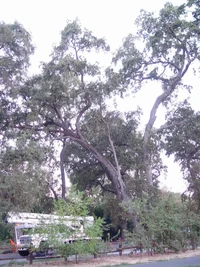
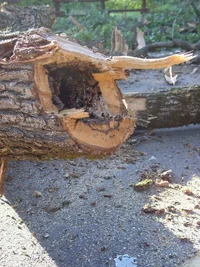
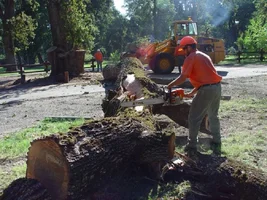
I was digging through some old photos and found a job I did last summer on a Valley Oak. This was a definate potential for heavey splitting .

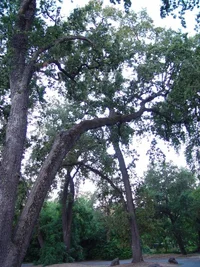
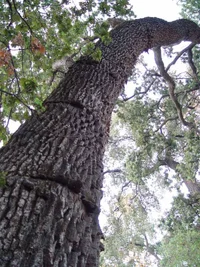
The (first) photo is of the whole tree . AS you can see, the trunk to the left is very heavy and there is another large latteral headed West that you cant see, but I'll show in the (secound) pic. The so called central leader in the first photo was to stay and the rest of the tree was slated to be removed because of High traffic target.The
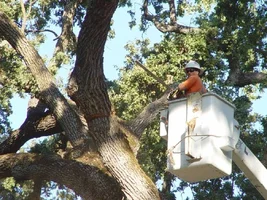
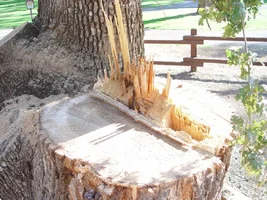
(last) pic in the session which is the falling cut, shows the potential for splitting.

Notice the shearing in the hing wood, compression towards the front and amount of pulling wood.Some of the pulling wood could have been eliminated by cutting up the hing just a tad more. This falling cut was bored out, cut back to about six to to eight inches of holding wood then tripped below the actual bore cut about four to six inches.This photo doesn't show the trip.

Enjoy ,

Greg
 

Attachments

  • 7663-#1Full view of Valley Oak.webp
    7663-#1Full view of Valley Oak.webp
    186.1 KB · Views: 127

New threads New posts

Back
Top Bottom