knot

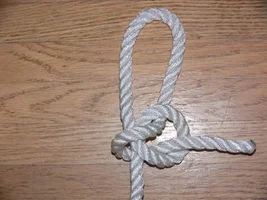
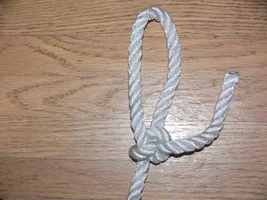
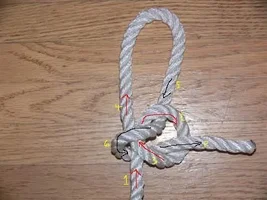
Is there a name for this knot? Make a half hitch like the bowline then pass the tail up through the "hole" but now just go over top of the "tree" and up the "hole" and cinch tight. Harder to untie then the bowline but does not appear to come loose if hung up and the tail is not in the way.
 
me neither?

jp
grin.gif
 
i tried to tie this knot in the way you describe and got nothing that could be called a usable knot, especially compared to a bowline. I'll check Ashley's book of knots later and see what he has to say about it.
 
[ QUOTE ]
Oh crud-I have seen a name for that but can't remember what it is -It is considered a Bowline variation and I used to use it quite a bit.

[/ QUOTE ]

Sorry (
grin.gif
) Blowline perhaps?

Isn't it just a bowline tied wrong? Why use a variation that is hard to untie?
 
The Bowline has been called the King of Knots....and the King has sired many children. I quit using that variation at all a dozen years ago. Why'd I use it? 'cause I learned THAT as a bowline and it worked well. It isn't hard to untie just a little harder than a standard bowline. On the other hand it sets more easily/securely in stiff 3 strand rope.....which is what I learned on.

BTW try looking for a "Back Bowline" that may be the name of it.
 
At first i thought you meant a Spier; an American (www.mytreelessons.com/Archive/Army Rigging Field Manual.pdf )type of fixed eye (like a Bowline) that is slipped. But the pic looks closest to a Jacked Bowline to me; only the Bitters/tail goes back the opposite direction through the Half Hitch and lays neatly against the eye in a Jacked(rabbit going back down the hole inline but reverse direction it came up like in normal Bowline).

i'd think the less "Square"; more "Granny" finish shown in the previously attached pics would be less stable/ less reliable. The Jacked would have a more "Square"-esque fini.

A Jacked Bowline could be considered an accidentally maid Bowline; and not as secure. Except; like in a retrieveable mount to hang a pulley without the 2x2:1 effect; whereby a regular Bowline empowers it's Half Hitch to trap the Bitter Tail by an inline pull(like a SheetBend). So the spreading apart pull of the retrieve-able mount could be riskier with a regular type of Bowline mechanics. The Jacked version, however is maid to capitalize on an across/non-inline pull to lock; so is better in this case. Where the long end becomes the Bitters and the Eye Spreading becomes the Standing Part.

A Jacked-DBY can be seen in "The Art & Science of Practical Rigging"; used as described here.

A regular Bowline is just like a SheetBend to self to form eye; except the trapping Hitch has pulls at both ends to form a Half Hitch with inline pull to the longer part of the rope; as it's Standing Part.
 
[ QUOTE ]
...A regular Bowline is just like a SheetBend to self to form eye; except the trapping Hitch has pulls at both ends to form a Half Hitch with inline pull to the longer part of the rope; as it's Standing Part.

[/ QUOTE ]

There ya go. That's one reason why a Bowline is a more trustworthy knot than a Sheet bend even though they look so similar.
 
Here is a pic i maid years ago about Bowline to SheetBend Compairison. It shows because of the conversion of the Hitch in a Sheet to a Half Hitch in a Bowline; the way the forces are carried is also changed.

If we look at the bight as the escape force and the Hitch/ Half Hitch respectively as the lock force (against escape); we can see that in a 100# equal and opposite force loading; the Sheet's Hitch has a 100# of the total 200# force for lock; versus the 100# of escape force.

But, the Bowline takes the 200# total forces (divided up into 100# equal and opposite for a 100# loading); and takes 150# of it to empower the lock; versus only 50# of 'escape' force potential (all figuratively speaking).

But, notice; that both mechanisms are empowered as inline forces; not spreading forces.

If we employ the Retreivable-Remote Bowline Mount (as shown much better in "The Art and Science of Practical Rigging") strategy to isolate a limb and only have a 2:1 support load (rather than a 2x2:1 of floating a pulley anchored to the ground); we can place a spreading apart force on the Bowline eye; improperly.

That is where the "Jacked Bowline" (sorry, i guess it is olde picture day) strategy becomes useful. For, on a spreading apart of the eye; it's usually errant pulls are now inline more properly. For now the 'long end' of the line is not the Standing Part of initiating pull outside the eye/loop formed; but rather the inside of the eye/loop becomes the Standing Part. Sot he Jacked, just turns to accommodate and have the proper inline mechanics. This should be maid as a DBY ; only (if using the slip knot method shown) grabbing the part that is going to be the eye to pull through to slip knot as the Standing Part; rather than the 'long end' of the line grabbed as the slip knot as the Standing Part as shown in the animated .gif linked.

edit: Slip-Knot/ Climber's Bowline style in a DBY

Note: The Jacked Bowline pic was maid to show the failings of the Jacked; and shows also an inferior version; whereby contrary to usual Bowline strategy; the tail should finish outside the eye; not inside as shown. Finishing outside properly places the most immediate Standing Part force on the easiest to hold tail in truer http://igkt.pbwiki.com/f/BabyHoldingBus2.swf style. Though, as with the other DBY forms; this is much less an issue; but as true proper and understanding rope mechanics; this shows the best mechanics.
 
There are bowline & "anti-bowline" variations to be preferred to
the one you show. Bring the end through the rabbit hole from
the opposite side, and make the 2nd pass through this hole
on the eye-side of the first, and repeat. This will give you a
stronger & more secure knot, also easily enough to untie.
(I call it "anti-bowline" because of the end being brought back
through the opposite side of the nipping loop (rabbit hole).)

Rather than the two-popular Yosemite Bowline, take the tail
around both legs of the eye and tuck it back down (opp. to
its emergeance) through the central nip (rabbit hole), which
then gives the mainline 3 diameters to bend around and crush.
In the bowline image provded above (here):
www.cave.org.vt.edu/images-knots/jpg/full/bow3.jpg
... one would swing the end under-right then left-across/over
the legs of the eye, then rightwards under the central knot
to emerge up out of the narrow triangular center.
A similar re-tucking looks good--maybe better--for the "Cowboy
bowline", where the collar around the mainline is made in the
opposite direction such that the tail lies on the outside of the
eye legs rather than between them.

The retucking of the end pulls the eye legs together sufficiently
to prevent easy loosening of the knot even as the mainline
comes back through the collar (which is the key to untying
the knot).

*knudeNoggin*

 

New threads New posts

Back
Top Bottom