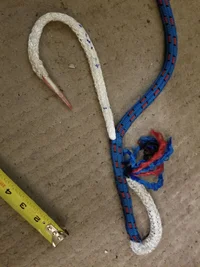
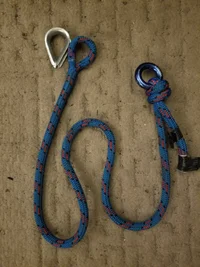
Is Blue Moon a realistic expectation as a beginner-splicer?

eyehearttrees

Not a new Member
Location
Tampa-Area
I respect the "get a bunch of ropes & learn them all" approach but, for my circumstances, right now I'm just going to be splicing my current Blue Moon climb line and some new Yalex for a sling(s), I've no worries about splicing Yalex/Tenex hollow braids but I've tried to splice my Blue Moon before and spent 2hrs only to get one part stuck in another while doing one of (or 'the'?) hard push where you're fighting to put rope-in-rope.....I'm pretty confident that, if I'd had the time & patience, I could've done it on a 2nd attempt.

But then I read a ton of posts by @NickfromWI on splicing and in-addition to seeing that he's got material on splicing Blue Moon specifically (though I was quite frustrated when part1 ended and there was no part 2!) but, most-importantly, I read a post of his on this forum that describes a kind of "pull-through" fid instead of a pushing-fid, I'd been using an appropriate-diameter length of aluminum (that I tapered with buffer discs @10k RPM to really get a nice smooth front-edge to), I had the piece of rope taped crazy-tight, but halfway through the bury the rope pulled-free from its taped-affixment to my aluminum rod --- I've very, VERY little doubt that, had I been able to pull, I could've made it work.

So, awaiting some yalex+t-rex (can't understand why tenex is the go-to, it seems the inferior two-carrier, hollow braid HMPE cordage of the 3...) and eager to do all the neat things that such an open-interior rope allows, but "the bug's bitten" me enough that, with the remainder of my day being mostly-free, I'm going to try Blue Moon again. I know replies here aren't lightning fast but I figure tthere's a great chance that it'll be dinner time and I'll be fighting my way through round #3 or something, because in biting this off a 2nd time I won't be able to put it down til I've got a splice done!!!

Thanks a ton for any&all input, even if you think it's mundane I bet I'll learn something from it :D

PS- Anyone know what double-braided bull-lines are the easiest to splice? I don't see any need (for myself) for splices on my climb-line, however for a bull-line it seems that you'd **always** want the end of the working-leg to be spliced otherwise that's the weak-point in a properly configured system....I'm really set on getting the 5/8" Polydne (maybe 3/4" but probably 5/8"), I know it's "possible" to splice but unsure if it's, I dunno, closer to splicing Blue Moon, or somewhere in-the-middle of the "Blue Moon to Tenex" spectrum of ease-of-splice!! I'm opposed to really static lines (anything much under 2% I wouldn't be interested in, no stable braid no sirius), truly hoping that Polydyne isn't remotely as hard as Blue Moon but when looking at it it appears to just be a beefed-up version of the same thing, in most regards... Thanks for any suggestions on this, it seems that being able to keep a fresh/strong splice on the tail of the working-end of your bull-line is a very useful thing to do, I want to be confident I can splice new eyes into the end of my rope 2 or 3 times through its life as it wears-out!
 
You would benefit from trying a couple of Stable Braid or similar rope (Husky for example) splices first. The Yale 11.7's (Blue Moon et al) have a tighter outer braid.
Splicing used ropes is another kettle of fish. Good luck with your endeavors.
 
I've spliced All Gear (Atlantic Braids) Husky in 3 sizes, Yale Polydyne in 4 sizes, and a couple of other doublebraid rigging ropes, and found them all easier to splice than climbing lines. In fact, when my first climbing line splice (Yale Aztec) came out less than stellar (looked like shit) I practiced on rigging ropes, then went back to the climbing ropes because the easier rigging ropes allows you to get through the whole splicing process, and understand it, before trying the much tighter weave of the climb line sheaths.
 
You would benefit from trying a couple of Stable Braid or similar rope (Husky for example) splices first. The Yale 11.7's (Blue Moon et al) have a tighter outer braid.
Splicing used ropes is another kettle of fish. Good luck with your endeavors.
You would benefit from trying a couple of Stable Braid or similar rope (Husky for example) splices first. The Yale 11.7's (Blue Moon et al) have a tighter outer braid.
Splicing used ropes is another kettle of fish. Good luck with your endeavors.
Ugh I was worried about this, the idea that if I just keep trying Blue Moon I may end up doing a 2nd, 3rd and 4th attempt w/o success and lose steam....Is Stable Braid a LOT easier to splice than Polydyne? Splicing Polydyne is the next step after Blue Moon, so perhaps the smartest move for me is to just decide whether I'm getting 5/8" or 3/4" Polydyne and start my testing with that, order an extra 50' on the spool?

Re used-ropes.....I hear that in-general they're more-difficult to splice but I'd been thinking that, with Blue Moon, it could actually be EASIER on used-ropes because that super-tight, super-stiff cover-braid has been made far more supple - would love to hear @NickfromWI take on this (also would be curious why Polydyne is easier than Blue Moon, if I'm being honest I'd kinda assumed that the Polydyne would be incredibly similar, just larger, and possibly even tighter braids, than Blue Moon (am dumbfounded at how Yale pushed the #'s they did on that line, just amazing am surprised it's not the go-to rope for riggers IE surprised the 1-something-% elasticity lines are still being purchased at all for general-rigging!)
 
I've spliced All Gear (Atlantic Braids) Husky in 3 sizes, Yale Polydyne in 4 sizes, and a couple of other doublebraid rigging ropes, and found them all easier to splice than climbing lines. In fact, when my first climbing line splice (Yale Aztec) came out less than stellar (looked like shit) I practiced on rigging ropes, then went back to the climbing ropes because the easier rigging ropes allows you to get through the whole splicing process, and understand it, before trying the much tighter weave of the climb line sheaths.
Isn't Atlantic Braids making Notch's lines as well? Gotta look into them am curious why a manufacturer wouldn't insist on keeping their name on the ropes (IE Yale wants to protect its image so it'll re-color a line for special releases but, *in general*, they still want it known that their outstanding lines are actually Yale-made!)

I'm surprised rigging DB's are easier to splice, if anything I'd have pictured them being "denser" (I mean, they've got less stretch and higher-average-strength than climb lines, so when thinking of Blue Moon // Polydyne I had thought "gotta be OK at splicing the BM before you could do the Poly"!)

How did splicing the Polydyne compare to your other splices? I'm getting 5/8" or 3/4" (*very* open to suggestions!) polydyne and splicing its working-end (no matter how many times I've gotta flip the rope's orientation or cut-off worn-out-ends) is something I consider **critical** because a proper rigging setup should have its weak-point at the bull-line to load junction, not having a spliced line has a much more significant impact on any system that line is used in, was pretty surprised when I understood that (and left me confused why it's not far more common / 'the norm' for people to splice & re-splice their rigging lines!)

Such a great feeling to hear the Poly wasn't difficult like B.Moon is, so glad you posted thanks a lot :D
 
Yep, totally doable after a few easier practice splices to get the process down.
I've gotta order cordage anyways so will definitely get "the easiest" (I keep hearing Stable Braid but others have said True Blue - if there's a known "this is about the easiest DB rope to splice" then I'd be happy to hear it!), although at same time I'm already getting Polydyne so maybe that's easy-enough that it could count as my splicing-practice cordage? Will grab 10' of TB or S.Braid regardless, just so I"ve got a feel on the 'range' of difficulty!! Can see the value in that even if I'd already started with a successful splice on the Polydyne, just to get a better feel for splicing because I'm realizing it's far more important than I'd initially thought (was going to get a splice on my climb line but don't see any point as I'm so lightweight that I never stress my basal-anchoring it's insane, used to use a steel thimble inside a figure-8-witih-bight to run my rope through at the trunk of the tree and now I don't even keep that thimble in there anymore because it's just not getting that substantial a force on it!)
 
Anyone have links they'd be willing to share to help me understand this? I like NErope's & samson's youtubes, they were my primary/sole source when I first attempted the Blue Moon, however I'm hearing about two things that I really want to find good coverage on:

1 - using a pulling-fid instead of a pushing-fid (the tight jacket on BM would make a pulling-fid a far better choice!)

2 - **which is better** between burying/tucking the *core* first, or the *cover* first.....it seems that the experts (Nick, brion) are doing the *opposite* way as the Samson/NEropes videos, I would be incredibly grateful for any links to videos or articles that are thorough, like Samson/NE's stuff, only with the nick/brion approach to cover/core burying-order!


///the neat thing about the BM is that, when I mess up a splice, at least I'm left with (2) usable ropes LOL, got a BM cover-braid as my chainsaw strop and have played with the inner-braid as a prusik (NOT on my climb line, actually haven't used it in-action yet once, it's obviously not meant to be exposed / is very soft but I know I'll find a use for it!)
 
A length of wire bent in half can be fashioned into a pulling fid. Coat hangers can work, or piano wire I heard? You just want it pretty straight and stiff except for the tight 180 degree bend that catches the rope for a bury.
I tuck the core first. It doesn't really matter either way, but I think it's easier to manage the loose braids and tapered ends with the core stuck in the throat already. Lots of little tricks here and there to help things stay neat and run through well. Like stitching the crossover or using pins or awls to keep parts from pulling or moving around while working.
Used rope is harder to splice. It is literally harder, as in more dense because of grit and compression expanding the yarns and filling the tiny spaces.
Just wait till you grab a fat bull rope. It is squishy because there is more space in there to fill with more rope, thus the easy splicing.
 
If True Blue was mentioned it was referring to using it as a rigging line, it is a solid braid twelve strand that can be spliced, but is very tedious, and more like a three strand splice.
 
A length of wire bent in half can be fashioned into a pulling fid. Coat hangers can work, or piano wire I heard? You just want it pretty straight and stiff except for the tight 180 degree bend that catches the rope for a bury.
I tuck the core first. It doesn't really matter either way, but I think it's easier to manage the loose braids and tapered ends with the core stuck in the throat already. Lots of little tricks here and there to help things stay neat and run through well. Like stitching the crossover or using pins or awls to keep parts from pulling or moving around while working.
Used rope is harder to splice. It is literally harder, as in more dense because of grit and compression expanding the yarns and filling the tiny spaces.
Just wait till you grab a fat bull rope. It is squishy because there is more space in there to fill with more rope, thus the easy splicing.
OMG the pulling-method wasn't just better I honestly don't know that I ever could've done the initial core-through-cover pull without one (I followed Samson's video, seemed pretty identical to the NEropes video I tried&failed to my 1st go-'round. Yale's were very confusing to me so sadly couldn't stick w/ my favored Co here!)

After I got the core through I thought "the hard part is over" ROFL!! I must've spent 30min fighting that last 1% of the operation, milking everything into-place, I think I had wayyy more slack on the core that I was trying to milk-into the final product, does this look sloppy/loose:
20191104_124252.webp
(I'd snipped the alum-wire I'd used as a pull-fid, still hadn't removed it fully...) But the core, from point 1 to 2 (can't recall the letters used :P ), in hindsight I'm guessing that should've been way tighter, at any rate after some fighting indoors I got it here and realized my sizing was a touch too tight for the thimble I'd hoped to fit:
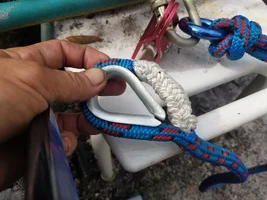
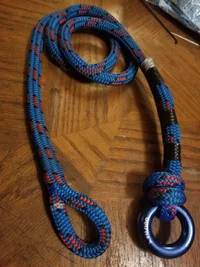
20191104_131327.webp
^you can reallly see how bad the bunching-up of the core-over-cover segment was as I tried finishing it, I eventually had to get 1" rebar to put through the eye as a pull-handle, hitched the rope itself to my truck's tow-hitch and thank god I'm able to "snap" with a ton of force, I doubt most people I know would've been able to finish it, when it got to that last 1% I must've spent 20min, blistering my hands, moving it part-millimeter at a time (if a snap got any movement!) til I finally closed it :D

20191104_192924.webp
20191104_145429.webp

(the silver paint-pen line is 1" away from the core-over-cover that was milked-into the cordage, I like it there so I can always see that it's stayed the same however it's hard to imagine it could slip hell I can't imagine trying to whip-lock this I doubt a needle could get through I mean it is hard-as-a-rock at those first inches of doubled-rope inside the covering!!)

~~~~~~~~


Was splicing attempt #2 (both on this Blue Moon, though the first time the rope was pretty new), this time I must've spent 4-5hr because I was determined not to waste another piece in fact I started last night & paused overnight because I needed a better pulling-fid design, at any rate now that I've got this done I know I could do it again in a fraction of the time and, w/ blue moon being among the tougher splices out there - heck Yale doesn't even list directions for it - it's got me feeling like I could do most-anything I'd want to, am totally on cloud-9 right now LOL :D

(/u/ @NickfromWI - yeah, it realllllly IS addictive!!!!!)
 
I tuck the core first. It doesn't really matter either way, but I think it's easier to manage the loose braids and tapered ends with the core stuck in the throat already. Lots of little tricks here and there to help things stay neat and run through well. Like stitching the crossover or using pins or awls to keep parts from pulling or moving around while working.
To be clear, this is the 'normal' method right? I just followed samson/NE's style, unsure what differentiates 'tuck' / 'bury' and was unable to find "the Toss method" (Yale's was basically incomprehensible to me lol, was too nervous at another failure!) Would like to learn the other way, just to know it, as the idea of field-splicing is very very appealing so if it's a quicker/easier way I'd wanna know! Aaaaand thanks a ton for including:

Used rope is harder to splice. It is literally harder, as in more dense because of grit and compression expanding the yarns and filling the tiny spaces.
Just wait till you grab a fat bull rope. It is squishy because there is more space in there to fill with more rope, thus the easy splicing.
I didn't get "easy DB rope to practice with" because I had to figure-out how practical this was ASAP because I'm overdue for ordering a proper bull line and had to be sure I could count on being able to field-splice it, I was reallllly set on Polydyne so figured that, if I could do BM, then I could comfortably order the Polydyne (and even save myself the $20 from them factory-splicing it, may as well do practice-splices on that cordage when I get the spool :D ) so am SO happy to read this!!! What do you think of the consideration between 5/8", and 3/4", polydyne? Part of me thinks to go 3/4", it'd feel better in the hand, last longer, allow me to push the rope more (double-Safebloc rigging and whatnot), but at the same time the 19k ABS of their 5/8" seems plenty especially when 3/4" tenex is my main anchoring.....I'm still stuck, I feel like whichever one I choose, I'll end up wishing I'd gone with the other....the 3/4" is just so damn strong I feel like it's a must-have, would allow so much, but at the same time the 5/8" at 19k ABS basically does that too.....realistically I think one of the things I'm unsettled on is how the change in diameter will play-out IRL with my anchors (Safebloc, X-rings Lrg & XL/beast), just picturing 3/4" poly being forced through a double-headed anchor (with two of the 'large' x-rings) makes me think they'll essentially become a friction device in and of themselves! And, with the Safebloc, I'm picturing that 3/4" will let me control tthings far better simply because the rope will get more friction-contact and thus be more in-control/slower.....

Would love thoughts from anyone on that, I mean both the 5/8" and the 3/4" are "serious duty" (19k and 26k ABS lines with 3% elasticity so proper shock-absorption, dunno why people buy 1% lines for rigging!), the 3/4" gives me extra friction, gives extra grip when holding/running the line, and allows bigger things to be thrown into double-safebloc-rig setups (where you're multiplying force on the line due to the friction+mech.advantage of the system), just fear having it for a week and thinking "I paid over $50 extra so I could have a heavier, bulkier rope when the 5/8" was already overkill" yknow! :P
 
In writing that ^ I am left in awe at these ropes, was talking about it earlier to someone who wandered why the splicing-ability was so important to me, I was able to hold up the spliced rope ^ and say "this side with the splice can hold the cord's 6500lbs ABS, the other side that's got an O-ring knotted-on can take maybe 80% of that at absolute-best"

I'm surprised I didn't realize the importance of field-splicing earlier, I mean honestly I doubt I'll ever splice the blue moon again (well, til I get another spool of it for climbing and the current one becomes my light-duty rig line!) cuz for climbing I'm plenty trusting of the ropes hell I'd climb on jjust the cover-braiding of BM, but rigging...........Rigging is always a game of calculations and safe-weights, this is inherently a factor of the gear you're using IE anchors for the bull line and the line itself -- if you gotta terminate the bull-line to the loads with knots, instead of always having a nice fresh splice on the end, your 20k line may as well be a 14k line yknow? So, IMO at least, it seems insane to not always be ready to splice teh end of your rig-line as you're cutting its strength so significantly when it's not spliced and, for its usage, almost all operations are functions of "safe weights" which is A) what you're comfortable with and B) what your gear can hold.....so yeah splicing, for me, is a rigging concern, cannot wait to get my polydyne (am actually planning to use it for anchors as well, may order a length of 1" for that purpose but at any rate I hate the super low stretch of these HMPE's like yalex/tenex for rigging systems, wayyy too static (and even tensile strength isn't anything to write home about, if talking 3/4" then polydyne is stronger than tenex-tec and I'll bet the polydyne by yale is actually a true 3/4" whereas Samson's tenex-tec 3/4" is thicker than 3/4" which drives me nuts!)


Soo....150' 3/4" polydyne (26k abs, 3% elast.), anchored by all rings or friction-devices, secured with 3/4" or 1" polydyne slings (spliced, of course!), should let me do almost anything that I'm comfortable with while providing a safe, bulletproof, friction-slowed system (I have X-rings' 3-ringed sling, am picturing a 3/4" line forced-through the 3 rings, bet it'd provide as much friction to a 3/4" line as my Safeblock would put on a 1/2"!! Wish DD made the #'s more available, I've already got pages of practice tests for my anchors / 'heavy-duty' rigging system!!)


So glad I made this thread, cannot imagine I didn't realize the first time "no fid will get through this thing, not if the cover's gotta hold a core + a fid-with-core", the wire (alum wire) trick worked on the 1st try, am just soooo stoked right now I cannot believe I've spliced a rope :D LOL a grown man all giddy from sewing/crafts ROFL!!!!!
 
You seem to be very enthusiastic in the pursuit of knowledge, and I applaud you for that, However, I feel you may focusing on some of the less important issues. Not sure what size wood you plan on dropping into these rigging systems, but for 90% of the work I do 1/2 inch line is more then enough with a minimum of a 10:1 safety factor...I feel you should experiment with some more basic systems before diving head first into a more complex double whip tackle system for example. Your heart and brain seem to be in the right place so please take this as constructive. Sometimes 1 step forward is faster then 3 forwards....swiftly followed by 4 back
 
Get your self 50’ or so of Polydyne or some such double braid and cut it up to make slings for practice, get the technique down pat.
Get yourself a few lengths of music wire, it’s super tough stuff, heat it in the middle and fold it in half. Drill out a 1” diameter branch or something to put the ends through and fold the wire ends over.

Next start paying attention to the wasted core amount after buying. You will see that many inches are cut off after the bury. Once you get a feel of this, start a dramatic “pre taper” about half of the core or a little more. I’d say half the strand volume for about 6” or a little more with larger ropes. You can now insert this into your wire fid 3” +. Then when your burying there is half the doubles volume you’re pulling through.

The easiest part of a DB splice is the quickest way to fuck it up, this is milking out the crossover! Take your time doing this, and consider stiching it together to hold it in place. Whipping twine, a cut off from the cover taper or such works good enough. I use just a few passes without knotting it.

Next trick when running the spice home is to anchor the knot you tied very securely. Grab the cross over and pull the core between the knot and cross over as tight as possible, KEEP THIS TIGHT! Take your opposite hand and while keeping tension on the core start pulling the cover slack towards the cross over.

Once the splice has only about a inch left before the cross over gets sucked in. I take a break. Then insert whatever to use as a handle, most the time a carabiner. Next I then will spike the throat of the splice excluding the core bury with a whipping needle. Now I then finish the core bury, by marking where the core exits the cover. Next Mark the core through the little window at the throat. Pull the core where it exits, trim taper and bury core.

Next, remove cross over stitching (sometimes I’ll leave it). Remove the needle spike and start running the splice home while keeping as much tension on it as I can.

Stubborn splices, trick # 1 whack it with a hammer handle on a smooth hard surface. This loosens the cover at the throat. Bend throat and splice in all directions. Whack a little more, then bury a little more. Repeat as needed. Add water as needed

#2 water based lube or a little gentle soap. Best applied for the hardest splices, but before the bury gets super tight. Soak and wash rope afterwards.

#3 use a come-a-long to tension rope between splice and knot. Just over taught. Take a friction hitch and tightly starting on by the knot “rappel” the hitch toward the splice. Jump on rope then repeat as needed.

If there is a little bunching of excess cover slack in the eye, this can be corrected after the splice is ran home but before whipping. Basically shock load it by hanging vertically and dropping into it while wearing a saddle. Minor 3-12” shock loads. Sometimes you need to massage the throat while doing this.

Cheaper and easier to start off easy before trying to tackle a hard splice.
 
The eye cover looks a little bunchy, the core has been sucked in too far during the final milking back of the cover.
 
You seem to be very enthusiastic in the pursuit of knowledge, and I applaud you for that, However, I feel you may focusing on some of the less important issues. Not sure what size wood you plan on dropping into these rigging systems, but for 90% of the work I do 1/2 inch line is more then enough with a minimum of a 10:1 safety factor...I feel you should experiment with some more basic systems before diving head first into a more complex double whip tackle system for example. Your heart and brain seem to be in the right place so please take this as constructive. Sometimes 1 step forward is faster then 3 forwards....swiftly followed by 4 back
I know tone is hard to convey online but...I sincerely appreciate your notice&acknowledgement of my enthusiasm, you're very correct there :)
I appreciate the concern but assure you I'm FAR more conservative than you'd ever have guessed, hell my saw has a 10" bar and I'm not looking to upgrade anytime too soon as I'm still not 'mastering' what the 10" can drop! On weds I'll get my 1st real/high-grade bull lines (1/2", 5/8" and 3/4" polydyne cords), yet not one is 100' long -- that's by design, it was better for me to get varying diameters of lower lengths because they're not for in-field use they're for practicing/testing and, in doing that, *I* choose what I want to cut and the short-lengths I've got coming are more-than sufficient for the testing I'll be doing!
I hope that within 6mo, maybe 1yr, I'll be ready to "take that next step" and go buy a >30cc // 12-->16" top-handled saw alongside a 200' bull line, but even at that point I'd still have them in-hand and be practicing them in my backyard for weeks (at least) before field-use, it may sound unrealistic I just don't know how I could 'prove' that I'm trying to learn these things so I can be better in the long-run, NOT so I can start deploying them on-jobs!

Thanks again for the concern, honestly I'm now thinking about how to put something in my signature to make-clear that I'm in my testing-phase still!! I do real tree gigs but only the most-basic stuff, I've said "I can't do that" plenty of times and it wasn't for lack of equipment or that I wasn't 95% sure it'd be fine, I just wouldn't do a job I was only 95% confident on just like I wouldn't climb to a 75' TIP that I was only 95% confident on LOL, I'm good with #'s and know having a "95% confident" mindset is what equals dangerous in these contexts, I LOVE that adage of "there's old climbers, bold climbers, but no old, bold climbers", I love & fully apply Reg's concept of "never make a 'fuck-it' cut", I'm just eager to progress here but in no way, shape or form would that EVER be at the expense of my safety, the safety of things(or people) nearby me when I work, or even at the risk of public failures (IE when I do tree jobs right now that don't require rigging but I rig anyways to practice, I am not "pushing" things the way I do in my backyard, as I wouldn't ever want to snap a line - a line of no practical consequence - anywhere that a client could see it!) I'm 100% of the mindset that the only reliable path for me is the 'low&slow' mindset for every step I take in this industry, again I totally see it as "steps on an icy stairway" and those stairs'-steps aren't even plumb they're tilted-down this proverbial stairway, each step is taken with the utmost intent & confidence, always acutely aware of what a misstep could do to myself/my future in this area/the people/things around me!

Sorry for length but in reading your post I realize I could, maybe am, coming-across as some wreckless a-hole who's putting himself & others in danger and it couldn't be further from the truth, I'm scared-to-death of missteps here, my intent with the more advanced stuff is partly because I'm planning to be doing it in the field someday and partly because I simply like the approach of being over-competent for any actual jobs IE I plan to push-forward & learn in practice-zones for my foreseeable future in this, never "step-by-step" on jobs, no matter how cautiously, the only times I'll take any chance of a system's failure is when it's in a controlled situation wherein I know what the failure will do and am OK with it IE maybe in a few months I'll be comfortable enough to do real on-job rigging over generic flower-beds where, I expect to be doing that on-job around the time I'm getting comfortable with all kinds of advanced techniques in my yard or on jobs where there's nothing but clear-earth below me, both for selfish reasons of wanting a long / reliable career here as well as thinking it ethically-abhorrent to "wing it" when there's stuff at stake (and, in the context of rigging logs, I'd consider it to be "winging it" if you're doing anything you're not fully-convinced you're totally capable of, I always expect to have a higher/more conservative margin between what I *can* do and what I actually do in-field....I expect that at some point, I'll need less of a margin but doubt that'll come in the first year or two of this!)
 
Not sure what your employment situation is already, or if you’re kinda invested in another career already but you could benefit so much by going to work full time for an established tree service. Just by working the ground you can absorb tons of knowledge about rigging and how different species will behave and react, where you’ll find tension or pressure depending on lean/ center of gravity and external forces and how you can make those forces happen or counter and negate existing ones.

We can all chat online about this stuff til the cows come home, but getting out there and cutting and actually moving some material with someone who’s experienced to watch your back is how you really learn and retain the info. There’s a lot you can learn here and elsewhere by reading, I’d never say there isn’t, but real training and actual labor is the easy and safe way. Hard work IS the easy way! Read everything ever written about tree work and watch every YouTube video made on the subject but know that without an experienced eye watching your back, you really are winging it. You’ll get more than just answers, you’ll get up close demonstration and guidance and someone who can put a stop to a mistake before it’s made. You’ll get early answers to questions you didn’t know you were gonna ask, for real.

I’m not trying to give anyone here a hard time, I hope I ain’t coming off as holier than thou, I’ve had my share of mistakes that were absolutely due to inexperience and one of them almost ended my story permanently. I can’t understand why anyone would want to try to figure this stuff out for themselves when there’s likely local professionals that will pay you to learn it without the massive risks that come with trial and error. All you gotta do is return their investment in the form of honest and reliable labor. I like climbing, but I get a lot of satisfaction from working the ground too. If you got a driver’s license, no criminal history of theft, and no medical reason to not be in the industry, you’re probably hired man.

Also, I’d be stoked to be doing tree work in Tampa during the winter months :)
 
Just by working the ground you can absorb tons of knowledge about rigging and how different species will behave and react, where you’ll find tension or pressure depending on lean/ center of gravity and external forces and how you can make those forces happen or counter and negate existing ones.
Seriously.. this couldn't be truer. The only way to really understand these invisible forces is to have an experience eye & a good to expert understanding before considering trying to do it aloft. It all starts on the ground & really takes years to absorb. I remember my first season working the ground & constantly fucking up the 101 stuff.. getting my bar pinched, not being able to read pressure points, not understanding cause & reaction, blowing through hinges & just getting lucky on the lay, etc.. It took a good year of everyday cutting & A-Z ground work to be able to know the 101's inside & out... & that's just cutting techniques & general knowledge for ground work where you can jump out of the way or have a free range of motion when shit might go sideways... & It will go sideways on you, it's inevitable. Thats day in, day out, 8-10hrs a day running all sizes of saws & that's just barely scratching the surface of what I needed to understand basics of ground cutting/work... Thinking back, knowing what i know now, I could never imagine inserting myself into a climber/bucket role before having that experience & stacking the deck in my favor... At the time, would i have, if given the opportunuty or asked to? Yes.. i would have, but i guarantee i would have been relying on 50% luck to get me home everyday no matter how hard i mindfked each cut or movement.

There’s a lot you can learn here and elsewhere by reading, I’d never say there isn’t, but real training and actual labor is the easy and safe way.

Read everything ever written about tree work and watch every YouTube video made on the subject but know that without an experienced eye watching your back, you really are winging it.

You’ll get early answers to questions you didn’t know you were gonna ask, for real.
& These are usually the answers to the questions that will end up getting you froggered. Learning all this via the inet with no actual day in & day out experience leaves HUUUGE gaps in the knowledge spectrum that no experimenting in the back yard can completely fill. Yeah, it will give a feel for it, but the gaps will be there. There's really no substitute for it other than day in day out experience.

But hey... Can't fault ya... Youtube & Hashtags make everything look easy.. Just ask the youtuber who said a motor swap in my HD would be tit... Or find the tutorial that starts with "all you have to do is....".
 

New threads New posts

Kask Stihl NORTHEASTERN Arborists Wesspur TreeStuff.com Teufelberger Westminster X-Rigging Teufelberger
Back
Top Bottom