Inverted barber chair

Rico's recommendation of a deep face may be spot on. I disagree however, seems to me the hinge thickness was excessive for the diameter/ wood characteristics and it may very well have been over tensioned with either internal (lean) or external (pull) force. Either way we all have a plan till we get smacked in the face. Seems as if taking the escape route prior to pulling paid off! I find this to always be a good idea if possible.

Tony...
I believe Rico was talking about the notch being too shallow on the cherry, not the ash... The ash definitely split because there was too much force on the pull line, and some defect in the wood.

What the novice should keep in mind is that BBC will only happen when the force needed to split the trunk is greater below the cut than above, which typically only happens at the stump, due to the dense wood at the trunk flare, but can happen above a big crotch.. On straight grain wood, a trunk will most often split down which of course can be a killer if the climber has a lanyard below the cut. I've been thinking about using this property to jump tops, but have yet to find a good scenario to try it..

The tendency of trunks to split or BBC when notches are so shallow is certainly one of the main reasons the standard recommendation for notch depth is 1/3 diameter.. when you go shallow the amount of force needed to split the trunk goes WAY DOWN!!!

Here's a vid to show the trunk split with just a back cut and skid steer on the pull line... It splits down instead of BBC

 
Too many people are using bore cuts too often. It’s a specialty cut used in special circumstances, primarily with hard leaners. And deeper face cuts give the tree something to tip over on, put a shallow face in a big tree you are trying to wedge over and you’ll be there all day beating on wedges.
Edit: I was speaking in general terms and not referring to jimbo’s or cjms pictures. Like tony says I wasn’t there and don’t know what you were up against.


On the other hand bore cuts aren't used enough because most suburban fallers don;t have enough practice to feel comfortable so they just cut up the back cut until the tree starts to move, which can be very problematic if there isn't enough force to get the tree to tip on a decent hinge thickness. When I first started bore cutting I sucked at it so I started boring almost all falls just for the practice, until it became SOP.. Just inately knowing how much hinge to leave. Now I do it on a good percentage of falls but not all... I honestly find that bore cutting is close to as fast as a standard back cut. It recall hearing some loggers talking about it as though it were an inferior practice and waste of time...
 
On the other hand bore cuts aren't used enough because most suburban fallers don;t have enough practice to feel comfortable so they just cut up the back cut until the tree starts to move, which can be very problematic if there isn't enough force to get the tree to tip on a decent hinge thickness. When I first started bore cutting I sucked at it so I started boring almost all falls just for the practice, until it became SOP.. Just inately knowing how much hinge to leave. Now I do it on a good percentage of falls but not all... I honestly find that bore cutting is close to as fast as a standard back cut. It recall hearing some loggers talking about it as though it were an inferior practice and waste of time...
The main issue with a bore cut , when not required, is that you may inadvertently collapse the tree onto your bar if the tree is either rotten or you cut into the face or a corner, because a bore cut is blind until it emerges out the other side. I personally only use one when the situation calls for it, just like all the other cuts in my bag of tricks. Salome cuts, topple cuts, conventional and humbolt all have a place. A technically perfect humbolt cut may not be correct on a huge rotten cedar snag.
 
I am curious if this is was an EAB killed tree. A lot of the recorded incidents cutting them have been basal failures.
Yeah it was a EAB killed tree I do hundreds of them every weeks... That one wasnt that big maybe 25" in diameter max, it was pretention way to much...was working with weirdos in a new business so I can't count on them to pull with the truck if I say pull.... It was a back leaner over a little shed/firespot so I ask to pretention it a bit more to cover the lack of awareness...haha it works good! The crack was going roots deep in the stump! I was expecting a small Baber chair but not that! Every thing went fine on the job
 
Last edited:
The main issue with a bore cut , when not required, is that you may inadvertently collapse the tree onto your bar if the tree is either rotten or you cut into the face or a corner, because a bore cut is blind until it emerges out the other side. I personally only use one when the situation calls for it, just like all the other cuts in my bag of tricks. Salome cuts, topple cuts, conventional and humbolt all have a place. A technically perfect humbolt cut may not be correct on a huge rotten cedar snag.

That is not a proble with the technique, it is a problem with the sawyer.

Tony
 
  • Like
Reactions: evo
That is not a proble with the technique, it is a problem with the sawyer.

Tony
Yes it is always the user of the tool that is responsible for sure. But I watched a feller bore cut a 30’ fir that was weighted nicely to the fall line and he cut out the back side without eating enough toward the hinge. The tree split up the center for half it’s length... he turned to run and tripped on his axe. The tree sissored back and narrowly missed him. Had his saw been moving in the direction of the hinge he likely would have kept up with the holdingwood cut. Yes it was his fault but I contend that the choice of the back cut was the primary culprit.
 
What in the hell is a topple cut?
Another name for a cut when the undercut is far deeper than center of tree, used to move the center of mass towards the desired direction or topple the trunk. I believe Mr.Baranek himself used that term in his book... could be mistaken though? Someone stole my copy... gave it to a new hire to study and he promptly quit after a hot day behind a chipper! Never saw him or the book again lol.
 
Yes it is always the user of the tool that is responsible for sure. But I watched a feller bore cut a 30’ fir that was weighted nicely to the fall line and he cut out the back side without eating enough toward the hinge. The tree split up the center for half it’s length... he turned to run and tripped on his axe. The tree sissored back and narrowly missed him. Had his saw been moving in the direction of the hinge he likely would have kept up with the holdingwood cut. Yes it was his fault but I contend that the choice of the back cut was the primary culprit.
That's interesting....
I've never heard of anything like that nor of I ever heard or even thought about the possibility of the tree sitting down on the bar during a plunge cut.

That may be somewhat dependent upon what kind of trees you're working on. Probably a lot more chance of that happening in the woods than in a backyard

Anyhow it's always good to learn new things hopefully not the hard way.
 
That's interesting....
I've never heard of anything like that nor of I ever heard or even thought about the possibility of the tree sitting down on the bar during a plunge cut.

That may be somewhat dependent upon what kind of trees you're working on. Probably a lot more chance of that happening in the woods than in a backyard

Anyhow it's always good to learn new things hopefully not the hard way.
Yep seen it done! The other way is for the saw to overpower the user and ( if you put your saw in the wrong way ) have it speed cut right into your undercut! Novice mistake but yes I’ve seen that too!
 
Yep seen it done! The other way is for the saw to overpower the user and ( if you put your saw in the wrong way ) have it speed cut right into your undercut! Novice mistake but yes I’ve seen that too!

I have seen trees collapse on the cut, but the tree was so rotted it would have collapsed on any cut.

In all the examples given, It’s still an issue with the application, not the technique. Like saying the pencil misspelled your name.

Tony
 
I have seen trees collapse on the cut, but the tree was so rotted it would have collapsed on any cut.

In all the examples given, It’s still an issue with the application, not the technique. Like saying the pencil misspelled your name.

Tony
Exactly! Thats what I said initially. There is a place for it.
 
That's interesting....
I've never heard of anything like that nor of I ever heard or even thought about the possibility of the tree sitting down on the bar during a plunge cut.

That may be somewhat dependent upon what kind of trees you're working on. Probably a lot more chance of that happening in the woods than in a backyard

Anyhow it's always good to learn new things hopefully not the hard way.
Actually, yeah you are right in the type of tree thing too.. It happens very easily when cutting old Cedar trees that are hollow. We had a Northern slope of big cedars, 4 foot and up dbh, long dead and destined for the US shake wood market. Most were hollow powder blowers and almost all of em leaned hard down the slope. Some were best suited for det cord than logging! strap cutting the good ones usually did the trick, but once in a while ... you would have a tree sit down on the bar whilst stuffing it in behind the undercut. No biggie we always carried spare bar and chains! And at least 2 saws!
 
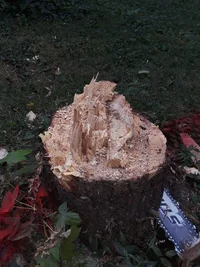
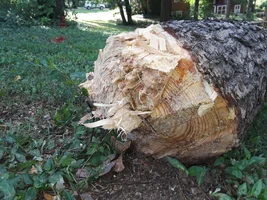
I hate to be an asshole, but I'm gonna. That's not a proper notch, under-cut, or pie-cut (cherry tree). No offense, but sometimes we all need to sharpen our skills at the stump.


How about this one @rico ? For the record, this is not my cut. I only flush cut it for the stump grinder. Homeowner removal, but seeing it did remind me of your quoted comment.
 

Attachments

  • 20180725_151033.webp
    20180725_151033.webp
    754.1 KB · Views: 26
  • 20180725_151040.webp
    20180725_151040.webp
    819.5 KB · Views: 26
I didn't talk to him about this cut since he wasn't home, but he did ask me to look at falling a couple of more because his saw "jammed and needs a new tensioner" it's possible he finished this cut with something other than a chainsaw just to get it down?

Either way I'll try to give him a good price to keep him from taking down the rest himself. Just to keep the trees on his property and reduce the risk to injuries.
 
He has given me a good bit of business already, I was out there grinding over 100 small stumps yesterday, and I am removing 2 others trees plus possibly these 4 more for him that I am quoting. I'll make enough that I don't feel the need to charge him extra. Besides if he gets himself killed from dropping trees that I charged him too much for, not only would I not get any future work, but his wife and kids would surely be disappointed as well. I think I will just send him a fair price instead of gouging. Now I have upped peoples prices in the past for their actions, typically if they are rude or disrespectful, but not for trying to accomplish something themselves.
 

New threads New posts

Back
Top Bottom