Indiana University Tree Props

Greg_L

Participating member
Location
Bloomington, IN
Greetings!

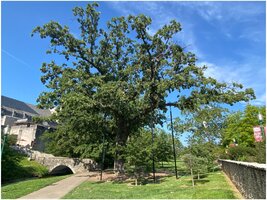
I’m the campus Arborist at IU’s main campus here in Bloomington, IN. We have a Bur oak that’s estimated to be between 180-200 years old. She’s a 58.5” DBH monster with a drip line diameter over 100’. Needless to say, she takes top priority in our plant health care program.

I thought you all in particular would find our recent limb propping project interesting. We ran sonic tomography on the base a few years back to get a grasp on the size of a cavity that was just visible from the exterior and decided it would be prudent to prop a few of the massive overextended limbs, and just recently got our hardware finally installed.

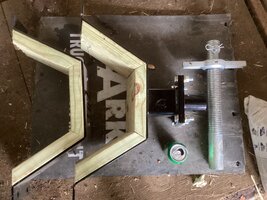
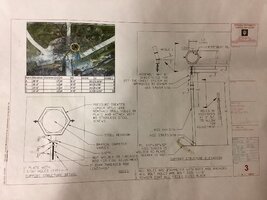
The props were custom designed and fabricated, and are 4x4“ steel tubing that rest on 4x4’ floating plates (we did zero digging), and at the tops there’s a hand-cranked jack system that allows for gross and fine adjustment. The actual heads are clamshell-shaped hexagons lined with lumber, so we didn’t drill into anything. As the years pass and the limbs grow, we can swap our pieces of the lumber lining for smaller thicknesses to allow for expansion, etc.

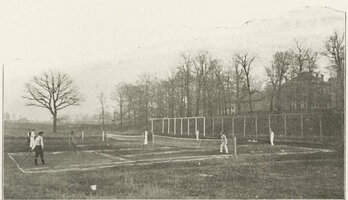
Pardon the photo…it was taken with a wide-angle lens, but they are quite straight (compare to the stone wall to the right). The last image was taken in 1900, and the tree is in the background on the left.
 

Attachments
  • 890AAAF7-AD40-40AA-8F45-E4C6CA038EC8.jpeg
    890AAAF7-AD40-40AA-8F45-E4C6CA038EC8.jpeg
    597.7 KB · Views: 75
  • 9E807057-254F-4EC2-8C5D-F190D60002F6.jpeg
    9E807057-254F-4EC2-8C5D-F190D60002F6.jpeg
    238.8 KB · Views: 71
  • 010F512E-99BE-4F28-A6A1-2DEB1A86B470.jpeg
    010F512E-99BE-4F28-A6A1-2DEB1A86B470.jpeg
    84.1 KB · Views: 74
Last edited:
Thanks for sharing!

Just to clarify: the props are to reduce the probability of whole tree failure (because of decay in the trunk), not just to reduce the likelihood of of individual limb failures?
 
Nice. Penn State has two Japanese Maples that were planted around 1920 that are propped. Not the size of your monster but still huge for palmatum's.
Yes! I'm familiar with what they did over there...we did quite a bit of digging leading into this project.
Thanks for sharing!

Just to clarify: the props are to reduce the probability of whole tree failure (because of decay in the trunk), not just to reduce the likelihood of of individual limb failures?
Yes and no. The props were intended to reduce the potential for total limb failure due to the excessively over-extended massive limbs (some over 40" at their bases), but this was all done with the understanding that triangulating the trunk with at least three props around all sides (there's one on the backside that you can't see because it wasn't put up when this picture was taken) would reduce movement at the base in major storm events and help mitigate potential total root failure as well. We felt that limb failure was a higher risk at this point in the game, so that was our main focus.
 
I have a couple of things to add for consideration.

Was typical threaded rod used? Were the nuts and threads generously covered with anti-seize compound?

Even better, source the bolting materials from companies that build bridges or seafront docks, etc., even looking to towers and utility line poles.

They use a coarse thread and heavy coatings of galvanized coating.
 
That sounds right about like what was used. I wasn't involved on the fabrication side, but we had a lot of say in the design process. The adjustable rods are heavy, galvanized, and about 3" in diameter.
 
I'm on the small screen of my laptop so moving around the design sheet isn't so easy.

The adjusting screw is spec'd as one inch diameter.

Has there been a static pull test done?
Any weight reduction?
 
We have a Bur oak that’s estimated to be between 180-200 years old. She’s a 58.5” DBH monster with a drip line diameter over 100’. Needless to say, she takes top priority in our plant health care program.
Impressive - I’m curious about that age estimate - have you taken a core sample?

I “own” an old Bur Oak that is a small fellow compared to yours at only 50” DBH - 78’ max drip line, but having observed its growth over my 70 years (and that of its little cousin about 100 yards distant) I would intuitively assign it an age of about 250-300 years - perhaps I’m away off, but then again everything must grow more slowly here up north in southern Quebec.

These days I generally climb it once a year in the fine fall weather - just for the heck of it, and remove some dead wood, but am not planning any other support measures.
 
Impressive - I’m curious about that age estimate - have you taken a core sample?

I “own” an old Bur Oak that is a small fellow compared to yours at only 50” DBH - 78’ max drip line, but having observed its growth over my 70 years (and that of its little cousin about 100 yards distant) I would intuitively assign it an age of about 250-300 years - perhaps I’m away off, but then again everything must grow more slowly here up north in southern Quebec.

These days I generally climb it once a year in the fine fall weather - just for the heck of it, and remove some dead wood, but am not planning any other support measures.
Guessing tree age based on size is a guess, at best, without any other context.

My favorite example:
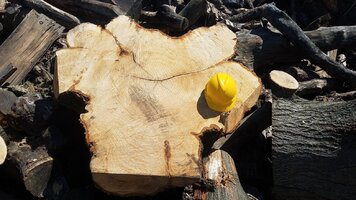
I helped a friend cut an ash tree down in his dad's yard. After I made the last cut that was about 34" I said "hey Dan, we're gonna play a game - is this tree older than you or younger than you?" He said "A tree that big has gotta be older than me." I counted the rings at 54. It was younger. About a week later I was out administering a timber harvest for a sale I marked. The owner was in his 70's. He reports his grandfather bought the woods when he (the grandfather) was younger and they've never cut anything since. He didn't want to harvest, but EAB was going to kill the trees anyhow. I started counting rings on a 24" diameter stump. I quit counting at about 3" in at 70 rings...so over 200 years. This was in much better soil. The difference would have been sunlight/competition.

Here's a big Pin oak that was 57 years (observed on pile at compost site, don't know where it came from):
1691974753018.jpeg


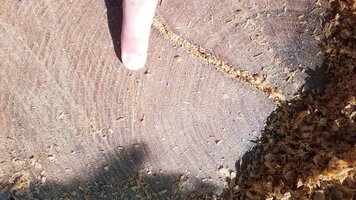
Even knowing how slow your tree has grown for the last 70 years (have you taken measurements or have old pics?), we don't know what the first years of its life were.

Here's another pic...notice relatively wide rings for a bit, then about 20 years of pretty tight rings, then wide rings again. Space to grow, competition came along, then a timber harvest so it had room to grow again. If that harvest never happened, the tree would be much smaller.

1691975315596.jpeg


In the OP, they at least have a 120+ years of history. Wonder if they know some land/site history before that too?

When somebody asks "how old is the tree" I usually start with "when was the house built?". This area was just about all cleared for agriculture, so safe bet most trees were not there when the house was built. Obviously, there are exceptions...

What other context do you have with your Bur oak? I find tree aging interesting...I look at rings a lot, not just to see absolute age, but to see if i can make inferences about history (like the one with rings that changed size above).
 
I have the same situation here. Our main downtown area has a 30 foot wide median with a number of large Darlington Oaks in it in the 50 to 60 inch dbh class. Most people think they are 200 years old but there is a photo from the 1950's that shows them to be about 80.
 
  • Like
Reactions: ATH
I have the same situation here. Our main downtown area has a 30 foot wide median with a number of large Darlington Oaks in it in the 50 to 60 inch dbh class. Most people think they are 200 years old but there is a photo from the 1950's that shows them to be about 80.
are there records about when that street was built? I guess if there are photos from the 50's, they would just about be new trees then. my mind is still stuck that something from the 50s is 50 years old...but we're well beyond that!
 
I have the same situation here. Our main downtown area has a 30 foot wide median with a number of large Darlington Oaks in it in the 50 to 60 inch dbh class. Most people think they are 200 years old but there is a photo from the 1950's that shows them to be about 80.
Did you take the photo?
Just poking fun. ;)
I can say that because I'm older than you.
 
Last edited:
are there records about when that street was built? I guess if there are photos from the 50's, they would just about be new trees then. my mind is still stuck that something from the 50s is 50 years old...but we're well beyond that!
Street was rebuilt 2004 to 2007.

I'm from the '50s and I'll be 70 in a couple days.
 
I'm on the small screen of my laptop so moving around the design sheet isn't so easy.

The adjusting screw is spec'd as one inch diameter.

Has there been a static pull test done?
Any weight reduction?
The specs were adjusted by the fabricator during the build, so some things don't line up.

We haven't done any post-installation pull tests, but we did do some gentle weight reduction prior.
 

New threads New posts

Kask Stihl NORTHEASTERN Arborists Wesspur TreeStuff.com Teufelberger Westminster X-Rigging Teufelberger
Back
Top Bottom