Incense Cedars

I have a potential client with a DEAD!!! incense cedar in his back yard. They tell me the tree has been dead for at least 5 yrs. There is no way to fell the tree and to remove would need to be climbed, however, I dont want to be a statistic in the 'Awakenings' thread. Should I risk it?? Im looking for your opinion.

Thanks!
 
Don't risk your life for a few hundred bucks! If you can get partway up without feeling at risk, maybe you can drop the top, then piece down the rest. Or maybe you can use a good, strong throwline (like Spectra) to pull the high branches down without climbing. If not, it ain't worth it. Even if you put a crazy high price and make a lot of money on the job, is it worth losing earning power for weeks of recovery (or forever)?

Be safe, and let the loonies and the crane guys have these crumbling skeletons.

Keith
 
put a high pice on it and rent a crane big enough for the job with an operator experienced in tree removals or try renting a self propelled manlift which will fit through the gate if it will be tall enough
 
Great suggestions guys, but there aren't any 300' cranes around. Even if there were, I dont think theyd like the power lines that close. As for the lift, yard's too small.

What about using contractor scaffolding? Anyone have any experience doing it that way??
 
I've never heard of anyone doing treework off of scaffolding. I'd think it would be about as smart as doing tree work off of a ladder. Gravity always works, when you cut a limb it is going to fall below you. If you are on a ladder or scaffolding, you need to consider what would happen WHEN (not 'if') a limb hits your support.

After reading the different responses including your own, I'd recommend walking away or else hiring the best climber you can find to do the tree.
 
</font><blockquote><font class="small">In reply to:</font><hr />
What is a different climber going to do? Bring the tree back to life?

[/ QUOTE ]
I guess you've been falling down without your helmet again, Lovey. Just what would you expect a qualified climber to do?
 
</font><blockquote><font class="small">In reply to:</font><hr />
I'd think it would be about as smart as doing tree work off of a ladder

[/ QUOTE ]
I work off a ladder lots.
Not only is it faster in some instances it can be the safest method in some instances.
You have to use what the job calls for.
 
</font><blockquote><font class="small">In reply to:</font><hr />
Should I risk it??

[/ QUOTE ]
I don't think you should risk it but instead make an assessment by testing it and use your best judgement.
 
Scaffolding is a terrible problem... with a ladder at least you have the chance to grab whats left of the tree (not that it'll do much good). But just disrupt the support of a single leg of a pipe scaffold and all "you know what" breaks loose. You are lucky if you get thrown free, usually everything starts to fall in no given direction and starts to disassemble, usualy ending with you somewhere in the middle of the pile with severe injuries (think pipe braces /vs flesh) not pretty. I'm fairly sure that a falling log could snatch out corner braces, walk boards, and legs on the way down. Or you could get lucky... sure would make a great story to tell the grandkids someday ;)
 
How about climbing up to where it is 7-10 inches, then guying it with two- three lines. Then reach up with a pole saw and limb as much as you can reach. top it, using and open face, and no lowering line.

I've worked on only a couple incense cedar, not sure how much strength the wood fiber would have. Take up a drill and test the trunk in a few spots.

We're halfway through doing a 90 foot big leaf maple, stone dead for 3 plus years. Bark off at the bottom, and peeling everywhere. Amazing dust clouds when chipping..and the peely, fluffy bark gets blown back out the load.

We guyed all the tops together at 55 feet. Tree is between two houses, so we plywooded each roof edge. We free dropped some branches, lowered others..and have actually been able to tie in at 60 feet, and have about half the top out. The 17 ton boom truck is coming tomorrow with 85 foot of stick, so we should finish in a 2-3 hours.

Then we go to crane one long lateral elm leader from over a house, plus two more picks. Job number three is a 70 foot quite dead 32 inch dbh hemlock with spreading canopy, and near the primaries. It is in a cemetary, so we have to lay some plywood to drive over a few headstones..will crane that one, branches on, in three picks. Then we have three doug fir sticks, 30, 85 and 85 feet high, on two different job sites to pick out..and sell to the mill. So, it will be a busy day!!! As was today, with the elm and maple.

Photos will follow. You'll have to go to Arborist site, where I might be able to post a couple videos.

 
Just for my own curiousity. How tall is this tree? what kind of tapper does it have and how much of the top can be felled without rigging, if you can fall the top at all .

I've done qite a few dead Cedars and once you can get that top out , the rest can come down gingerly in small firewood size cuts. one thing I do , or try to do , especially in the smaller parts of the tree , is to keep my body weight close into the trunk. Centralized. A little abnormal for spurr work because you risk a chance of a kick out because your more straight up and down rather than your normal stance in a live tree. But if you take a full wrap around the trunk with your flipline, this will help prevent that and a major road rash.

Good luck if you do it and let us know how it went if and when you do it

Greg
 
As of this reply, and to my knowledge, the tree still stands. The height is around 35' as the tip is almost as high as the primary elec. w/in 10' to the side. DBH is around 16-20". The tree also leans to one side at about 10 degrees and the basal 2-3" has white mold-like stuff on it.

As for dropping the top, no can do. Wood fence in the way. I think we have a plan mapped out if the customer decides to go ahead with the job.

I will keep you all informed.
 
You can use throwline to set three guy lines. Even if you can't choke the line, just getting them around limbs and pulled out will stabilize the tree.

Scaffolding is a good idea. Oretty cheap to rent or have a company install it for you.Be sure and lanyard in when you're on the scaffolding. As a backup, guy out the scaffolding too. Earth anchors or stakes will work as anchors if trees, etc. aren't located nearby.

This is a good time to use a pole saw on a stick. You can take out quite a bit with them and keep yourself out of the drop zone.

Using a self propelled scissor lift is also a good plan.

Tom
 
</font><blockquote><font class="small">In reply to:</font><hr />
As for dropping the top, no can do. Wood fence in the way. I think we have a plan mapped out if the customer decides to go ahead with the job.

[/ QUOTE ]

I have disassembled many a wooden fence.......

sure you already thought of that......
 
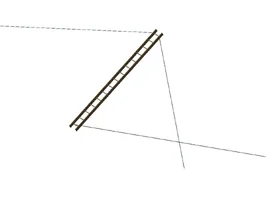
I have used this system twice (in 8 years) but it worked well for me with a 25ft ladder. 3 ropes, one attached to the bottom of a ladder and to the base of the tree. Two attached to the top pulling back at angles. (see attached pic) I used gibbs on all attachments as adjusters. I also put a friction saver on the tope rung and safetied it to the side. You can climb the ladder taking up the slack on your climbing line as you go, and work on the tree in small pieces, as you come down. Once you get lower, you can gently swing out and suspend yourself from the friction saver and keep working your way down. This system feels a little bouncy but really worked for me.

Dave
 

Attachments

  • 6864-ropeladder.webp
    6864-ropeladder.webp
    19.7 KB · Views: 54
Dave, when you use this set up consider a piece of 3/4" all thread with eyes screwed on the ends through the rung of the ladder. All thread through the rung, large washer bigger than opening of rung, nut then screw on eye on each side. The rungs of the ladder are not meant to take the load you can put on them and will bend. The all thread will take the load when the rungs won't.
 
&gt;The rungs of the ladder are not meant to take the load you can put on them and will bend.

I kind of have to disagree with you there. The loads would be hardly different than someone standing on a rung. You can even stand on a ladder and bounce with no effects other than flex. The rod is a good idea though. Another idea would be to set up a self equalizing anchor from the sides.

Dave
 
</font><blockquote><font class="small">In reply to:</font><hr />
As for dropping the top, no can do. Wood fence in the way. I think we have a plan mapped out if the customer decides to go ahead with the job.

[/ QUOTE ]
ummm... You might want to re-read this statement that you made and consider how easy a section of fencing is to remove and re-install. Even if a section of fence gets trashed, it's like $35 at HD per section of common 6' wooden fencing (around here anyways).

Wow, I'm shocked at all the suggestions for scaffolding and/or rigging of ladders for a tiny 35' tree. Sounds like LawnSite ideas around here. I thought this was where the REAL climbers hung out?
 

New threads New posts

Back
Top Bottom