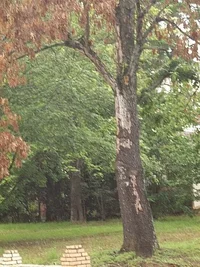
Hypoxylon fungus on one stem of a tree

I've run across a few situations where hypoxylon fungus has killed one stem of a tree but the tree doesn't continue to get infected. It's usually ona tree where the stem that is infected is 10-30% the diameter of the main trunk.

My question is, knowing that usually hypoxylon is so difficult to check, is there any reccomended combination of fertilizers, fungicides or other measure that would boost the chance of the main part of a healthy-looking tree becoming infected where there appears to be a localized infection on a smaller stem of the tree?

Any thoughts on that?
 
Not sure what you're asking, if are you asking if Xylariaceous ascomycetes such as Hypoxylon spp are unique in some way as compared to other fungi such as Basidiomycetes such as Meripilus giganteus then as far as our current level of understanding of the modes of degredation of woody cells then certainly the answer is yes.

As for fertilizers and fungicides based on my level of understanding their impact has not been shown to be specific to any one of the classifications we place fungi into.

The observations you report are not dissimilar to matters discussed in another thread that was running about Ganoderma spp.

Think about the decay triangle, Inoculum potential : Microbial growth conditions : Susceptability of tissues.
 
The spread of hypoxylon canker disease is favored by moisture stress of the tree. That means that spread is favored not just by dry soil but by conditions that induce moisture stress such as fine root injury, soil compaction, salt accumulation, etc. Some folks recommend tree fertilization to reduce disease spread...but I think those are folks that recommend fertilization no matter what. Fungicides are also not considered as effective here...although some folks might apply them!

As a little sideline with no practical application to your question, Hypoxylon fungi and others in that Asco family (Xylariaceae) are able to use a more broad array of nitrogen compounds to meet their needs than do most Basidio fungi (mushrooms, most "conk"-forming fungi). As Sean says in his earlier post, their pattern of cell wall attack and degradation is different from the Basidios as well.
 
[ QUOTE ]
is there any reccomended combination of fertilizers, fungicides or other measure

[/ QUOTE ]Yes invigorating the roots will decrease moisture stress and can strengthen tree defenses against infection.

I work on some oaks that had hpoxylon break out ~12 years ago and they are still around; over a garden center display area in fact.
 
[ QUOTE ]
Yes invigorating the roots will decrease moisture stress and can strengthen tree defenses against infection.


[/ QUOTE ]

Which may well envolve the recommendation of no ferts and no fungicides to be applied at all
wink.gif
 
[ QUOTE ]
[ QUOTE ]
Yes invigorating the roots will decrease moisture stress and can strengthen tree defenses against infection.


[/ QUOTE ]

Which may well envolve the recommendation of no ferts and no fungicides to be applied at all
wink.gif


[/ QUOTE ]There ya go; the fungicidal/fungistatic activity is in the compost, as are many the nutrients. Occasionally we blend in other nutrients, for specific goals.

"It's usually on a tree where the stem that is infected is 10-30% the diameter of the main trunk."

In this case maybe the side stem is being "shed" by the tree, and it has been walled off inside before the outside finishes dying...was the end of the stem shaded out/suppressed? In these cases maybe hypoxylon/Kretzschmaeria is strictly a recycler not a pathogen.
 
[ QUOTE ]
[ QUOTE ]
is there any reccomended combination of fertilizers, fungicides or other measure

[/ QUOTE ]Yes invigorating the roots will decrease moisture stress and can strengthen tree defenses against infection.

I work on some oaks that had hpoxylon break out ~12 years ago and they are still around; over a garden center display area in fact.

[/ QUOTE ]

As mentioned weakened trees are most often attacked by Hypoxylon spp. Early in my career I worked a lot in new developments. I cannot say that then or up to now I have ever encountered an Oak that had Hypoxylon on the main stem that survived. Generally a weakened tree is not capable of being "invigorated" (or invigorating itself) and once infected (esp. the main stem) it soon becomes much less capable. As cankering girdles stems not only does the distal portion die, the delignification of wood causes structural weakness rapidly and hazards if targets are nearby.

As mentioned though I have witnessed trees survive if infected branches are removed and conditions favor vitality of the tree.
 

Attachments

  • 187220-hypoxylon2.webp
    187220-hypoxylon2.webp
    86.7 KB · Views: 79
hypoxylon can be endophytic--existing inside the tree without any wounding--so the concept of infection is a bit different.

Codit happens, but yes it is not common that hypoxylon's spread is stopped. It takes a LOT of root invigoration; how willing are arborists to work that hard on the bottom half of their tree?

I'll be back on that property this month--will try to get you a pic dave. :)
 
Sure I'll snap stalled infections wherever i see them. Not unusual--“In a healthy tree, the pathogen is usually
compartmentalized and invasion or spread
is stalled,” Codit said, remembering his Modern
Arboriculture.

So the answer of course is to make trees healthier...duh?

Dave in your pic it looks like hypoxylon is a digester not a killer.

Paying trees forward works!
santa.gif
 
[ QUOTE ]
Sure I'll snap stalled infections wherever i see them. Not unusual--“In a healthy tree, the pathogen is usually
compartmentalized and invasion or spread
is stalled,” Codit said, remembering his Modern
Arboriculture.

So the answer of course is to make trees healthier...duh?

Dave in your pic it looks like hypoxylon is a digester not a killer.

Paying trees forward works!
santa.gif


[/ QUOTE ]

A weak tree, an opportunistic fungi. Which came first the chicken or the egg? Would this tree, in a weak condition have survived to work its way out of a marginal state if not for Hypoxylon closing the deal?.....Maybe....maybe not.
 
[ QUOTE ]
If the thunder don't get ya then the lightning will.

J. Garcia

Strengthen the tree!

Treeguys

[/ QUOTE ]

sometimes we as humans exaggerate our influence on life.
smile.gif
 
"Would this tree, in a weak condition have survived to work its way out of a marginal state if not for Hypoxylon closing the deal?.....Maybe....maybe not."

Hypoxylon was there all along--endophytic, remember?--, so the deal closing was coincident with the fungal spread. If the h didn't get it, then another fungus will...that was the point of the Dead line. :)

[ QUOTE ]
sometimes we as humans exaggerate our influence on life.
smile.gif


[/ QUOTE ]And sometimes we underestimate our potential for positive influence, if we are weighed down by doubt.
tongue.gif


I try to strengthen every tree I touch--don't you? That's what gets me out of bed in the morning (well plus i gotta p...)
 

New threads New posts

Back
Top Bottom