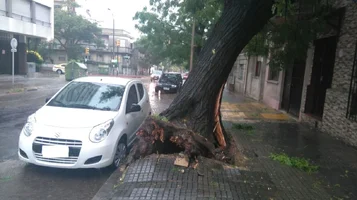
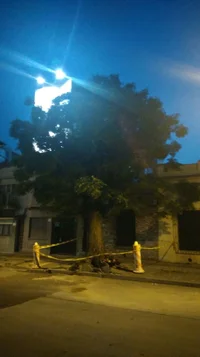
I know it's Melia azedarach but I'd like to know its approximate age. My neighboor guesses it was 100 years old. What do you think?


Follow along with the video below to see how to install our site as a web app on your home screen.
Note: This feature may not be available in some browsers.

Every single Melia I have seen in Uruguay has been topped, often multiple times. I think you are quite right that the tree is in the 100 year range.
Also you need to consider the timing. Carlos Thays was active (primarily in Buenos Aires) in the late 1800s and early 1900s and tree lined streets and parks were a favorite design. Thays favored Tipunana so I imagine that the street we are looking at was later than 1900.
In North Florida I feel like we could get that growth in 35 years or more. If someone told me that was a 200 year-old tree I wouldn't doubt it because it has signs of proper structural and reduction pruning, whether or not that's been done, and one could argue that it hasn't been watered much. The trunk size is quite substantial, relative to the canopy size. Over here, that species is as likely to have one structural form as another. I've never seen one with an "everyday tree" structure. They often topple and grow multiple leaders, like they planned it.
Are you going to/have you counted rings on it?
Welcome to the Buzz! What my friends in the southern US call Chinaberry is a pretty fast growing, pioneer, and short-lived (< 120 yr) species as an invasive in naturalized settings in the US. Sure, maybe you could find older ones in an arboretum. Growth rate as a street tree? in Uruguay? No idea. Well, that's not quite true. Could be half that age or less.
Chinaberry can produce crossdatable tree rings, depending on the growth environment. If all you want is a rough idea of age, you'll have to look at a cross-section and count. Now, rough ring-counting won't pass muster as dendrochronology, but would give an idea of 100 or 50 years old.
Not much help I'm afraid.
I thought everybody has been to Uruguay, home of the 1930 and 1950 world cup winners, tannat, purportedly tango, and Palacio Salvo the twin to Palacio Baralo.
Speak to Carlos Anaya in Buenos Aires, he is the Argentine expert on urban trees.