Re: How Co-Dom\'s split
Please forgive my ignorance, but what type of tools would one use to perform micro-surgery on included bark? I'm assuming that what you would want to do would be to remove the "barky" parts so that the two distinct portions of cambium tissue - from two distinct stems - would now be on close enough contact that they would be likely to become one over a period of time.
-------------
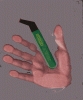
The tool is simple, cheap, and surprisingly available. Just wander into your neighborhood hardware store or super tool Mart and pick yourself up a plexiglass cutter. This is not the one I held up the ISA conference in Salt Lake City, and it is one of many I've tried with different heads according to their manufacturer's intentions.
The simplicity of the concept is to invite the two cambiums from two previously isolated woody cylinders to join each other, and once joined, allow the new single-sheet cambium to move forward following its cellular instructions and the mathematics of circles that it's so faithfully adheres to. The length of time it takes in the initial joining can be as little as a few days; parenchymal cells fill the space we create, and then due to the meristematic capabilities of tree cells, a new continuity of cambium is established.
The length of time for correction and growth is determined by the species, the age, the quality of surrounding conditions, and the success of our micro surgery. This is not a magic bullet. This is a simple intervention at the earliest of times that we can make in order to preclude any significant included bark that has some later arborist reaching for a chainsaw.
Here the tool is shown in relationship to my pudgy little hand and fits my discussion of microsurgery. The basic idea is minimal intervention with minimal wounding, and subsequent natural repair and growth. If I am quick and do my micro-cuts well with my preferred model which is half the blade thickness, there is a minimum exposure to pathogens and external complications.
Following Shigo's precepts, I expect the wounding to trigger CODIT 4 at the local area which further helps guard my intervention against invasive beasties. Perhaps it is difficult to accept the insertion of a small tool momentarily in the bark of a tree, much in contrast to the roaring bucking chainsaw. In practice, one develops a feel for the tool and its position relative to the cambial zone. The size of this tool and a young limb is tending toward included bark make excellent practice opportunities and have the additional advantage of changes being very visible.
--------------
Human surgeons often use advanced viewing technology (like tiny cameras) to be able to do surgery while viewing the process in real time. Have you actually performed micro-surgey on trees with incuded bark? That would be pretty freakin cool!
-----------
It's more than freakin cool, it's supe-freakin cool.
--------------
But more down to my humble practice, I have made it a point to observe trees that have split due to codominent stems & have watched the remaining sides fail in time. Once the one side fails - i think it is often the death warrant for the other side. Now, obviously this isn't the case in every scenario. But I have seen it repeatedly, warned clients about the dangers & in some cases have "saved" trees by reducing the remainder. In many cases, however, the tree must come down. Either by human hands, or by the hands of time.
I have spoken, heed my worms.
------------
Please understand that I know we can minimize the problems of included bark when we get there early enough, and when we understand that we are stewards and are obligated to look at minimum woundings when it's possible. We can again reduce the hazards of uncorrected included bark limb, and we can thus avoid our own creation of a hazard tree by the traditional removal of that limb and the exposure of the subject tree to all the rest of the adversities lined up around it.[/i]
It took me a long time to get a concept of the vascular cambium that I could wrap my head around. It's a distinct probability that a fat head makes it difficult to wrap In any case. But I persevered, with this tool and its partner tools based on different conditions and trees, I trust will be a substantial part of the new Arbor culture and others will delight in offering further improvements.
--------------
...I meant words! WORDS, I say.
--------------
Hey, don't worry. They now have pills for both
Bob Wulkowicz